

 US Dollar

How to design with patterns for unique textile projects
Posted by BLG on 2026 Mar 19th
Posted by BLG on 2026 Mar 19th


Creating textile patterns that feel fresh and cohesive remains one of the toughest challenges for fashion designers and home decorators. Whether you’re designing custom apparel fabrics or selecting coordinated prints for upholstery, achieving visual harmony while expressing originality requires mastering specific techniques. This guide walks you through the essential elements of pattern design, from foundational principles to cutting-edge AI tools. You’ll discover how to create seamless repeats, mix patterns confidently, and leverage modern innovations that transform weeks of work into minutes while maintaining your creative vision.
| Point | Details |
|---|---|
| Core design elements | Pattern success depends on mastering rhythm, symmetry, scale, color placement, and texture to create visual interest. |
| Seamless repeat methods | Basic tile, offset, brick, and half-drop techniques enable infinite pattern extensions without visible seams. |
| Pattern mixing rules | Vary scale across patterns, follow 60-30-10 color distribution, and start with one statement pattern for cohesion. |
| AI acceleration | Modern tools reduce pattern prototyping from weeks to minutes through automated tiling and material simulation. |
| Smart textile considerations | Functional textiles require balancing aesthetics with performance features, shifting traditional design workflows. |
Understanding the building blocks of successful patterns establishes your foundation for creating compelling textile designs. Core elements include rhythm, symmetry, scale, color, and texture, each contributing distinct visual effects that shape how viewers perceive your work.
Rhythm creates movement through your pattern via repetition, gradation, alternation, or flow. Repetition uses identical motifs at regular intervals, while gradation shifts elements progressively in size or color. Alternation switches between two or more motifs, and flow guides the eye along curved or directional paths. Choosing the right rhythm type depends on whether you want energy, calm, playfulness, or elegance in your design.
Symmetry determines balance and can be bilateral, radial, or translational. Bilateral symmetry mirrors elements across a central axis, creating formal, stable compositions perfect for traditional textiles. Radial symmetry radiates from a center point, often seen in medallion prints and mandalas. Translational symmetry repeats motifs across the surface without mirroring, producing dynamic, less predictable patterns. Experimenting with broken symmetry adds unexpected interest while maintaining overall structure.
Scale and proportion control visual weight and hierarchy within your pattern. Large-scale motifs command attention and work beautifully as statement pieces in fabric pattern types for sewers, while small-scale designs read as texture from a distance. Mixing scales within a single pattern creates depth, with larger elements anchoring the composition and smaller details adding complexity. Always consider viewing distance when determining scale, as patterns for upholstery need bolder motifs than those for garments.
Color placement dramatically influences pattern impact and mood. High contrast between motif and background produces bold, graphic effects, while low contrast creates subtle, sophisticated designs. Warm colors advance visually and energize spaces, whereas cool colors recede and calm. Limiting your palette to three to five colors typically yields more cohesive results than using many hues.
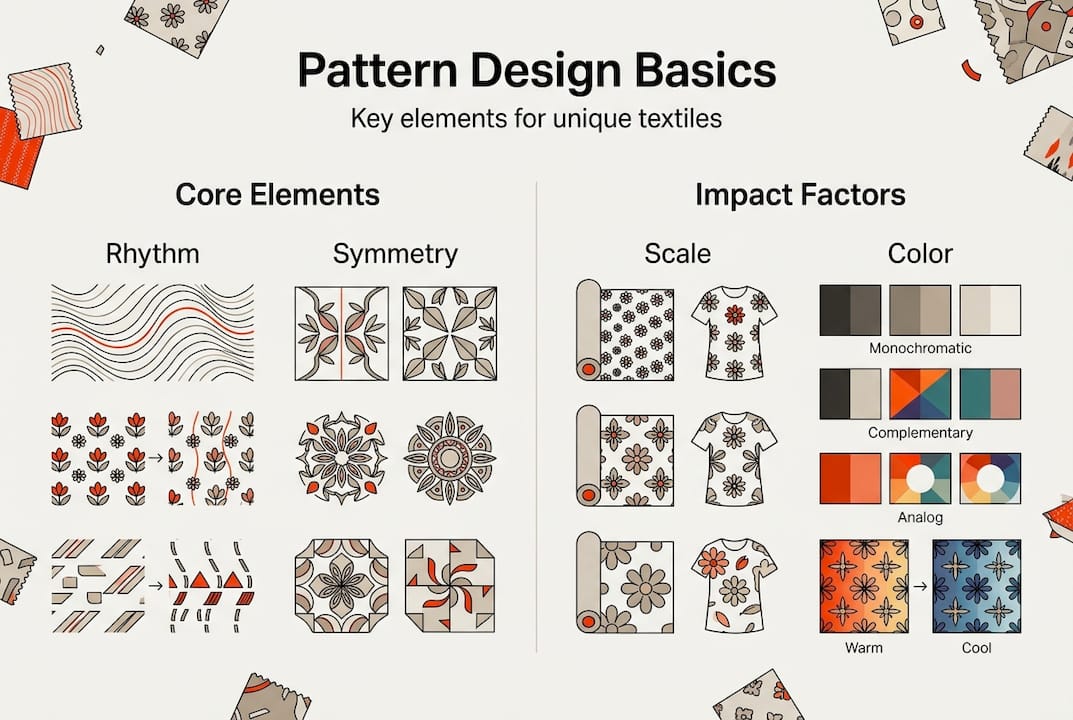
Texture adds tactile and visual depth that elevates flat patterns into dimensional experiences. You can simulate texture through shading, stippling, or linework in printed fabrics, or leverage actual textile texture through weave structures, pile heights, or surface treatments. Combining visual and tactile texture creates richly layered designs that engage multiple senses.
Pro Tip: Create a mood board with pattern examples that embody your desired rhythm and symmetry before sketching. This visual reference keeps your design cohesive as you develop individual motifs.
Successful pattern design begins long before you open design software. Thorough preparation through research, conceptual sketching, and strategic tool selection sets you up for efficient execution and professional results.
Start with trend and market research to understand what resonates with your target audience. Browse current runway collections, home decor magazines, and Pinterest boards to identify emerging color palettes, motif styles, and pattern scales. Analyze competitors’ offerings to find gaps you can fill with unique designs. Document your findings in a digital folder or physical notebook, organizing by theme, color, or application. This research phase prevents creating patterns in a vacuum and ensures your work connects with real market demands.
Concept sketching translates inspiration into workable design frameworks. Begin with loose thumbnail sketches exploring different motif arrangements, then refine promising concepts with more detailed drawings. Pattern design starts with grid systems that structure your repeat, whether square, rectangular, diamond, or hexagonal. Sketch your motifs considering positive space (the design elements) and negative space (the background), as both contribute equally to pattern success. Experiment with motif density, trying sparse arrangements for airy, modern feels and dense packing for traditional, ornate effects.
Digital tools transform sketches into production-ready patterns with precision impossible by hand. Adobe Illustrator excels at vector-based pattern creation, allowing infinite scaling without quality loss. Its pattern-making features automate tile creation and preview repeats in real time. Photoshop works better for painterly, photographic, or textured patterns, offering powerful color adjustment and layer blending. Both programs support seamless tiling through specific workflows that align edges perfectly.
Follow this digital creation workflow for best results:
Testing patterns on digital fabric mockups reveals issues invisible in flat tile view. Drape your pattern over 3D garment or furniture models to assess how it behaves across curves and seams. Check colorways on different fabric bases, as the same pattern reads differently on white cotton versus natural linen. Consider how your ordering custom fabrics online process will affect color accuracy and adjust your digital files accordingly.
Refine based on fabric type and printing method. Digital printing on cotton allows fine detail and unlimited colors, while screen printing requires separating colors into individual layers. Woven patterns need simplified motifs that translate into thread intersections. Knit fabrics stretch, so account for distortion in your repeat calculations. Understanding these technical constraints during the design phase saves costly revisions later.
Pro Tip: Create pattern swatches at actual size and view them from typical distances before finalizing. A design that looks perfect on screen may feel too busy or too sparse on physical fabric.
Mastering repeat techniques and pattern mixing rules transforms good designs into professional, versatile textiles that work across fashion and home decor applications.
Seamless patterns use specific tiling methods that create infinite designs without visible breaks. The basic tile repeat places identical squares side by side, suitable for geometric or all-over designs where directional flow isn’t critical. Offset or brick repeat shifts alternating rows by half the tile width, mimicking brickwork and adding movement while disguising the repeat structure. Half-drop repeat shifts alternating columns by half the tile height, creating diagonal flow perfect for organic motifs like florals or paisleys. Each method produces distinct visual rhythms, so choose based on your motif character and desired energy level.
| Repeat Type | Visual Effect | Best For |
|---|---|---|
| Basic Tile | Stable, geometric, predictable | Stripes, plaids, simple geometrics |
| Offset/Brick | Dynamic, horizontal movement | Architectural motifs, modern designs |
| Half-Drop | Flowing, diagonal rhythm | Florals, paisleys, organic shapes |
| Mirror Repeat | Symmetrical, kaleidoscopic | Medallions, formal traditional patterns |
Pattern mixing success in fabric repeats in apparel design and home decor follows three key principles. The scale rule requires varying pattern sizes across your mix, typically combining one large-scale statement pattern, one medium-scale transitional pattern, and one small-scale accent pattern. This size variation prevents visual competition and creates hierarchy. The 60-30-10 color rule allocates your dominant color to 60% of the space, a secondary color to 30%, and an accent color to 10%, ensuring cohesion across different patterns. The odd number rule suggests using three or five patterns rather than two or four, as odd groupings feel more dynamic and less matchy.
Start with a statement pattern that anchors your scheme. This bold, large-scale design sets your color palette and style direction. Pull two or three colors from this statement pattern to guide your secondary pattern selections. If your statement pattern features navy, coral, and gold florals, choose geometric or stripe patterns incorporating those same hues. This color repetition unifies disparate pattern styles into a cohesive collection.
Balance pattern types for visual interest without chaos. Combine organic and geometric patterns, mixing florals with stripes or paisleys with plaids. Pair busy, intricate patterns with simpler, more restful designs to give the eye places to rest. Include at least one solid or nearly solid fabric that reads as texture rather than pattern, providing breathing room in your overall composition. When matching fabric patterns for quilts, this principle prevents overwhelming the viewer while maintaining visual richness.
Pro Tip: Photograph your pattern combinations in both color and black-and-white. The grayscale version reveals whether your value contrast (light versus dark) is strong enough, independent of color choices.
Cutting-edge technologies are reshaping how designers create patterns and what textiles can do, opening possibilities unimaginable just a few years ago.
Artificial intelligence has revolutionized pattern generation speed and experimentation. AI tools reduce prototyping from weeks to minutes by automating tedious technical tasks while preserving creative control. Prompt-based design lets you describe desired patterns in natural language, with AI generating multiple variations instantly. These tools create seamless tiles automatically, eliminating the manual edge-matching process that traditionally consumed hours. Material simulation shows how patterns will appear on different fabric types, from matte cotton to glossy satin, before committing to physical samples.
AI excels at generating pattern variations for A/B testing. Input your base design and receive dozens of colorway options, scale adjustments, and motif arrangements in minutes. This rapid iteration identifies winning designs faster than traditional methods, compressing development cycles dramatically. AI also analyzes successful patterns in your niche, suggesting motif combinations and color palettes aligned with current market preferences.
Key AI capabilities transforming pattern design include:
Smart textiles introduce functionality that fundamentally alters design approaches. Unlike traditional decorative fabrics, smart textiles balance aesthetics with performance, such as color-changing properties, embedded sensors, or shape-memory behavior. This dual requirement shifts design workflows away from pure trend following toward problem-solving. Visualizing how patterns will look during functional state changes presents unique challenges. A thermochromic fabric that shifts from blue to yellow when warm requires designing for both color states simultaneously.
Smart textile designers must consider factors beyond traditional aesthetics. Conductive thread placement for sensors influences pattern layout, as functional elements become visible design features. Washability and durability requirements may limit motif complexity or color choices. Integration with electronics demands collaborating with engineers early in the design process, rather than treating pattern design as a standalone creative phase. These constraints spark innovation, pushing designers to develop patterns that enhance rather than hide functional elements.
“AI doesn’t replace the creative craft of pattern design; it augments it by handling technical grunt work and enabling faster experimentation. The designer’s eye for beauty, cultural relevance, and emotional resonance remains irreplaceable.”
Staying current with 2025 fabric trends for designers while exploring technical textiles modern fabric positions you to leverage both traditional craftsmanship and emerging technologies. The most successful designers blend AI efficiency with human creativity, using tools to expand possibilities rather than automate away artistry.
Pro Tip: Use AI to generate pattern variations quickly, but always refine the final design manually. AI suggestions provide excellent starting points, but your trained eye catches subtleties algorithms miss.
Now that you understand how to create and combine patterns effectively, sourcing the right fabrics brings your designs to life with professional results. Quality textile selection makes the difference between concepts that impress on screen and finished projects that delight in person.
Explore backdrop fabrics perfect for fashion displays, photography projects, and large-scale installations where your pattern work takes center stage. These versatile textiles provide the ideal canvas for showcasing custom prints and coordinated pattern schemes. For interior applications, browse affordable home decor fabrics available by the yard in weights suitable for upholstery, drapery, and accent pillows. Whether you’re executing a bold pattern-mixed living room or creating a signature apparel line, fabric-fabric offers the diverse textile selection supporting projects at every scale.
From traditional cotton prints to specialty technical textiles, having reliable fabric sources lets you move confidently from pattern design to finished product. Quality materials showcase your pattern work at its best, ensuring colors stay vibrant and prints remain crisp through years of use.
Adobe Illustrator and Photoshop are top tools for creating professional seamless patterns. Illustrator excels at vector-based geometric and illustrative patterns with its dedicated pattern-making features and infinite scalability. Photoshop works better for painterly, photographic, or textured patterns, offering superior color adjustment and realistic fabric simulation. Both support tile repetition workflows and export files compatible with digital fabric printing services.
Mix patterns by varying scale, following 60-30-10 color distribution, and using odd numbers of patterns starting with one statement piece. Combine one large-scale, one medium-scale, and one small-scale pattern to create visual hierarchy. Pull colors from your statement pattern to guide secondary selections, ensuring cohesion across different designs. Balance organic patterns like florals with geometric options like stripes, and include at least one solid or texture-reading fabric as visual rest space.
AI accelerates pattern generation but doesn’t replace creative judgment or design intuition developed through experience. These tools excel at automating technical tasks like seamless tiling, generating variations, and simulating materials, compressing timelines dramatically. However, human designers remain essential for innovative concepts, cultural relevance, emotional resonance, and the refined aesthetic decisions that separate memorable patterns from generic output. Think of AI as a powerful assistant that handles grunt work, freeing you to focus on creative strategy and artistic refinement.
Repeat size depends on fabric width, intended application, and printing method constraints. Measure your motif dimensions, then add spacing appropriate for your desired density. For digital printing, repeats can be any size, but 12-24 inches works well for most applications. Screen printing typically uses smaller repeats due to frame size limitations. Calculate how many repeats fit across your fabric width, adjusting size so seams align properly when fabric panels are sewn together. Always create test prints at actual size to verify the repeat reads as intended.
Current trends favor maximalist florals with oversized blooms, geometric patterns with 1970s influences, and nature-inspired organic motifs reflecting sustainability values. Abstract watercolor effects and hand-drawn illustrations add artisanal character that contrasts with digital perfection. Vintage revival patterns reinterpreting designs from past decades remain strong, particularly mid-century modern geometrics and Victorian botanicals with contemporary color updates. Mixing these trending styles with timeless classics creates collections with both immediate appeal and lasting relevance.