

 US Dollar

Yarn count explained: Better fabric choices every time
Posted by BLG on 2026 Apr 29th
Posted by BLG on 2026 Apr 29th


TL;DR:
- Yarn count measures the yarn’s linear density, indicating its thickness and suitability for projects.
- Indirect systems (like Ne) measure length per weight; higher numbers mean finer yarns, opposite in direct systems.
- Count is a starting point; fiber, ply, twist, and construction significantly influence yarn behavior and finished fabric.
If you’ve ever stared at two yarn labels with completely different numbers and had no idea which was thicker, you’re in good company. Yarn count is one of those concepts that trips up beginners and experienced crafters alike, mostly because the numbers seem to work backward depending on which system you’re reading. Get it wrong, and your fabric ends up too stiff, too sheer, or totally off-gauge. Get it right, and you can walk into any yarn shop or browse any online listing and know exactly what you’re buying before you touch a single skein.
| Point | Details |
|---|---|
| Yarn count basics | Yarn count measures thickness using either weight per length or length per weight. |
| System differences | Indirect and direct count systems interpret numbers in opposite ways regarding thickness. |
| Beyond the numbers | Fiber type, twist, and ply affect performance as much as count does. |
| Conversion caution | Converting between count systems requires careful attention to avoid mistakes. |
| Best practices | Always swatch or test gauge in addition to checking yarn count for best results. |
Yarn count sounds like it should be simple. It’s just a number on a label, right? But that number actually carries a lot of information about how thick or thin a yarn is, and understanding it changes how you shop, how you plan, and how your finished project turns out.
At its most basic, yarn count is a measure of linear density. It tells you the relationship between the length of a yarn and its weight. Depending on the system used, count is either expressed as how much weight a given length of yarn has, or how much length you get from a given weight. Both approaches measure the same thing from opposite directions, which is exactly why the numbers can seem contradictory.
Why does this matter so much for crafters? Two big reasons:
The measurement itself is done through standardized testing. Yarn count is determined using the ISO 2060 skein method, which measures a known length’s weight to compute linear density. This global standard means a count from one manufacturer should, in theory, compare directly to the same count from another.
“Yarn count offers a measurable, standardized way to communicate fineness between producers, retailers, and end users. Without it, two companies could call the same yarn by completely different names and create total chaos in sourcing.” — Textile manufacturing industry perspective
Pro Tip: Never rely on how a yarn feels in your hand alone. Fibers like merino wool and bamboo can feel equally soft but behave completely differently once knit. Yarn count gives you a consistent, objective reference point that your fingers simply can’t replicate.
Understanding count also helps you grasp concepts like what is fabric yardage, because once you know how dense a yarn is, you can better predict how much fabric a given amount of yarn will actually produce.
Here’s where things get genuinely confusing, and where most crafters throw up their hands. There are two fundamentally different systems for measuring yarn count, and they define “higher number” in opposite ways.
Indirect count systems measure how many fixed-weight units fit into a fixed length. The most common example is the English Cotton Count, abbreviated Ne. In indirect systems like Ne, a higher count means a finer, thinner yarn because the count measures length per fixed weight. So a Ne 40 yarn is finer than a Ne 20 yarn. The higher the number, the more length you can spin from the same amount of fiber, which means the yarn is thinner.
Direct count systems work the opposite way. They measure weight per unit length. In direct systems like Tex and Denier, a higher count means a coarser, thicker yarn because the count measures weight per fixed length. A Denier 150 yarn is heavier and thicker than a Denier 50 yarn of the same fiber.

Here’s a quick side-by-side comparison to keep them straight:
| Feature | Indirect system (Ne) | Direct system (Tex/Denier) |
|---|---|---|
| Higher number means | Finer, thinner yarn | Coarser, thicker yarn |
| What is measured | Length per unit weight | Weight per unit length |
| Common uses | Cotton, linen, wool | Silk, synthetics, fine fibers |
| Example unit | English cotton count (Ne) | Tex (g/1000m), Denier (g/9000m) |
| Common in | Apparel weaving, spinning | Hosiery, industrial, carpet |
Different fibers tend to use different systems, which adds another layer of complexity:
When you’re measuring fabric yardage for a project, knowing which count system your yarn uses means you can much more accurately estimate how much you actually need. Buying too little of a fine Ne 60 cotton when you thought you were getting a thick yarn is a costly mistake, both in time and money.
The key takeaway: always identify which system a label uses before comparing two yarns by their numbers. A Denier 30 and a Ne 30 are not remotely similar yarns.
Understanding the systems is essential, but savvy crafters know yarn count isn’t the end of the story. Here’s what you need to keep in mind.
Yarn count measures linear density, and nothing else. It tells you about the relationship between a yarn’s length and its weight, but it doesn’t tell you everything about how that yarn will perform in your hands or on your needles. Several other factors change the behavior of a yarn dramatically even if two skeins share the exact same count value.
Key factors that count alone doesn’t capture:
Yarn count alone often won’t let you predict knitting or crochet gauge, because finished behavior also depends on fiber type, twist, ply, and how the yarn is built, even if two yarns share the same count value.
This is a big deal for crafters. If you’re selecting yarn for a structured woven piece versus a stretchy knit garment, knowing the count is a starting point, not a finish line. Understanding the difference between knit and woven structures, for example, helps you see why the same yarn count produces very different results depending on how it’s constructed.
And when you’re working with textured fabrics, count matters even less in isolation. A textured weave in fabric is shaped as much by the weaving technique and fiber combination as by the linear density of the yarn itself.
“Diameter is actually very difficult to measure directly on a real yarn because it compresses under a gauge and isn’t perfectly round. Count is a practical proxy, but it has real limits when fiber structure and construction vary significantly.” — Textile industry guidance on yarn measurement
Pro Tip: Always knit or sew a test swatch before starting any major project, even when you know the yarn count. A 4-inch swatch takes minutes and saves hours of heartbreak. Compare your swatch gauge to the pattern requirements before you commit to a full project.
If you’ve ever picked up a yarn and realized the numbers didn’t match your expectations, you’re not alone. Here’s how to take control when the math gets murky.
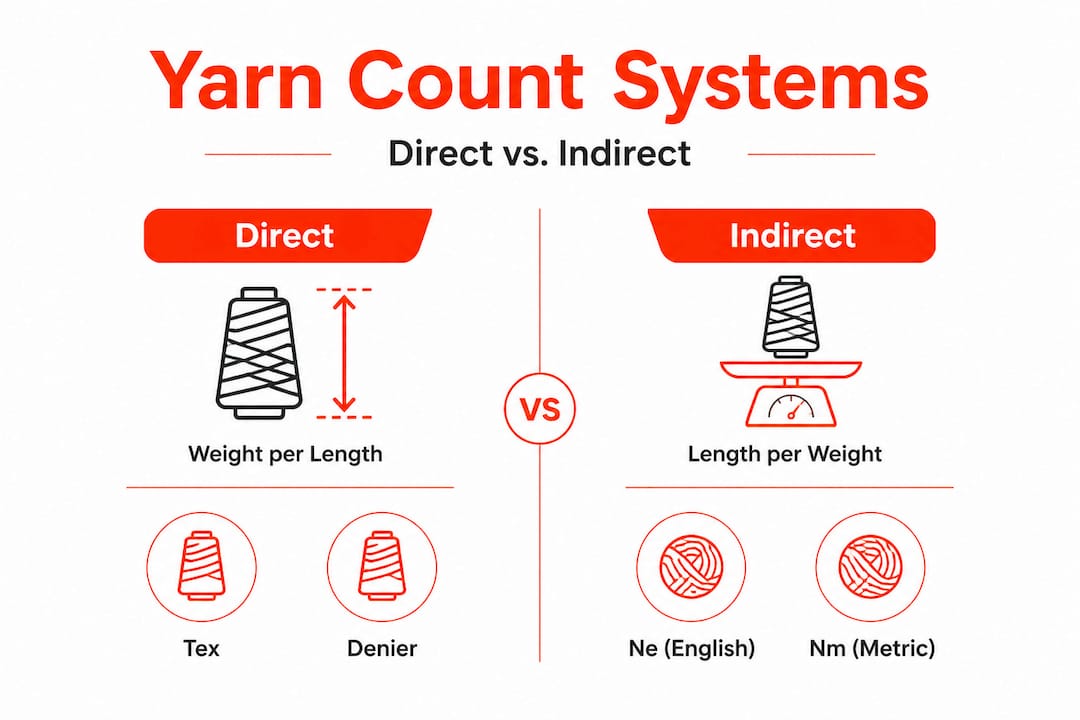
Because indirect and direct numbering interpret the same “fineness” direction differently (higher is finer for indirect, higher is coarser for direct), conversions must be done carefully when comparing labels across fibers and brands. Skipping this step leads to buying the wrong weight, misjudging how much you need, and creating finished fabric that looks nothing like your vision.
Here’s a step-by-step approach to handling unfamiliar labels:
Here’s an example conversion table to give you a practical reference:
| Yarn description | Ne (indirect) | Tex (direct) | Denier (direct) |
|---|---|---|---|
| Fine cotton thread | Ne 60 | ~10 Tex | ~90 Denier |
| Medium cotton yarn | Ne 30 | ~20 Tex | ~180 Denier |
| Chunky cotton yarn | Ne 10 | ~59 Tex | ~531 Denier |
| Fine silk filament | N/A | ~11 Tex | ~100 Denier |
| Standard nylon | N/A | ~17 Tex | ~150 Denier |
Pro Tip: If conversion math isn’t your thing, several free online yarn count calculators handle the work instantly. Search for “yarn count conversion calculator” and enter your values. The tool does the direction logic for you, which eliminates the most common source of error. When budgeting a project, pairing count knowledge with a fabric cost estimation process helps you plan purchases accurately without overspending or coming up short.
Misinterpreting a count label leads to real project problems: fabric that’s too heavy for a summer blouse, a crochet blanket that uses twice as much yarn as planned, or a woven panel that’s too sheer to use as a curtain. The conversion step is worth doing every single time you switch between fiber types or brands.
After going through all the technical ground, here’s some honest, hard-earned perspective that most articles skip over.
The crafting world sometimes talks about yarn count as if knowing the number is enough. It isn’t. And leaning too heavily on count numbers actually limits your creativity in ways that sneak up on you. When you get locked into only shopping for familiar count ranges, you start ignoring yarns that could surprise you in the best possible way.
The real value of yarn count is in narrowing the field, not in making the final call. Think of it like a first filter when shopping. You rule out obvious mismatches quickly. A Ne 2 yarn isn’t going to produce a delicate lace shawl no matter how skilled you are. But within a reasonable count range, the fiber, twist, ply, and construction are often more important than the exact number.
What years of experimenting with different counts, gauges, and swatching actually teaches you is this: the number gives you a starting point, and your hands and eyes take it from there. A crafter who only trusts numbers misses the slightly unusual bamboo blend at Ne 18 that produces the most beautiful draped fabric they’ve ever worked with. A crafter who only trusts touch misses the fact that two nearly identical-feeling wools have completely different counts and will behave very differently after blocking.
The best approach is to treat yarn count as a working hypothesis. It tells you where to start looking. Your swatch tells you whether you’re actually on track. Keep a simple project notebook where you log the yarn count, fiber, twist level, and your swatch results. After a handful of projects, you’ll start to see patterns that no article can teach you, because they’ll be specific to the way you knit, the tension you hold, and the fabrics you love. That personal data is genuinely priceless.
Encourage yourself to try unfamiliar counts intentionally. Buy a small amount of something outside your usual range, swatch it, and note what happens. Your skills as a crafter grow fastest at the edges of your comfort zone, not in the middle of it. And when you’re ready to put this all into practice on a real project, checking a fabric ordering guide first means you’ll shop smarter, waste less, and start your next project with full confidence.
Now that you understand how yarn count works, both the systems and the real-world limits, it’s time to apply that knowledge to actual fabric selection.

At fabric-fabric.com, we carry a wide range of fabrics suited to every count range and project type. Whether you’re creating lightweight garments, structured home pieces, or dramatic stage backdrops, knowing your yarn count helps you pick the right weight and weave from the start. Browse our full selection of backdrop fabrics for large-scale projects, or explore our home decor fabric collection to find exactly the weight and drape your next interior project calls for. Every product listing includes detailed descriptions so you can match what you’ve learned to real fabric choices with confidence.
Not always. In indirect count systems, a higher count means finer yarn, but in direct count systems like Tex and Denier, a higher count means a thicker, heavier yarn.
Count alone doesn’t capture ply, fiber type, twist, or construction, all of which significantly affect how a yarn knits, weaves, or sews up in practice.
Use a reliable conversion formula such as Tex = 590.5 / Ne, or use a free online calculator. Careful attention to system direction is essential because indirect and direct systems interpret higher numbers in opposite ways.
No. Fiber, ply, and twist all affect gauge independently of count, so always test with a swatch before starting a full project.