

 Canadian Dollars

What is moisture wicking? A craft and fashion pro's guide
Posted by BLG on 2026 May 15th
Posted by BLG on 2026 May 15th

TL;DR:
- Moisture-wicking fabrics move sweat along fiber surfaces through capillary action, promoting quick evaporation. Polyester resists absorption with low moisture regain, enabling faster drying and drier feeling garments. Proper testing, construction, and care ensure these fabrics perform optimally in activewear and performance applications.
If you’ve ever labeled a polyester knit “moisture wicking” because it dries fast, you’ve made the same mistake most people do. What is moisture wicking, really? It’s not absorption. It’s the opposite. Moisture wicking moves sweat along fiber surfaces through capillary action, pulling it away from skin so it can evaporate at the outer layer of the fabric. Understanding this distinction changes how you select fabrics, construct garments, and care for finished pieces. This guide breaks down the real science and translates it into decisions you can make at the cutting table.
| Point | Details |
|---|---|
| Wicking is not absorption | Moisture wicking involves moving sweat along hydrophobic fiber surfaces, not soaking it in like cotton. |
| Polyester excels in wicking | Polyester fibers have low moisture regain (<0.4%), facilitating quick sweat transport and evaporation. |
| Fabric structure matters | Mesh and textured knits create capillary channels that improve moisture spreading and drying. |
| Testing standards guide selection | Methods like AATCC TM195 objectively classify fabrics to help choose the best moisture-wicking materials. |
| Care affects performance | Avoid fabric softeners and pre-wash garments to keep moisture channels clear and maintain wicking ability. |
Most crafters and designers assume that a fabric either absorbs moisture or repels it. Moisture wicking is a third behavior entirely. Instead of pulling liquid into the fiber itself, wicking fabrics move moisture along the surface of the fiber, channeling it outward through a network of microscopic capillary pathways.
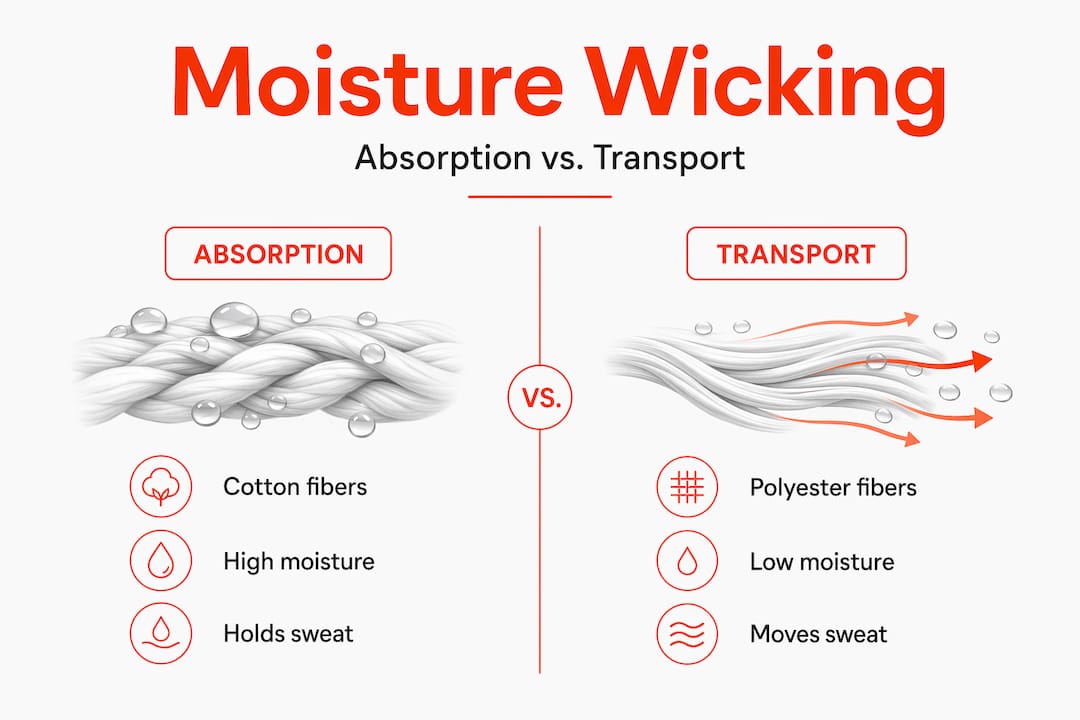
This happens because of two things working together: fiber chemistry and fabric structure.
Fiber chemistry determines how much moisture a fiber will absorb. A low moisture regain value means the fiber resists absorbing water. Polyester moisture regain sits at less than 0.4%, which means almost no water enters the fiber at all. Instead, sweat molecules get drawn across the fiber surface by capillary forces and transported outward toward the fabric’s exterior. Hydrophobic polyester fibers use these surface-level capillary channels rather than absorption to move moisture quickly.
Fabric structure creates the capillary channels that make transport possible. Fiber cross-section shape, yarn twist, stitch density, and weave or knit type all determine how many pathways exist for moisture to travel. More channels mean faster, more even transport.
Here’s how the two most common fibers compare on the core question:
Cotton is not a bad fabric. But cotton’s strength is comfort in low-sweat conditions, not moisture management. When you’re constructing activewear or any garment meant to perform under physical stress, choosing cotton as your primary layer based on a “breathable” label is a mistake you’ll feel in the finished garment.
“Moisture wicking” on a hang tag tells you almost nothing. Knowing which tests a fabric has passed tells you everything.
The textile industry uses a handful of standardized methods to evaluate moisture management, and understanding them gives you a real basis for comparing fabrics rather than relying on marketing copy.
The most widely used is AATCC Test Method 195, which measures absorption rate, spreading speed, and drying rate to classify fabrics as excellent, good, or poor for moisture management. It also captures wetted radius and a one-way transport index, which tells you how effectively moisture moves from the inner surface to the outer surface. That directionality matters enormously in garments worn against skin.
A newer method, AATCC TM217-2025, uses image analysis to track both vertical and horizontal wicking under conditions that simulate real garment wear. This addresses a gap in older testing: the fact that how fabric performs lying flat in a lab often differs from how it performs on a moving body.
When you’re evaluating fabrics for a project, look for these key indicators:
The impact of knit and woven construction on these numbers is real. Knitted fabrics with looser stitch structures generally create more open capillary pathways than tightly woven fabrics at the same fiber content, which is why athletic mesh outperforms a plain taffeta made from the same polyester yarn.
Understanding fiber behavior and fabric construction together is what separates a garment that performs from one that just looks the part.
| Fiber | Moisture regain | Wicking behavior | Best use case |
|---|---|---|---|
| Polyester | Under 0.4% | Excellent surface transport | Activewear, base layers |
| Nylon | ~4% | Good surface transport | Outerwear, swimwear |
| Merino wool | ~16% | Moderate, natural wicking | Light outdoor layers |
| Cotton | 6.5 to 8% | Absorbs and retains | Casual, low-sweat wear |
| Linen | ~12% | Absorbs but releases faster than cotton | Warm-weather clothing |
Modified fiber cross-sections, like star-shaped or trilobal polyester fibers, enlarge the capillary channels between fibers, dramatically improving wicking performance over standard round-cross-section fibers. This is why two polyester fabrics at the same weight can perform very differently.
Fabric construction amplifies or limits whatever the fiber brings. Here’s what to look for:
Cotton absorbs roughly 7 times more moisture than polyester and holds it in the fiber, which is why cotton t-shirts feel heavy and cold during exercise. It’s not a performance shortcoming you can design around by choosing a different weave.
Fabric weight also matters. For activewear crafts, a range of 100 to 180 gsm hits the sweet spot where the fabric is light enough to dry fast but dense enough to move moisture efficiently across its surface area. Heavier fabrics hold more moisture in their structure before evaporation catches up.
Lining fabrics are often overlooked in this conversation. A moisture-wicking outer shell loses much of its benefit if the lining layer traps sweat against the skin. Selecting a low-regain polyester or nylon lining keeps the capillary system working across the full garment construction.
Pro Tip: Avoid fabric softeners at all costs when washing moisture-wicking fabrics. They coat the microfiber surface and block the capillary channels that make wicking work. One wash with the wrong product can noticeably reduce performance in a finished garment.
Knowing the science is one thing. Applying it through your making process is where performance lives or dies.
Before you sew:
Construction considerations:
After finishing:
Polyester fabric care is straightforward once you understand what you’re protecting. You’re not just cleaning the fabric. You’re maintaining a microscopic transport network.
Pro Tip: If you’re crafting high-performance activewear, look for polyester fabrics in the 120 to 150 gsm range with a textured or mesh knit. This combination gives you the best balance of moisture transport speed, evaporation rate, and structural stability for garments that move with the body.
Here’s the uncomfortable truth about how moisture wicking gets discussed in both retail and crafting communities: most of the conversation collapses the distinction between wicking and absorption, and that collapse leads to genuinely bad fabric choices.
Walk into any fabric store and ask about moisture wicking, and you’ll likely be shown something labeled “quick dry.” Those are not the same thing. A quick-dry fabric might absorb a moderate amount of moisture and then release it relatively fast. A true wicking fabric resists absorption entirely and moves moisture to the surface for evaporation. The end result might feel similar in mild conditions. Under real physical stress, they perform completely differently.
The marketing problem runs deeper. Terms like “breathable,” “moisture management,” and “performance fabric” get applied to anything from open-weave linen to synthetic blends with no consistent scientific definition. Crafters who rely on those labels end up guessing.
“Wicking does not equal absorption. Polyester wicks via capillary action along hydrophobic surfaces (under 0.4% regain), while cotton absorbs and retains moisture, leading to clammy feel.” — Huada Creation Group experts, 2026
The second thing experts consistently overlook is the role of care in long-term performance. Fabric softener is the single most common cause of wicking performance degradation in consumer garments. It’s also the least discussed. Designers spend significant effort selecting the right fiber and construction, then the finished garment loses half its performance after three washes because the care label doesn’t explicitly warn against softeners.
The third overlooked factor is the system view. Fiber chemistry and fabric structure are not independent choices. A trilobal polyester fiber in a dense plain weave will underperform a standard round-cross-section polyester in an open mesh knit. You can’t evaluate fiber content in isolation from construction, and you can’t evaluate construction in isolation from care.
Designers who understand polyester’s full range of properties, including its limitations, are the ones who build garments that actually perform as labeled.
You now understand what separates a truly wicking fabric from everything else on the market. The next step is finding materials that actually meet that standard.

At Fabric-Fabric, we carry a wide range of polyester and performance blended fabrics suited to activewear, functional fashion, and crafting projects of every scale. Whether you need lightweight mesh for athletic construction or a structured knit for a performance-focused fashion piece, our fabric catalog includes options built around the fiber content and construction properties covered in this guide. For home-based makers exploring moisture-aware designs beyond apparel, our home decor fabric range also includes moisture-considerate options for functional textile projects. Browse by fabric type, weight, and use case to find exactly what your next build needs.
Moisture wicking refers to a fabric’s ability to move sweat away from skin along fiber surfaces through capillary action, allowing quick evaporation without absorbing the moisture into the fiber. Moisture moves along hydrophobic fiber surfaces rather than into them, which is the core distinction from absorbent fabrics.
Polyester’s moisture regain of 0.4% means it resists absorbing sweat and instead transports it along fiber surfaces, while cotton’s 6.5 to 8% regain causes it to pull moisture into the fiber and hold it there, creating that familiar heavy, damp feeling.
Look for fabrics tested under AATCC TM195 standards showing high moisture spreading speed, fast drying rate, and a strong one-way transport index, which confirms moisture moves from skin-side to outer-side rather than staying put.
Avoid fabric softeners, pre-wash new garments once or twice before wearing, and always air-dry rather than machine-dry to protect the microfiber capillary channels that make moisture transport possible.