

 US Dollar

What is synthetic leather: your essential guide
Posted by BLG on 2026 May 17th
Posted by BLG on 2026 May 17th

TL;DR:
- Synthetic leather is made by coating fabric bases with polyurethane or polyvinyl chloride to mimic natural leather in appearance and durability. It offers environmental advantages, including lower water usage and the ability to produce consistent, customizable materials for fashion and interior decor. Its practical benefits include easy maintenance, excellent resistance to wear, and expanding sustainability options, positioning it as a future-forward choice.
Synthetic leather has quietly become one of the most misunderstood materials in both fashion and home decor. Designers and decorators often assume it is simply “fake leather” without knowing what it actually contains, how it performs, or why the faux leather market is projected to reach $64.5 billion by 2033. That number is not hype. It reflects a real shift in how professionals source materials for apparel, upholstery, and interiors. This guide breaks down exactly what synthetic leather is, what it is made from, its types and properties, and how to use it effectively in your work.
At its core, synthetic leather is composed of a woven or knit fabric base coated with either polyurethane (PU) or polyvinyl chloride (PVC). That coating is what delivers the leather-like look, feel, and durability. The base fabric, typically polyester or cotton, provides tensile strength and flexibility. Without it, the surface layer would crack and fail under regular use.
The manufacturing process is more involved than most people expect. It is not simply a matter of painting plastic onto cloth. Understanding the steps helps you evaluate quality when sourcing materials for your projects:
The difference between PU and PVC comes down to the coating chemistry. PU (polyurethane) is softer, more flexible, and allows for some breathability since it is a more porous material. PVC (polyvinyl chloride) creates a denser, harder surface that is more resistant to moisture and abrasion. For fashion professionals, PU generally feels closer to natural leather against the skin. For home decor, particularly heavy-use upholstery, PVC often wins on durability. You can explore how these compare with other synthetic fabric types explained on Fabric Fabric’s blog.
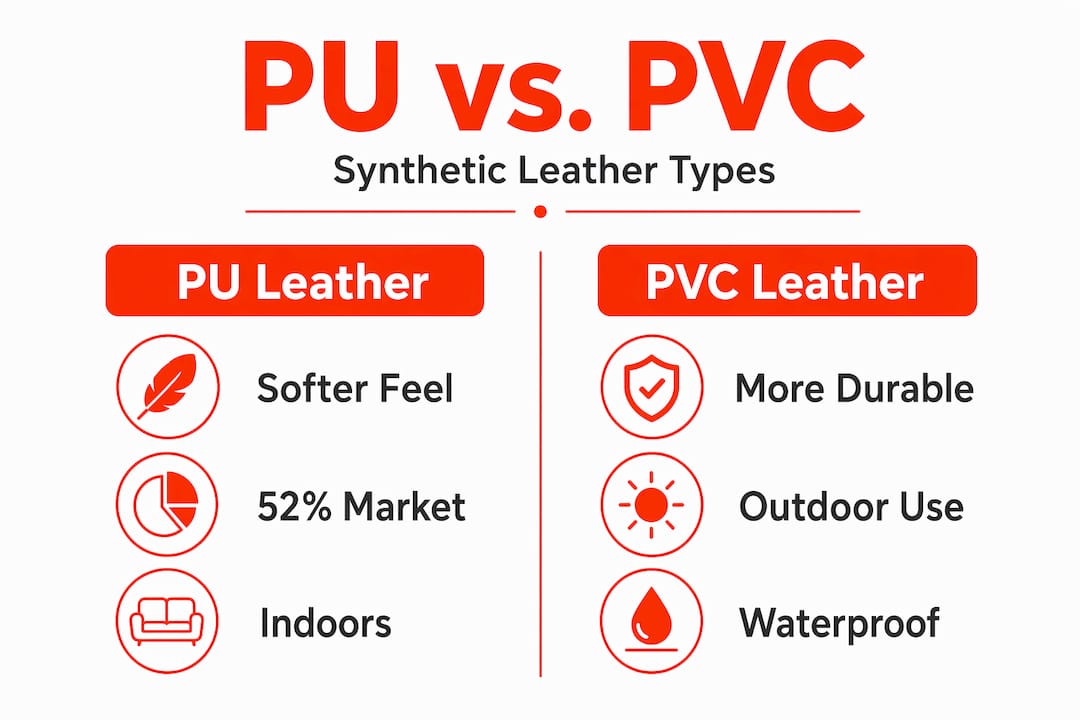
Understanding how synthetic leather is made helps you now distinguish key types and their best uses. The two dominant categories, PU leather and PVC leather, are not interchangeable. Each serves different environments and performance demands.
PU leather accounts for 52% of the synthetic leather market and is the go-to choice for fashion designers and indoor upholstery. It mimics the supple hand feel of natural leather and is the material behind most designer handbags, shoe linings, jacket panels, and sofa covers you see in retail today. It can be produced in ultra-thin forms for garment work or built up in heavier weights for furniture.
PVC leather is the tougher option. It is valued for durability and water resistance, making it ideal for outdoor furniture, commercial seating, marine upholstery, and any surface that faces heavy contact or moisture exposure. The trade-off is that PVC can feel stiffer and is less breathable.
| Feature | PU leather | PVC leather |
|---|---|---|
| Softness | High | Medium |
| Breathability | Moderate | Low |
| Water resistance | Moderate | High |
| Durability | 3-8 years | 5-10 years |
| Typical cost | Moderate | Lower |
| Best for | Fashion, indoor upholstery | Outdoor, commercial use |
| Environmental profile | Better (lower VOCs) | Higher chemical load |
Key synthetic leather properties to look for when sourcing:
You can also reference home decor fabric types to see how synthetic leather fits alongside other common upholstery and decor materials.
Pro Tip: Always request a physical sample before committing to a large order. Synthetic leather quality varies significantly between manufacturers. Flex the sample, check the grain under lighting, and rub it firmly with a damp cloth to assess colorfastness and coating adhesion before committing to a project.
With materials and uses clear, it is essential to consider synthetic leather’s sustainability credentials and innovations. This is where the conversation gets more nuanced than most articles let on.
Synthetic leather uses nearly seven times less water than natural leather in production. Tanning animal hides is extraordinarily water-intensive and produces significant chemical waste. That comparison matters to designers and decorators who are responding to client pressure for responsible sourcing.

The environmental story of synthetic leather is improving. The early criticism, and it was fair, centered on PVC’s reliance on chlorine chemistry and the off-gassing of volatile organic compounds (VOCs). That is changing. Companies like Kuraray and Huafon are innovating with bio-based PU compounds and solvent-free production methods that significantly reduce emissions during manufacturing.
Key environmental advantages of synthetic leather over genuine leather:
“Synthetic leather uses nearly seven times less water than natural leather, making it a more sustainable choice for fashion and home decor professionals looking to reduce their environmental footprint without compromising on material quality or performance.”
The vegan leather category is now mainstream, not niche. Brands across fast fashion, luxury, and interior design are publicly committing to reducing or eliminating animal leather from their supply chains. Synthetic leather is often the practical answer. For a broader framework on responsible material choices, the guide to sustainable fabrics is worth reading alongside this article.
Beyond eco benefits, let’s examine how synthetic leather performs day-to-day and what care practices extend its life.
Synthetic leather lasts 3-10 years in typical use and requires roughly 80% less maintenance than genuine leather. You do not need conditioning oils, wax treatments, or specialty cleaners. A damp microfiber cloth handles most surface soil. That simplicity is a genuine operational advantage for hospitality interiors, retail furniture, and garments that need to look sharp after repeated handling.
Practical advantages of synthetic leather in daily use:
That said, synthetic leather is not bulletproof. The most common failure mode is peeling or delamination, where the coating separates from the backing. This usually happens after 3-5 years in heavy-use upholstery when the base is low-quality woven fabric. Using microfiber base materials significantly improves resistance to this kind of peeling because the fibers bond more tightly with the coating compound.
Pro Tip: Keep synthetic leather away from direct sunlight for extended periods. UV exposure accelerates surface cracking in both PU and PVC materials. For furniture near windows, use UV-filtering window treatments or rotate cushion placement periodically. For garments stored long-term, keep them in breathable fabric bags rather than plastic, which traps humidity and accelerates coating breakdown.
Common pitfalls and how to avoid them:
For more general guidance on caring for your project materials, the fabric care checklist covers the fundamentals clearly.
Here is the perspective most synthetic leather coverage misses: the real disruption is not about replacing genuine leather. It is about what becomes possible when your material is freed from the constraints of animal hides.
Natural leather’s appeal is partly sensory and partly cultural. It ages in ways people find beautiful. It has a smell, a weight, a warmth that synthetic materials have historically failed to match. That is real, and it is not going away. But here is what the conversation overlooks: synthetic leather offers something genuine leather structurally cannot, which is complete consistency combined with unlimited customization. You can specify an exact grain pattern, an exact color, an exact weight, and receive that material identically across thousands of meters. No hide-to-hide variation. No unexpected scars or texture shifts mid-panel.
For production-scale fashion and large interior projects, that predictability is enormously valuable. It means fewer material rejections, more accurate pattern cutting, and cleaner cost forecasting. Designers who have worked extensively with both materials often discover that synthetic leather is not the compromise. It is the specification.
“The combination of sustainability, customization, and cost-effectiveness positions synthetic leather as the future material of choice across fashion, upholstery, and interior design sectors.”
The sustainability pressures accelerating this shift are not going to ease. Consumer expectations, brand commitments, and emerging regulations around animal products in manufacturing are all pushing in the same direction. The designers and decorators who learn synthetic leather deeply now, understanding its types, properties, maintenance needs, and sourcing criteria, will be better positioned than those who treat it as a fallback option.
The texture and color possibilities in contemporary synthetic leather are underestimated by most professionals still working from a mental image of the stiff, shiny “pleather” of the early 2000s. Modern PU leather can be embossed to replicate ostrich, crocodile, pebbled calf, or completely abstract textile-like surfaces. It is a design tool, not just a substitute. If you are actively rethinking your material palette, exploring choosing eco-friendly fabrics is a useful next step.
Whether you are upholstering a statement armchair, cutting panels for a structured jacket, or sourcing backing materials for a craft project, having the right fabric collection to browse makes a measurable difference in your outcomes.
At Fabric Fabric, you will find a carefully curated range of synthetic and home decor textiles suited for exactly these kinds of projects. From our backdrop fabrics collection to a full range of home decor fabric options, the catalog is organized by use so you spend less time searching and more time creating. All listings include detailed descriptions, usage suggestions, and clear pricing so you can plan projects with confidence. Explore the range today and find the material your next design deserves.
Synthetic leather is made by coating a fabric base like polyester or cotton with plastics such as polyurethane (PU) or polyvinyl chloride (PVC) to mimic real leather. The fabric base and coating together determine the material’s feel, durability, and appropriate uses.
Yes, synthetic leather typically uses significantly less water and produces fewer emissions than traditional animal leather. Specifically, synthetic uses seven times less water per square meter than natural leather production.
Synthetic leather lasts 3-10 years and requires 80% less maintenance than genuine leather, though genuine leather can outlast it with proper conditioning. Synthetic’s easy cleaning and low upkeep make it a strong practical choice for most commercial applications.
PU leather is softer and more breathable, preferred for fashion and indoor upholstery, while PVC leather is more durable and water-resistant, making it suitable for outdoor and high-contact uses. PU holds 52% market share globally, reflecting its popularity in fashion and furniture.