

 US Dollar

What Does Woven Fabric Mean? A Clear Guide
Posted by BLG on 2026 Jun 17th
Posted by BLG on 2026 Jun 17th

TL;DR:
- Woven fabric is created by interlacing warp and weft yarns at right angles on a loom, resulting in a structured, durable textile. It dominates the textile market with about 66.5% share and is essential for tailored clothing, home decor, and industrial uses. Understanding its construction, weave types, and grainline importance helps in selecting the right fabric for specific projects and ensures proper garment fitting.
Woven fabric is defined as a textile made by interlacing two sets of yarns at right angles on a loom, producing a stable, structured material used across clothing, home decor, and industrial textiles. The two yarn sets are called the warp, which runs lengthwise, and the weft, which runs crosswise. This 90-degree interlacing is what gives woven fabric its characteristic firmness and minimal stretch. Understanding what woven fabric means helps you make smarter choices when buying fabric, sewing garments, or decorating your home. Woven fabrics represent about 66.5% of the global textile market, dominating over knit fabrics at a 2:1 ratio.
Woven fabric is constructed by threading two distinct sets of yarns through a loom and crossing them at right angles. The warp yarns run vertically along the length of the fabric. The weft yarns run horizontally, passing over and under the warp yarns in a repeating pattern. This interlacing on a loom is what separates woven textiles from knit or non-woven alternatives.
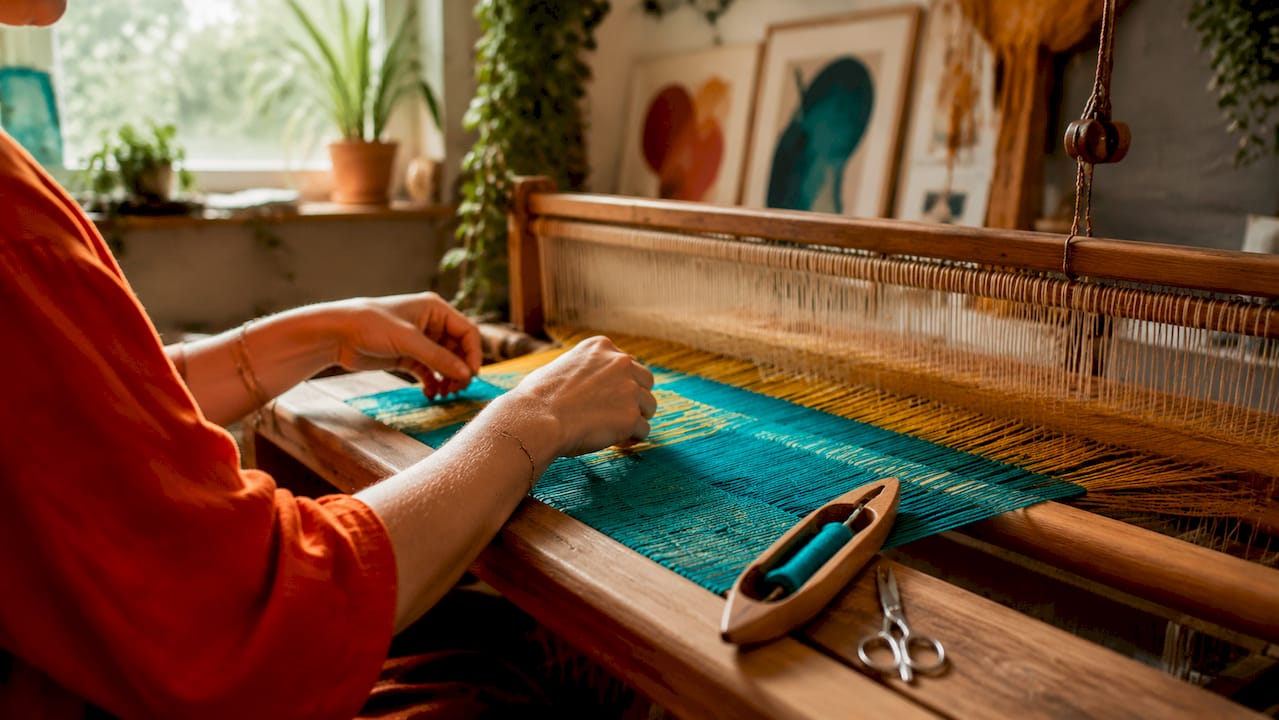
The loom holds the warp yarns under tension while the weft is woven through them, one row at a time. Each pass of the weft locks into the previous row, building a grid-like structure. That grid is what gives woven fabric its stability. You can pull a woven fabric along its length or width and it will resist distortion far better than a knit.
The result is a textile with a clear grain. The lengthwise grain runs parallel to the warp yarns. The crosswise grain runs parallel to the weft. There is also a bias grain, which runs at 45 degrees to both, and it is the only direction where woven fabric has any natural give.
Pro Tip: Always cut pattern pieces with the grainline arrow aligned to the warp direction. Cutting off-grain causes garments to twist and pull after washing, and that distortion cannot be fixed once the seams are sewn.
The grainline in woven fabric dictates how every pattern piece must be positioned. Misalignment causes permanent twisting and deformation that no amount of pressing will correct. This is one of the most critical technical facts beginners overlook.
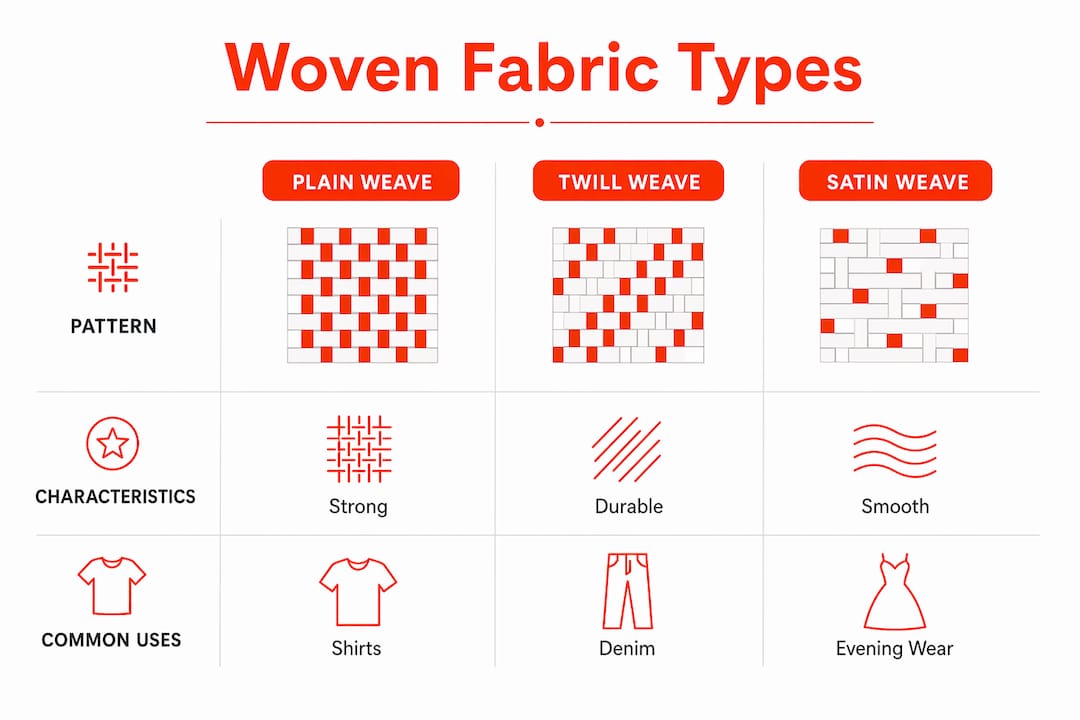
Three main weave types categorize woven fabric: plain weave, twill weave, and satin weave. Each produces a different surface texture, drape, and level of durability. The weave structure directly affects how a fabric looks, how it moves on the body, and what it is best used for.
Plain weave is the simplest structure. The weft passes over one warp yarn and under the next, alternating with every row. This creates a tight, even grid that is firm and durable. Cotton muslin, linen, and canvas are all plain weave fabrics. Plain weave holds its shape well and is easy to sew, making it a go-to for beginners and structured garments alike.
Twill weave creates a diagonal line across the fabric surface. The weft passes over two or more warp yarns before going under one, shifting by one yarn with each row. This offset pattern produces the characteristic diagonal ridge, called a wale. Denim, gabardine, and chino are all twill weave fabrics. Twill has more drape and slightly more elasticity than plain weave, which is why it works so well for trousers and jackets. Fabric-fabric carries several twill weave varieties worth exploring if you want to understand how much the wale angle changes the finished look.
Satin weave floats the weft over four or more warp yarns before going under one. Those long floats reflect light evenly, creating the glossy surface satin is known for. The trade-off is durability. Fewer interlacing points mean the fabric snags more easily and wears faster under friction.
| Weave Type | Structure | Texture | Durability | Common Uses |
|---|---|---|---|---|
| Plain weave | Over 1, under 1 | Flat, even | High | Canvas, muslin, linen |
| Twill weave | Over 2+, under 1 | Diagonal ridge | Medium-high | Denim, chino, gabardine |
| Satin weave | Over 4+, under 1 | Smooth, glossy | Lower | Formal wear, linings |
Understanding these three structures gives you a foundation for reading any fabric weave guide and making confident choices at the fabric store.
Woven fabric is structurally distinct from both knit and non-woven textiles. Knowing the difference prevents costly mistakes in sewing and purchasing. Fabric expert Andrea Eastin of Fair Fit Method points out that woven fabric requires seams, darts, and pleats to shape around the body, while knit fabric uses its built-in stretch to conform. Confusing these two systems is one of the most common causes of garment fitting failures.
Knit fabric is made from a single continuous yarn looped back on itself, like a hand-knitted sweater scaled up to machine speed. Those loops give knit fabric stretch in multiple directions. T-shirts, leggings, and jersey dresses are all knit fabrics. Knit is forgiving to cut and sew because the stretch accommodates minor grainline errors. The downside is that knit fabric distorts under tension and does not hold structured shapes as well.
Non-woven fabric skips yarn entirely. It is made by bonding or felting fibers together using heat, pressure, or adhesives. Interfacing, felt, and disposable surgical masks are non-woven textiles. Non-woven fabric has no grain, no stretch, and no drape. It is used where structure or filtration matters more than appearance or comfort.
Woven fabric lacks inherent stretch unless elastic fibers like elastane are woven in. That rigid grid structure is a feature, not a flaw. It is exactly what makes woven fabric the right choice for tailored garments, bags, and home textiles where shape retention matters.
Pro Tip: Before buying fabric for a sewing pattern, check whether the pattern calls for woven or knit fabric. Substituting one for the other is the single fastest way to end up with a garment that does not fit, no matter how carefully you sew it.
For a deeper look at how these two fabric families compare in real garment applications, the Fabric-fabric guide on knit vs. woven differences breaks it down clearly.
Woven fabric is the standard choice for any application where structure, durability, and shape retention are the priority. Woven fabrics are built with a tightly interlaced structure that supports seams and darts, making them ideal for suits, dress shirts, trousers, and structured bags. That same firmness makes woven fabric the dominant material in home textiles like curtains, upholstery, and table linens.
Here are the most common applications and the reasons woven fabric is chosen for each:
Woven fabric maintains structure after repeated washing, which is why it is the standard for high-quality workwear and formal fashion collections. That durability comes at a cost. Woven fabric production runs at 0.5–6 yards per minute, compared to 2–16 yards per minute for knit fabric. Slower production means higher manufacturing costs, which is reflected in the price of quality woven garments.
Care matters too. Most woven fabrics benefit from cold or warm water washing and low-heat drying. High heat causes the yarns to shrink unevenly, distorting the grain and changing the drape. Pre-washing fabric before cutting is standard practice for any woven project where fit precision matters.
Woven fabric is the most widely used textile structure in the world because its interlaced yarn grid delivers shape retention, durability, and tailoring precision that no other construction method matches.
| Point | Details |
|---|---|
| Core definition | Woven fabric is made by interlacing warp and weft yarns at right angles on a loom. |
| Three weave types | Plain, twill, and satin weaves each produce distinct textures, drape, and durability levels. |
| Key difference from knit | Woven fabric has minimal stretch and requires darts and seams to shape garments. |
| Grainline is critical | Cutting off-grain causes permanent distortion that cannot be corrected after sewing. |
| Dominant in textiles | Woven fabrics represent about 66.5% of the global textile market, outpacing knit fabrics 2:1. |
Most people who are new to sewing or fabric shopping treat woven and knit as interchangeable. They are not. I have seen beginners buy a beautiful cotton jersey for a blazer pattern and wonder why the finished garment looks nothing like the photo. The fabric was wrong for the construction system, full stop.
What I find more interesting is how understanding fabric structure changes the way you look at clothing you already own. Pull the hem of a dress shirt and feel how little it gives. Then pull the hem of a T-shirt. That difference is the entire story of woven versus knit in your hands.
The other thing worth saying plainly: woven fabric is not harder to work with than knit. It is different. Once you understand that woven fabric shapes the body through construction rather than stretch, the logic of tailoring clicks into place. Darts are not decorative. They are the woven fabric’s answer to curves.
My honest advice is to start with a plain weave cotton like quilting cotton or muslin before moving to twill or satin. Plain weave is forgiving, easy to press, and shows you exactly how grainline affects the finished piece. Get that right, and every other woven fabric becomes easier to handle.
— kev

Fabric-fabric carries a wide selection of woven fabrics suited for home decor, apparel, and craft projects. Whether you are looking for structured upholstery fabric, crisp cotton for a tailored shirt, or decorative textiles for your next room refresh, the range covers plain weave, twill, and specialty finishes. Browse the backdrop fabric collection for event and decorative woven options, or explore the full home decor fabric range for by-the-yard selections that bring the weave types covered in this article to life. Fabric-fabric makes it easy to find the right woven textile for any project, with clear product descriptions and usage guidance throughout the store.
Woven fabric is a textile made by crossing two sets of yarns at right angles on a loom. The result is a stable, structured material with minimal stretch used in clothing, bags, and home textiles.
In clothing, woven refers to garments made from fabric constructed on a loom, such as dress shirts, suits, and trousers. These garments use seams, darts, and pleats to shape the fabric around the body because woven fabric does not stretch.
Woven fabric is made from interlaced yarns and has a defined grain, drape, and durability. Non-woven fabric is made by bonding or felting fibers together and has no grain, no stretch, and limited drape, making it suitable for interfacing and industrial uses rather than garments.
Woven fabric has minimal stretch along the warp and weft directions. It has slight give on the bias grain, which runs at 45 degrees. Stretch is only added when elastic fibers like elastane are incorporated into the yarn during weaving.
The three foundational weave types are plain weave, twill weave, and satin weave. Plain weave is the most durable, twill weave adds diagonal texture and drape, and satin weave creates a smooth, glossy surface suited for formal and decorative applications.