

 US Dollar

Master the fabric costing process: a practical guide
Posted by BLG on 2026 Apr 12th
Posted by BLG on 2026 Apr 12th

TL;DR:
- Accurate fabric costing includes materials, processing, labor, overheads, wastage, and landed costs.
- Small businesses should use job order or BOM-based methods, updating costs regularly for shifts.
- Adding a 10-15% waste buffer and monitoring costs prevent hidden profit drains.
Unpredictable fabric expenses are one of the fastest ways to turn a profitable project into a loss. You cut the wrong amount, forget to account for shrinkage, or skip freight costs, and suddenly your margins disappear. For crafters and small business owners in the textile industry, mastering the fabric costing process is not optional. It is the difference between pricing with confidence and guessing every time. This guide walks you through the core components of fabric cost, the best costing methods for your scale, a repeatable step-by-step calculation process, and the most common mistakes that quietly drain your budget.
| Point | Details |
|---|---|
| Know your cost drivers | Fabric, processing, overheads, and landed costs all impact your final price calculation. |
| Choose the right method | Select a costing approach that matches your business scale and keeps calculations realistic. |
| Add adequate buffer | Always include a 10-15% allowance for waste and shrinkage to prevent underestimating expenses. |
| Review and adapt regularly | Recalculate costs when freight, inventory, or product lines change for continued accuracy. |
Before you can calculate anything accurately, you need to know what actually makes up your fabric cost. Many crafters only think about the price per yard. But that number is just the starting point.
Fabric cost factors cover a wider range than most people expect. According to industry data, direct materials account for 40-70% of total fabric cost, with overheads typically adding another 20%. The full formula looks like this: total fabric cost = greige cost + dyeing + finishing + indirect costs + overhead.
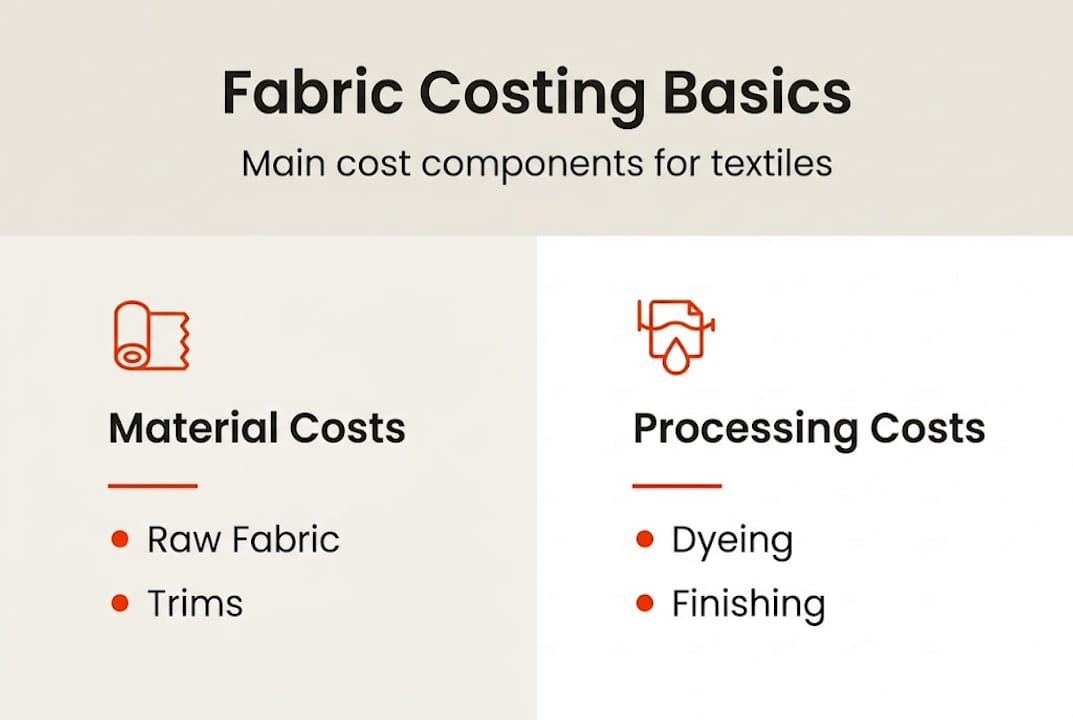
Here is a breakdown of the key components:
| Cost component | Typical contribution | Notes |
|---|---|---|
| Raw fabric (greige) | 40-70% | Yarn, base cloth |
| Processing (dyeing, finishing) | 10-20% | Sizing, weaving, treatments |
| Labor | 5-15% | Cutting, handling |
| Overheads | ~20% | Utilities, equipment, admin |
| Wastage | 5-15% | Shrinkage, offcuts, errors |
| Landed costs | Variable | Freight, duties, tariffs |
The components most crafters miss are wastage and landed costs. Freight charges and import duties can add 10-20% to your base price depending on your supplier’s location. Wastage is equally sneaky. Fabric shrinks when washed, patterns require matching, and cutting always produces offcuts.
Using a solid fabric sourcing guide helps you identify suppliers who are transparent about these added costs upfront, which makes your estimates far more reliable.
“The biggest costing errors in small textile businesses come not from the price per yard but from the costs that happen before the fabric even reaches the cutting table.”
Pro Tip: Always add a shrinkage and waste buffer of at least 10-15% to your raw material calculation. Pre-wash a sample before finalizing your yardage estimate for any new fabric type.
Understanding these building blocks means your costing starts from a place of accuracy, not optimism.
With the cost components clear, the next step is picking a costing method that fits how you actually operate. Not every method works for every scale, and using the wrong one leads to chronic under-pricing.
There are five main cost estimation steps and methodologies used in the textile industry:
For most crafters and small businesses, target costing strategies and job order costing offer the most practical starting points. As apparel costing experts note, small businesses should start with a BOM (bill of materials) or tech pack and apply simple per-garment formulas before scaling up to more complex systems.
| Method | Best for | Complexity |
|---|---|---|
| Absorption | Mid-size producers | Medium |
| Standard | Repeat production | Low-Medium |
| Job order | Custom/indie makers | Low |
| Variable | Volume analysis | Medium |
| Target | Retail-driven pricing | Medium-High |
Small businesses under-cost most often because they use a single flat rate without accounting for batch-specific variables like a new fabric supplier or a seasonal freight increase.
Pro Tip: Review and recalculate your costing method whenever you add a new product line, switch suppliers, or notice a significant shift in freight rates. Costs change faster than most people update their spreadsheets.
Having chosen your methodology, let’s put it to work with a process you can repeat for every project.
Fabric can represent 50-70% of finished product cost, which makes getting this calculation right one of the highest-leverage things you can do for your business.
Follow these steps for each project or style:
Common calculation errors to avoid:
For inventory planning best practices, keeping core fabrics at 50-60% of your inventory reduces the risk of costly last-minute sourcing. And when volume allows, buying bulk fabric can significantly reduce your per-yard cost and stabilize your costing baseline.
Once your calculation process is set, the final step is watching for the mistakes that quietly erode your margins.
The most common errors crafters and small business owners make:
To optimize, diversify your sourcing by allocating 50-60% to distributors and 10-25% to deadstock or secondary markets. This balances cost with risk. Always add a 10-15% buffer to your total, and recalculate whenever freight rates shift.
Smart inventory management strategies also reduce the frequency of emergency purchases that blow your budget.
“Shrinkage and waste are not edge cases. They are guaranteed costs. Build them in from day one, or they will show up in your profit and loss statement instead.”
For crafters looking to reduce waste creatively, upcycling fabric waste and exploring sustainable fabric tips can turn leftover materials into additional revenue streams rather than sunk costs.
Pro Tip: Set a calendar reminder every quarter to review your top five fabric costs against current supplier pricing. Even a 5% increase across three fabrics can shift your margins significantly over a full year.
Most fabric costing guides stop at the formula. They give you the math and assume the rest will follow. But the real challenge is not calculation. It is consistency.
The businesses that struggle most with costing are not the ones who got the formula wrong. They are the ones who built a solid process once and then never updated it. Freight rates change. Suppliers shift their minimums. A fabric you relied on goes out of stock and you substitute something slightly different without recalculating.
Small adjustments compound. Better marker making alone can recover 5-10% of fabric cost per run. Switching even one core fabric to a deadstock source can drop your material cost by 15-25%. These are not minor wins. Over a year of production, they represent real money.
We also think sustainability trends are reshaping what good costing looks like. Sustainable sourcing is no longer just an ethical choice. It is increasingly a financial one, as waste reduction and material efficiency directly lower your cost per unit. Adaptive, ongoing costing is not just about profitability. It is about building a business that does not get blindsided by the next supply chain disruption.
If you are ready to put these costing steps into action, having the right materials and a reliable source makes the entire process simpler and more predictable.
At fabric-fabric.com, we stock a wide range of fabrics with clear pricing, detailed product descriptions, and usage guidance so you can build accurate cost estimates from the start. Whether you are sourcing for apparel, quilting, or decorating projects, our home decor fabric selection and backdrop fabrics collection give you quality options at transparent prices. Knowing exactly what you are paying per yard, before you commit, is the first step to costing with confidence. Browse our full catalog and take the guesswork out of your next project.
The basic formula is: total fabric cost equals greige (raw) cost plus dyeing, finishing, indirect costs, and overhead. Every component must be included for an accurate result.
Small businesses benefit most from job order or BOM-based costing because these methods are simple to apply and easy to update as your product mix changes.
Always add a 10-15% waste buffer on top of your calculated yardage to cover shrinkage, cutting errors, and pattern matching losses.
High marker efficiency of 85-95% means your pattern pieces use more of each yard, reducing waste and making your cost calculations more accurate and your margins more predictable.