

 Canadian Dollars

The Main Kinds of Woven Fabric and How to Tell Them Apart
Posted by BLG on 2026 Aug 20th
Posted by BLG on 2026 Aug 20th

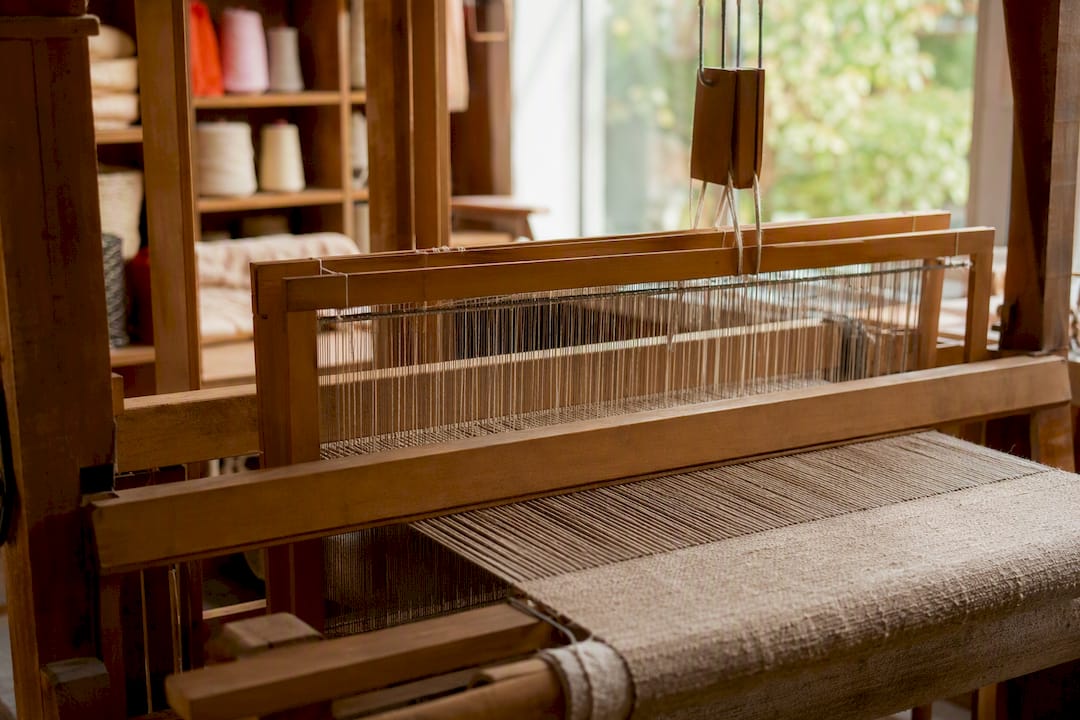
Every kind of woven fabric comes down to how two sets of yarn cross each other on a loom, and almost all of them trace back to just three structures. Woven fabric is cloth made by interlacing a lengthwise “warp” yarn with a crosswise “weft” yarn at a right angle, and the specific pattern of that crossing determines whether you end up with denim, chiffon, or upholstery-grade canvas.
Knowing which weave family a fabric belongs to, and roughly how much it weighs, tells you almost everything you need before you ever touch the bolt. That framework is what turns “I like how this looks” into “this will actually work for my project.”
Every woven fabric name you’ll encounter traces back to a plain, twill, or satin structure, and matching weave family plus GSM weight to your project is the single most reliable way to choose the right cloth.
| Point | Details |
|---|---|
| Three weaves rule them all | Plain, twill, and satin are the base structures behind nearly every named woven fabric. |
| Weight drives performance | GSM or oz/yd² tells you whether a fabric suits garments, linings, or upholstery. |
| Drape trades off with durability | Satin’s long floats give shine and drape but lower abrasion resistance than plain weave. |
| Check the edge and the fold | A frayed raw edge and a drape test reveal weave type without any special tools. |
| Shop by spec, not just photo | Fabric-fabric lists GSM and fiber content on every listing to match fabric to project needs. |
Picture a loom: one set of yarns runs straight up and down (the warp), held taut on the frame, while another set (the weft) threads over and under it from side to side. That interlacing is what makes woven cloth structurally stable in a way that knits are not, and it’s why a woven shirt holds its shape while a knit T-shirt stretches with you.
Knit fabric, by contrast, is built from a single continuous yarn looped through itself, similar to hand knitting on a much finer scale. That loop structure gives knits their stretch and recovery. Woven fabric generally has very little give, holds a crisp, structured shape, and frays at a cut edge because there’s no interlocking loop to hold the yarn ends in place.
Here’s the practical breakdown:
Pro Tip: Before you cut into any woven fabric, check whether it’s warp-faced or weft-faced. That detail changes which direction the pattern or sheen runs, and it affects how you lay out pattern pieces to avoid a mismatched grain line down the seam.
Nearly every woven fabric you’ll ever shop for is built on one of three interlacement patterns, and once you can spot the difference, you can predict how a fabric will drape, wear, and hold up over time.
Plain weave is the simplest interlacement: one warp yarn crosses over one weft yarn, then under the next, in a tight checkerboard pattern.
Twill weave produces the diagonal ribs you see on denim, and that diagonal comes from an offset interlacing pattern rather than a strict over-one-under-one grid.
Satin weave is built to maximize sheen by floating the yarn over several threads before it dips under one, which is why satin catches light the way plain and twill never do.
Fewer interlacements mean longer floats, and longer floats mean more shine and drape but less durability, a trade-off that holds true across nearly every named fabric on the market.
| Weave | Drape | Luster | Abrasion resistance | Typical float length | Typical weight range |
|---|---|---|---|---|---|
| Plain | Low to moderate | Low | High | 1 yarn | Light to heavy |
| Twill | Moderate to high | Low to moderate | Moderate to high | 2 to 4 yarns | Medium to heavy |
| Satin | High | High | Low to moderate | 4+ yarns | Light to medium |
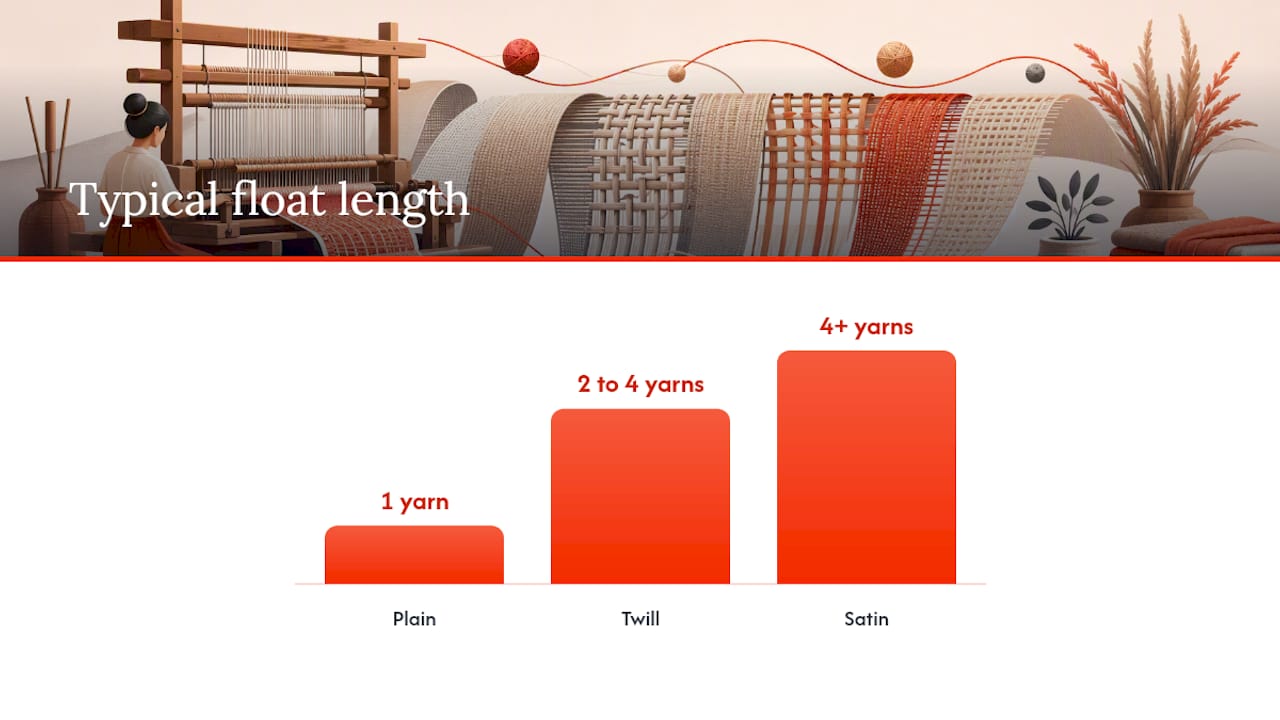
Recognizing which of these three interlacement patterns a fabric uses lets you predict its behavior before you ever wash or sew it, which is a far more reliable shortcut than judging by feel alone. Want a deeper dive into diagonal weaves specifically? Fabric-fabric’s guide to twill types breaks down seven variations you’ll run into while shopping.
Beyond the three basics, most of the “interesting” fabric names you see in shops come from loom attachments or mechanisms layered on top of a plain, twill, or satin base rather than an entirely new structure.
Specialized weave structures like these still rely on a plain, twill, or satin foundation in most cases, they just add a mechanism on top.
One distinction that trips people up: sateen is a cotton or cotton-blend fabric woven with a satin structure, giving it satin’s shine with cotton’s breathability, while satin typically refers to the weave itself, most often made with silk or synthetic filament yarns like polyester. If you’re comparing sheen and hand-feel between silky fabrics, this breakdown of satin versus chiffon is a useful side reference.
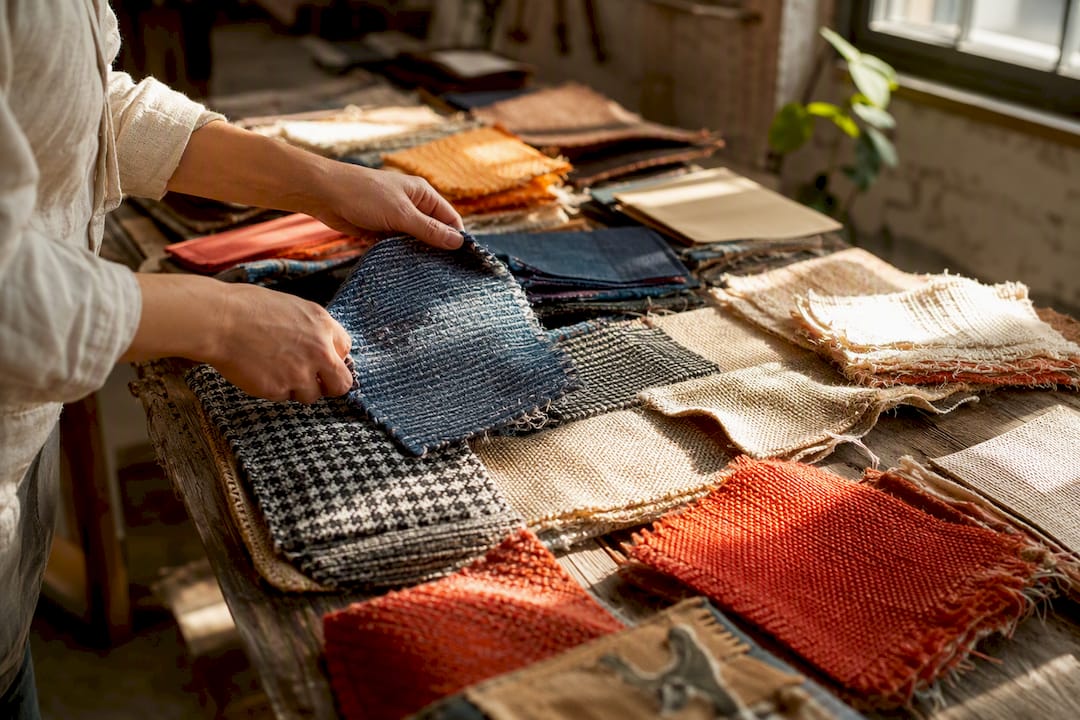
Here’s a curated rundown of the woven fabric names that show up most often in patterns, project instructions, and fabric shop listings, along with what they mean for your next project.
| Fabric | Weave family | Common fibers | Typical uses |
|---|---|---|---|
| Chiffon | Plain (leno-like sheer variant) | Silk, polyester | Eveningwear, overlays, scarves |
| Chintz | Plain | Cotton | Curtains, upholstery, home decor |
| Corduroy | Pile (on plain or twill base) | Cotton, cotton blends | Pants, jackets, children’s wear |
| Crepe | Plain (crepe twist yarns) | Silk, wool, polyester | Dresses, blouses, draped garments |
| Muslin | Plain | Cotton | Garment prototyping, quilting backing, swaddling |
| Gabardine | Twill | Wool, cotton, synthetic blends | Suits, trousers, trench coats |
| Taffeta | Plain | Silk, polyester | Bridal, formalwear, linings |
| Canvas | Plain (heavy, often basket variant) | Cotton, cotton/poly blends | Bags, upholstery, outdoor gear |
| Denim | Twill | Cotton, cotton/spandex | Jeans, jackets, workwear |
| Satin | Satin | Silk, polyester, acetate | Eveningwear, linings, lingerie |
| Georgette | Plain (crepe twist, sheer) | Silk, polyester | Dresses, blouses, layering |
| Buckram | Plain (heavily stiffened) | Cotton, linen blends | Hat brims, bookbinding, structure/interfacing |
| Cambric | Plain | Cotton, linen | Handkerchiefs, lightweight linings, quilting |
| Cheesecloth | Leno or loose plain | Cotton | Straining, gauze bandaging, loose garments |
A few shopping notes worth remembering. When buying satin or charmeuse, check the momme count (a silk weight measurement) rather than trusting the shine alone, since a lower momme silk-look polyester can feel just as glossy but drape completely differently. For corduroy, look at the wale count, the number of ridges per inch, since a higher wale count generally means a finer, more durable pile. And cotton, which shows up in muslin, cambric, and cheesecloth, tends to shrink more than synthetic blends on first wash, so always check the fiber label before cutting.
Weight is usually expressed in grams per square meter (GSM) or ounces per square yard (oz/yd²), and it has more influence on how a fabric drapes and performs than most beginners expect. Fabrics are often categorized as light, medium, or heavy weight based on their thickness and heft, with lighter fabrics suited to flowing garments and heavier ones used for structured or durable applications.
These GSM buckets, which line up with standard textile education classifications, aren’t arbitrary; they map directly to what a fabric can physically do.
Matching a fabric to a project comes down to lining up three variables: weave, weight, and fiber, against what the finished piece actually needs to do (drape, hold shape, survive washing).
Quick project-to-fabric pairings that come up constantly:
For a broader look at which fabrics suit which end use, Fabric-fabric’s overview of woven fabric applications is a useful companion to this checklist.
Woven fabrics ravel at the cut edge and can shrink unevenly depending on fiber content, so the single most important rule is this: finish your raw edges and prewash before you cut, not after.
Pro Tip: If a pile fabric like corduroy or velvet keeps shifting or crushing during pressing, press it face down on a towel instead of directly on the ironing board. It protects the pile from flattening and keeps the nap looking consistent.
You can identify most woven fabrics with three quick, non-destructive checks before you ever buy a yard.
Beyond a visual check, ask the seller for the fiber content and GSM listed on the bolt or product page. That non-destructive information tells you more about durability and care than touch alone ever will. It’s the same standard fabric educators and sewists rely on, and it’s the approach behind Fabric-fabric’s own woven fabric resources.
If there’s one thing I’d tell a beginner standing in front of a fabric wall, it’s this: stop shopping by picture and start shopping by hand. Fabric photos lie constantly about weight and drape, but running a swatch through your fingers and letting a corner hang for three seconds tells you almost everything a pattern envelope’s suggested-fabrics list is trying to communicate. I’ve seen more projects fail from picking a gorgeous satin for a structured bag than from any sewing mistake. Match the weave to the job first; the color and print are the easy part.
Once you know whether you need a crisp plain weave, a durable twill, or a fluid satin, the next step is finding it without guessing at weight or fiber content from a thumbnail photo. Fabric-fabric lists GSM, fiber content, and intended use on every product page, so you can match what you learned here to an actual bolt instead of hoping a swatch matches the description.
If your next project calls for heavier, structured cloth, whether that’s an upholstery redo, custom drapery, or an event backdrop, browse the home decor fabric collection for medium and heavyweight plains and twills built for exactly that kind of durability. Planning something oversized, like a photo backdrop or stage dressing? The backdrop fabrics page is worth a look for heavier woven options sized for that purpose. Either way, start by checking the weight and fiber listed on the product page against the project checklist above before you add anything to your cart.
What are the main kinds of woven fabric? The main kinds of woven fabric fall into three structural families: plain weave (poplin, muslin, chintz), twill weave (denim, gabardine, herringbone), and satin weave (charmeuse, sateen). Most named fabrics you’ll shop for are variants or blends built on one of these three.
What’s the difference between woven and knit fabric? Woven fabric interlaces two perpendicular yarn sets and has minimal stretch, while knit fabric is looped from a single yarn and stretches significantly. Woven edges fray when cut; knit edges typically don’t need finishing.
Is denim a twill or plain weave? Denim is a twill weave, identifiable by its visible diagonal rib pattern. That diagonal structure is also what gives denim its durability and resistance to abrasion.
How do I know if a fabric is heavy or lightweight? Check the GSM (grams per square meter) or oz/yd² listed on the product page. Under 150 GSM is generally light, 150 to 300 GSM is medium, and over 300 GSM is heavy.
What’s the difference between satin and sateen? Satin refers to the weave structure itself, usually made with silk or synthetic filament yarn, while sateen is a cotton-based fabric woven with a satin structure, giving it similar shine with more breathability.
Which woven fabric is best for beginners sewing clothing? Medium-weight plain weave cottons like poplin or quilting cotton are the easiest starting point, since they hold a seam well, don’t fray excessively, and behave predictably under a standard sewing machine needle.
These references back the classifications and comparisons used throughout this guide and are worth a look for deeper technical detail.