

 US Dollar

How to Read Fabric Specifications: A Crafter's Guide
Posted by BLG on 2026 Jul 3rd
Posted by BLG on 2026 Jul 3rd


TL;DR:
- Reading fabric specifications helps you choose the right materials, avoid mistakes, and ensure project durability. Key data points include fiber content, weight, width, shrinkage, colorfastness, and certifications, all of which influence how a fabric performs and lasts. Always verify full specifications before purchasing to make informed decisions and prevent issues like shrinking or bleeding.
Reading fabric specifications is the process of decoding essential details like fiber percentages, fabric weight, dimensions, and care instructions to make informed material choices. Every bolt of fabric carries a story written in numbers, symbols, and abbreviations. Crafters and designers who know how to read fabric specifications gain a real advantage: they pick the right material the first time, avoid costly mistakes, and produce finished work that holds up. This guide covers fiber content, weight, width, shrinkage, colorfastness, and certifications, using current industry standards so you can shop and plan with confidence.
The four essential data points for any fabric purchase are exact fiber content percentages, fabric width, fabric weight, and care instructions. Missing even one of these makes it impossible to judge whether a fabric suits your project, how much to buy, or how to maintain it after construction.
Fiber percentages are legally required on fabric labels and listed in descending order by weight. The first fiber listed dominates the fabric’s behavior, breathability, and durability. A label reading 95% cotton / 5% elastane behaves fundamentally like cotton, not like a performance stretch fabric. Beginners often assume the elastane content makes it a gym fabric. It does not. That 5% adds recovery, but the cotton still drives how it breathes, shrinks, and presses.
Fabric weight tells you how thick and dense a fabric is. The two standard units are grams per square meter (GSM) and ounces per square yard (oz/yd²). Lightweight fabrics run below 150 GSM and suit blouses, linings, and sheer curtains. Medium weights from 150–300 GSM cover quilting cotton, shirting, and most home decor uses. Heavy fabrics above 300 GSM include upholstery, canvas, and outerwear. Understanding fabric weight before you buy prevents the frustrating experience of ordering a fabric that drapes like cardboard when you needed something fluid.

Fabric width is measured selvage to selvage and typically runs 44/45 inches, 54/60 inches, or 108 inches for wide-format home decor cloth. Width directly affects how much yardage you need. A pattern drafted for 60-inch fabric requires significantly more yardage if you substitute a 44-inch alternative. Always check width before calculating your cut list.
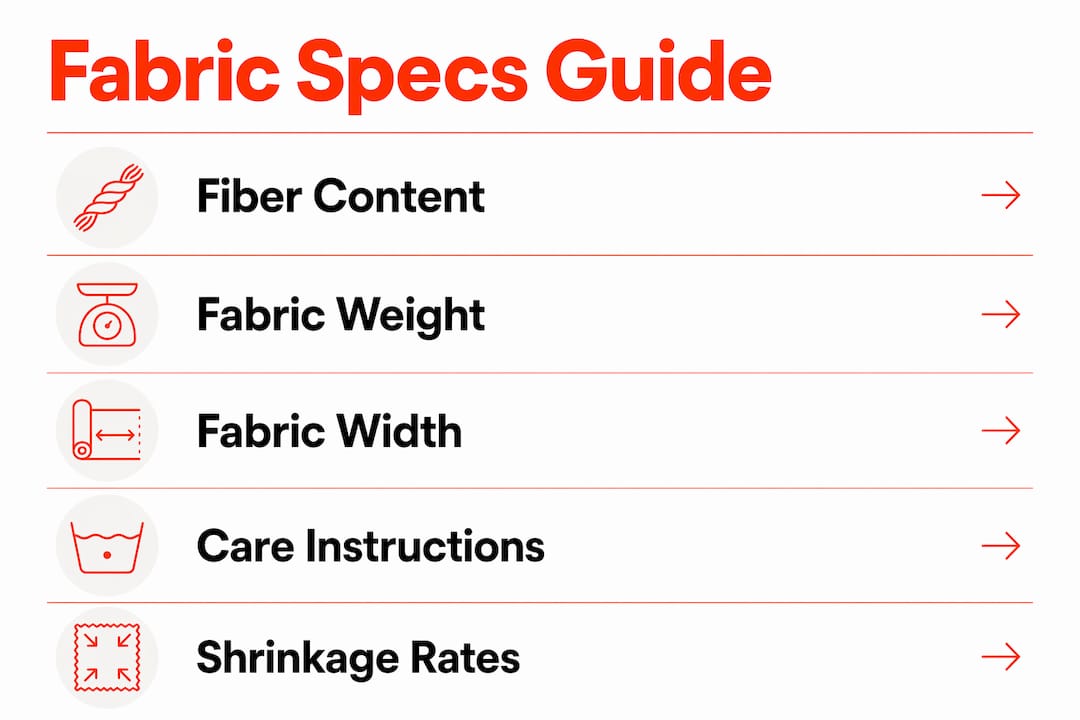
Care symbols use a wash tub for laundering, a triangle for bleaching, a square for drying, an iron for pressing, and a circle for dry cleaning. Dots inside icons indicate temperature: one dot for low, three dots for high. A crossed-out icon means that process is prohibited. Understanding these symbols prevents shrinkage, bleaching damage, and premature fabric wear. For a deeper breakdown of what each symbol means in practice, the fabric care labels guide at Fabric-fabric is worth bookmarking.
Pro Tip: If a fabric listing omits weight, width, or fiber content, treat it as incomplete. Ask the seller directly before ordering. A reputable supplier provides a full spec sheet on request.
Shrinkage is measured separately for the lengthwise direction (warp) and the crosswise direction (weft) after standardized wash tests such as AATCC 135 and ISO 5077. Warp shrinkage is almost always higher than weft shrinkage because the lengthwise threads bear more tension during weaving. Shrinkage under 1% is considered dimensionally stable. Anything above 1% requires you to add a cutting allowance or pre-wash the fabric before cutting.
Different fibers shrink at very different rates. Cotton and linen shrink the most, often 3–5% in the warp direction when not pre-treated. Wool can shrink dramatically if exposed to heat and agitation, sometimes exceeding 5%. Polyester and nylon are the most stable, typically shrinking less than 1% under normal wash conditions. Blends fall somewhere between their component fibers depending on the dominant content.
| Fiber type | Typical warp shrinkage | Typical weft shrinkage | Notes |
|---|---|---|---|
| Cotton (untreated) | 3–5% | 1–3% | Pre-wash before cutting |
| Linen | 3–4% | 1–2% | Softens with washing |
| Wool | 3–8% | 2–5% | Use gentle cycle, cold water |
| Polyester | Under 1% | Under 1% | Dimensionally stable |
| Cotton/poly blend | 1–3% | Under 1% | Depends on cotton ratio |
Pre-shrunk fabrics have already been washed under controlled conditions at the mill. Their spec sheets note this explicitly. If a spec sheet says “pre-shrunk,” you can cut to finished dimensions. If it does not, always add at least 3% to your cut length for natural fibers.
Pro Tip: When a spec sheet lists shrinkage as a range (e.g., 2–4%), always plan for the higher number. Cutting to the optimistic end of a range is how projects end up too short.
Colorfastness ratings tell you how well a fabric holds its color through washing, light exposure, and friction. The grading system uses a 1–5 scale for wash and rub fastness and a 1–8 scale for light fastness. Grade 1 means severe fading or bleeding. Grade 5 (or 8 for light) means excellent durability. These numbers come from standardized tests: ISO 105-C06 for wash fastness and ISO 105-B02 for light fastness.
Knowing these grades before you buy prevents real problems. A grade 2 wash fastness fabric will bleed onto adjacent fabrics in the first wash. A grade 3 light fastness fabric will fade noticeably within months near a sunny window.
Here is what the grades mean in practice:
For a full explanation of how these grading systems work and what they mean for your projects, the colorfastness guide at Fabric-fabric breaks it down clearly.
Certifications are third-party verifications that a fabric meets specific chemical safety or environmental standards. OEKO-TEX Standard 100 and GOTS are the two most recognized in the textile industry. OEKO-TEX Standard 100 certifies that every component of a fabric, including threads and dyes, has been tested for harmful substances. GOTS (Global Organic Textile Standard) covers both environmental and social criteria across the entire supply chain.
These certifications are not just marketing. They are critical safety verifications for garments intended for sensitive skin, children’s wear, or sustainable fashion markets.
Key things to look for on a spec sheet or label:
For more on why fabric certification matters for both buyers and brands, Fabric-fabric covers the topic in depth.
Pro Tip: Always verify certification numbers directly on the issuing body’s website. A label can claim anything. A database entry cannot be faked.
Most errors in reading textile specifications come down to skipping details that seem minor but are not. Here are the most frequent mistakes and how to avoid them:
Ignoring fiber blend order. Fiber percentages listed in descending order tell you which fiber controls the fabric’s behavior. Skipping past the percentages and just reading the fiber names leads to wrong assumptions about performance and care.
Overlooking weight tolerances. A ±5% weight tolerance is standard practice in quality assurance. If you order multiple bolts without specifying tolerance, you may receive fabric that varies noticeably in thickness and drape across your project.
Misreading care symbols. A crossed-out iron does not mean “iron carefully.” It means do not iron at all. Misreading a single symbol can permanently damage a fabric. When in doubt, look up the symbol in a standardized care symbol chart before proceeding.
Trusting “Made in” labels for fabric origin. “Made in” labels refer to where a garment was assembled, not where the fabric was woven or dyed. True fabric provenance requires mill documentation. If fabric origin matters for your project or brand, request a mill certificate from your supplier.
Accepting incomplete spec sheets. If a listing does not include all four core data points (fiber content, weight, width, and care instructions), ask for a full spec sheet before ordering. Reputable suppliers provide this without hesitation.
Reading fabric specifications correctly requires checking fiber content, weight, width, shrinkage, colorfastness ratings, and certifications before committing to any fabric purchase.
| Point | Details |
|---|---|
| Fiber content order matters | Fibers are listed by descending weight, so the first fiber listed drives fabric behavior and care needs. |
| Weight tolerance affects consistency | Specify a ±5% weight tolerance when ordering in bulk to avoid variance across your project. |
| Shrinkage above 1% needs allowance | Add a cutting allowance or pre-wash natural fiber fabrics before cutting to finished dimensions. |
| Colorfastness grades protect your work | Aim for grade 4+ wash fastness and grade 6+ light fastness for any fabric used in high-visibility or frequently washed projects. |
| Certifications require verification | Always confirm OEKO-TEX or GOTS certification numbers on the issuing body’s official website before trusting a label. |
Fabric feel is seductive. You touch a bolt, it feels right, and you buy it. I have done this more times than I want to admit, and I have paid for it every time. The fabric that felt perfect in the store bled dye in the first wash, or shrank two inches in length, or pilled after three wears. Every one of those failures was predictable from the spec sheet.
The shift that changed how I work was treating the spec sheet as the primary source of truth and the physical sample as confirmation. Not the other way around. When I started cross-checking colorfastness grades against the intended use, checking shrinkage percentages against my cutting allowances, and verifying certifications before buying for sensitive-skin projects, my failure rate dropped to nearly zero.
The other thing worth saying plainly: most sellers will give you a full spec sheet if you ask. The ones who cannot or will not are telling you something important. A supplier confident in their fabric has nothing to hide in the numbers. Asking for specs is not being difficult. It is being professional.
Fabric technology and testing standards also evolve. AATCC and ISO update their test methods periodically, and new certifications emerge as sustainability standards tighten. Staying current with these changes is part of working seriously with textiles. The crafters and designers who treat specs as a living document rather than a formality consistently produce better work.
— kev
Knowing how to interpret a fabric spec sheet is only useful when you can apply it to real purchasing decisions.
Fabric-fabric carries a wide selection of backdrop fabrics and home decor fabrics with detailed product descriptions that make it easier to apply what you now know. Each listing gives you the information you need to evaluate fiber content, weight, and care requirements before you buy. Whether you are sourcing material for a photography backdrop, a window treatment, or a quilting project, Fabric-fabric’s catalog gives you the specifics to make a confident, informed choice rather than guessing from a photo.
The four essential data points are fiber content percentages, fabric width, fabric weight, and care instructions. Missing any one of these makes it impossible to determine whether a fabric suits your project or how to maintain it.
Grade 4 or above on the wash fastness scale (ISO 105-C06) is the minimum for everyday apparel and home textiles. For outdoor or sun-exposed fabrics, a light fastness grade of 6 or above on the ISO 105-B02 scale is the accepted standard.
Shrinkage under 1% is considered dimensionally stable and requires no cutting allowance. Anything above 1%, which is common in untreated cotton and wool, requires pre-washing or adding a cutting allowance to your pattern dimensions.
OEKO-TEX Standard 100 certifies that every component of the fabric, including dyes and threads, has been tested and found free of harmful substances. Always verify the certification number on the official OEKO-TEX website to confirm it is genuine.
Fiber content is listed in descending order by weight, so the first fiber listed controls the fabric’s primary behavior, care needs, and performance characteristics. A 95% cotton / 5% elastane blend behaves like cotton, not like a stretch performance fabric.