

 Canadian Dollars

Why Fabric Certification Matters for Sustainable Brands
Posted by BLG on 2026 Feb 1st
Posted by BLG on 2026 Feb 1st


Sustainable fashion brands across the United States and Canada face growing pressure to prove their environmental claims with more than just labels. As consumers demand transparency and higher standards, fabric certification emerges as a powerful way to demonstrate real commitment. Understanding the difference between basic product labeling and the rigorous process of textile certification will help you strengthen your brand, meet regulatory requirements, and confidently communicate your values to a discerning audience.
| Point | Details |
|---|---|
| Fabric certification ensures accountability | It requires comprehensive third-party assessments to validate sustainability claims across the supply chain. |
| Brands must choose appropriate certifications | Different certifications focus on various sustainability aspects; brands need to align their choices with their goals. |
| Certification impacts consumer trust | Transparent processes and verifiable claims enhance brand credibility and influence purchasing decisions. |
| Investing in certification can yield long-term benefits | While there are immediate costs, robust certification fosters brand integrity and opens access to premium markets. |
Fabric certification represents a critical validation process for brands committed to genuine sustainability in textile production. More than just a marketing label, this rigorous framework evaluates textile standards through comprehensive third-party assessments that examine environmental, social, and quality benchmarks.
At its core, fabric certification involves multiple layers of verification designed to ensure transparency and accountability throughout the supply chain. Textile certification goes far beyond simple product labeling, requiring extensive documentation and auditing to confirm that sustainability claims are scientifically substantiated and operationally authentic. Key aspects of certification typically include:
Contrary to popular misconceptions, fabric certification is not a one-size-fits-all process. Different certification standards carry varying levels of rigor and focus. Some concentrate exclusively on environmental metrics, while others integrate social responsibility criteria. Brands must understand these nuanced differences to select certifications that genuinely align with their sustainability commitments.
Fabric certification transforms abstract sustainability claims into verifiable, measurable standards that protect both consumers and production ecosystems.
Pro tip: Research multiple certification standards and choose those with comprehensive, transparent assessment methodologies that go beyond surface-level environmental claims.
Sustainable textile production relies on a diverse range of fabric certification standards that address different environmental and social concerns. Textile certification frameworks encompass multiple specialized standards designed to validate specific aspects of sustainable manufacturing and material sourcing.
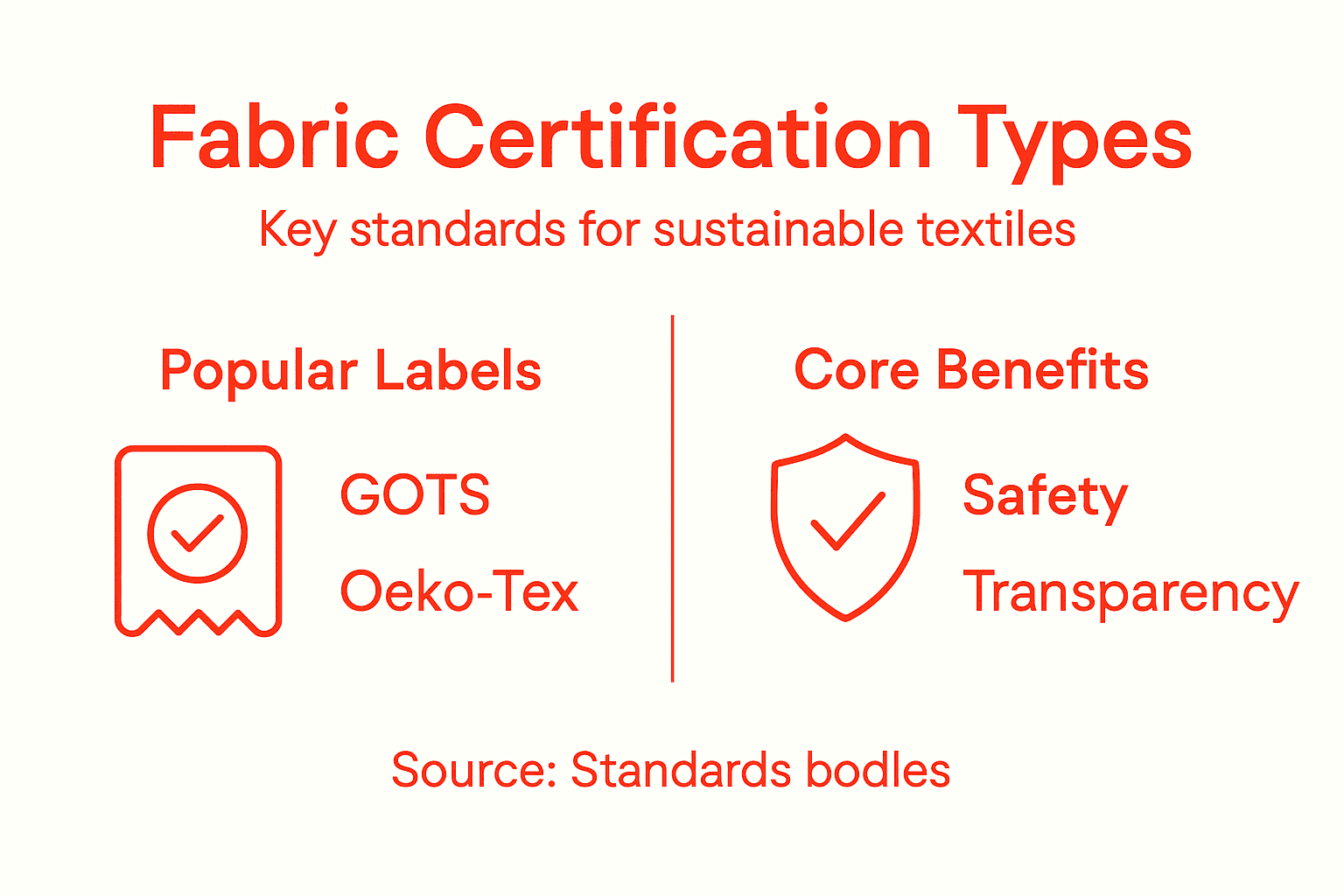
Among the most prominent certifications, the Global Organic Textile Standard (GOTS) stands out as a comprehensive benchmark for organic textiles. This certification ensures rigorous ecological and social criteria throughout the production process. Other critical certification types include:
Each certification serves a unique purpose in the sustainability ecosystem. Some standards concentrate on material content, while others emphasize supply chain transparency, worker conditions, or environmental impact. Brands must strategically select certifications that align with their specific sustainability goals and demonstrate genuine commitment to responsible textile production.

Here’s a summary of leading fabric certification standards and their primary industry impact:
| Certification Standard | Primary Focus | Industry Impact |
|---|---|---|
| GOTS (Global Organic Textile) | Organic materials & social standards | Drives organic adoption, boosts credibility |
| Oeko-Tex Standard 100 | Chemical safety | Ensures consumer product safety |
| BCI (Better Cotton Initiative) | Sustainable cotton farming | Promotes ethical raw material sourcing |
| RWS (Responsible Wool Standard) | Animal welfare & land management | Enhances traceable supply chains |
| GRS (Global Recycled Standard) | Recycled content verification | Validates recycled material claims |
Fabric certifications transform abstract sustainability claims into measurable, verifiable standards that protect consumers, workers, and ecological systems.
Pro tip: Develop a comprehensive certification strategy by combining multiple standards that comprehensively address environmental, social, and quality dimensions of textile production.
Fabric certification is a comprehensive, multi-stage process that transforms sustainable textile production through rigorous third-party verification. This intricate system involves systematic assessments across every stage of manufacturing, ensuring that textiles meet stringent environmental, social, and quality standards.
The certification journey typically encompasses several critical evaluation stages:
Third-party certification bodies play a crucial role in this process. Independent auditors meticulously trace fabric production from raw material sourcing through final manufacturing, ensuring that every stage meets predefined sustainability criteria. They employ sophisticated testing methodologies to objectively measure fabric characteristics, chemical safety, durability, and environmental impact.
Fabric certification transforms abstract sustainability promises into measurable, transparent standards that hold manufacturers accountable for their environmental and social commitments.
Pro tip: Request detailed certification documentation from suppliers to understand the specific sustainability standards and verification processes applied to your textile materials.
North American fabric certification operates within a complex regulatory landscape that balances mandatory safety requirements with voluntary sustainability standards. Consumer product safety regulations play a critical role in establishing baseline standards for textile manufacturing and importation.
The legal framework for textile regulation in North America involves multiple key components:
Mandatory certification processes require manufacturers to demonstrate compliance through comprehensive documentation and testing. The United States-Mexico-Canada Agreement (USMCA) further complicates this landscape by introducing additional provisions related to textile sourcing, labor practices, and cross-border manufacturing standards. These regulations ensure that fabrics meet stringent safety, environmental, and ethical production guidelines.
Regulatory compliance is not just a legal obligation, but a fundamental commitment to consumer safety and responsible manufacturing.
Pro tip: Maintain meticulous documentation of your fabric’s supply chain and testing results to streamline regulatory compliance and certification processes.
Fabric certification represents a strategic investment with complex financial and reputational considerations for brands. Certification costs impact business operations significantly, requiring careful evaluation of both potential risks and long-term benefits.
The financial implications of fabric certification can be categorized into several key areas:
Brand reputation emerges as a critical factor in the certification landscape. Companies that invest in robust certification processes signal genuine commitment to sustainability, potentially mitigating risks associated with greenwashing accusations. Transparent certification demonstrates accountability, which can translate into increased consumer trust and loyalty.
Below is a comparison of key risks and benefits for brands investing in fabric certification:
| Business Factor | Risk Example | Benefit Example |
|---|---|---|
| Financial Impact | Increased operational costs | Access to premium markets |
| Reputation | Accusations of greenwashing | Enhanced consumer trust |
| Market Opportunity | Limited market without certification | Expanded global reach |
| Compliance | Non-compliance penalties | Smoother regulatory approval |
Certification is not an expense, but a strategic investment in brand integrity and future market positioning.
Pro tip: Conduct a comprehensive cost-benefit analysis that considers both short-term certification expenses and long-term brand value enhancement.
Certification fundamentally transforms the relationship between brands and consumers by reducing information asymmetry in the marketplace. This critical mechanism provides transparent, credible signals that help consumers make informed purchasing decisions about sustainable textile products.
The consumer trust landscape for certified products involves several key dimensions:
Certification agencies play a pivotal role in building and maintaining consumer confidence. By establishing rigorous, enforceable standards, these organizations create a marketplace where sustainable claims become measurable and trustworthy. The more transparent and consistent the certification process, the more likely consumers are to value and select certified products.
Trust is not given; it is earned through consistent, verifiable actions that demonstrate genuine commitment to sustainability.
Pro tip: Communicate your certification details transparently, highlighting specific standards met and the tangible impact of your sustainable practices.
Navigating the complex world of fabric certification can be overwhelming but selecting textiles that meet high environmental and social standards is essential for any brand committed to sustainability. At https://fabric-fabric.com, we understand the importance of transparency and accountability reflected through certifications like GOTS and Oeko-Tex. Our curated fabric collections empower you to choose materials that align with rigorous sustainability criteria, helping you build consumer trust and distinguish your brand in competitive markets.
Discover a wide range of fabrics suitable for apparel, home decor, and craft projects all backed by clear product descriptions that highlight usage and quality details. Visit our main site today to find textiles that support your sustainability goals. Take the next step toward integrity and market credibility by shopping fabrics crafted for responsible production and certified excellence.
Fabric certification is a validation process that ensures textiles meet specific environmental and social standards. It is crucial for sustainable brands as it substantiates their claims of responsible manufacturing and fosters transparency in the supply chain.
The fabric certification process involves several stages, including document reviews, on-site audits, material testing, and chemical safety screening, conducted by independent third-party auditors to ensure compliance with sustainability standards.
Key types of fabric certifications include the Global Organic Textile Standard (GOTS), Oeko-Tex Standard 100, the Better Cotton Initiative (BCI), the Responsible Wool Standard (RWS), and the Global Recycled Standard (GRS), each focusing on different aspects of sustainability such as organic materials, chemical safety, and animal welfare.
Fabric certification enhances consumer trust by providing transparent and verifiable information about sustainability practices. Consumers are more likely to choose certified products because they have credible assurance of ethical production and measurable environmental impact.