

 US Dollar

What Is Moiré? Patterns in Textiles, Art, and Photos
Posted by BLG on 2026 May 25th
Posted by BLG on 2026 May 25th


TL;DR:
- Moiré results from wave interference when similar repetitive patterns overlap with slight misalignments, creating large, dynamic visual effects. It is intentionally used in textiles for luxury finishes and exploited artistically in Op Art to produce mesmerizing illusions. In digital photography, moiré appears as unwanted artifacts caused by conflicting patterns between scene textures and sensor grids.
You have almost certainly seen it before, even if you never had a name for it. That strange, wavy shimmer rippling across a photograph of a woven shirt. The hypnotic rings that appear when you lay two window screens on top of each other. The waterlike ripple on a bolt of luxury silk. All of these are moiré, and what is moiré, exactly, depends entirely on the context. It is simultaneously a photographic headache, a luxury textile finish, and a tool that artists have used deliberately for decades to create visual effects that feel almost alive.
| Point | Details |
|---|---|
| Moiré is wave interference | Two similar repetitive patterns overlapping imperfectly create a new, large-scale visual pattern. |
| Textiles use it intentionally | Luxury moiré fabric is produced by pressing layered fabric under heat to create a rippled, light-shifting finish. |
| Photography is vulnerable to it | Digital sensors create unwanted moiré when capturing fine patterns like fabric weaves or screen pixels. |
| It can be avoided or minimized | Adjusting aperture, shooting angle, or using optical low pass filters reduces moiré in digital imaging. |
| Artists embrace it deliberately | Op Art and generative designers use moiré’s visual instability to produce dynamic, mesmerizing illusions. |
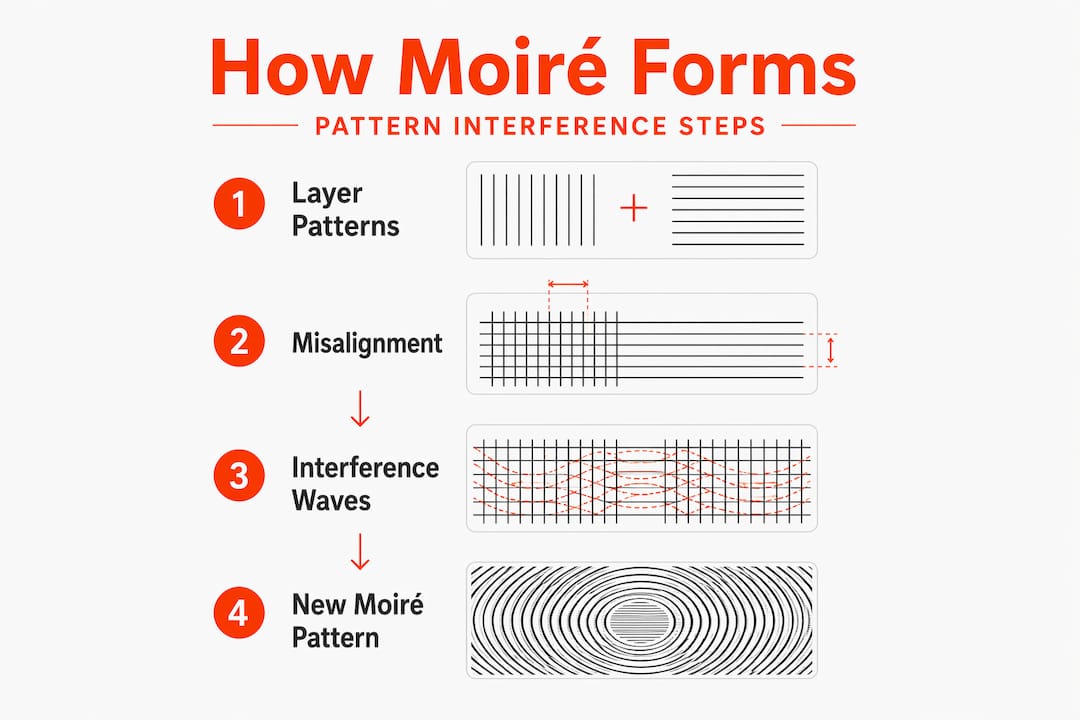
At its core, the moiré effect is a wave interference pattern created when two similar repetitive structures are superimposed with a slight difference in rotation, displacement, or spacing. Neither pattern alone produces the effect. It only appears when the two interact.
Think of it like two identical combs placed on top of each other. When their teeth line up perfectly, you see straight lines. Rotate one comb just slightly, and an entirely new pattern emerges between the teeth. That emergent pattern, with its sweeping curves and optical weight, is moiré.
The physics behind it involves constructive and destructive wave superposition. Where peaks from one pattern align with peaks from another, the visual signal is amplified, creating bright or dark bands. Where peaks meet troughs, they cancel each other out. The result is large visible interference patterns that dwarf the scale of the original individual grids or lines.
This is why slight variations matter so much:
What makes moiré so striking is that it is not a feature of either original pattern. It is an emergent property of their interaction. That makes it genuinely counterintuitive. You take two orderly, uniform structures, combine them imperfectly, and get something that looks almost organic and unpredictable.
Moiré is not just a photographic accident. In textiles, it is a deliberately crafted luxury finish with centuries of history behind it. The word itself comes from the French term for “watered,” and the visual effect lives up to that description perfectly: moiré fabric has a rippled, liquid quality that shifts as the light changes.
Traditional moiré textiles are produced through a process called calendering. Two wet layers of ribbed fabric, often silk, cotton, or rayon, are pressed together under heat and high pressure through engraved metal rollers. The pressure physically alters the fiber alignment and surface texture, creating the characteristic tone-on-tone striations that catch and reflect light differently at every angle.
The cost reflects the complexity. Producing a moiré finish adds roughly 15 to 20% to production costs due to the specialized equipment and careful handling required. That is why moiré fabric consistently appears in couture, formal wear, and high-end home furnishings rather than budget textiles.
Here is how moiré fabric compares to two other premium textile finishes:
| Finish | How it is made | Visual character | Typical uses |
|---|---|---|---|
| Moiré | Calendering two ribbed layers under heat | Rippled, watery, light-shifting | Evening wear, drapery, ribbons |
| Velvet | Cut pile woven on a loom | Deep, directional sheen | Upholstery, formal fashion |
| Satin | Float weave with long warp threads | Smooth, high-gloss surface | Lining, bridal, activewear |
Moiré fabric in luxury textile applications often uses silk as the base material because silk’s natural luster amplifies the rippled pattern best. Synthetic blends using rayon or polyester are more affordable but can produce a flatter, less dynamic version of the effect.
Pro Tip: When buying moiré fabric for sewing projects, move the bolt under different lighting angles before purchasing. The ripple effect changes dramatically depending on whether the light source is overhead or raking across the surface. What looks subtle on a shelf can be stunning under directional light.
This is where moiré shifts from luxury to frustration. When a digital camera sensor captures a scene that contains fine repetitive patterns, including fabric weaves, window screens, fence wire, or the pixel grid of a monitor, moiré appears as wavy or rainbow-colored artifacts that look nothing like the original subject.

The cause is the same interference principle described above, applied to digital resolution. The sensor itself is a grid of tiny photosites arranged in a regular pattern. When the repetitive pattern in the scene and the sensor grid are close in frequency but slightly misaligned, they interact and produce moiré. The camera is not broken. It is just doing exactly what physics demands.
Common scenarios where moiré appears in photography:
Reducing moiré in digital imaging takes a combination of approaches. Optical low pass filters built into some cameras apply a slight blur to the sensor data before it is processed, which reduces interference but also softens fine detail slightly. Many photographers consider this a worthwhile trade-off for documentary and portrait work, though landscape and product photographers often prefer cameras without them.
Beyond the hardware, your technique matters more than most people realize:
Pro Tip: If you shoot fashion, always photograph fabric samples at different distances before the main shoot. The moiré sweet spot where interference kicks in is often surprisingly specific, and knowing it in advance saves you hours in post-production.
Not everyone is trying to eliminate moiré. For a significant strand of visual art and design history, moiré is the entire point.
The Op Art movement of the 1960s, driven by artists like Bridget Riley and Victor Vasarely, deliberately exploited the optical instability of overlapping grids and lines. Their work made flat, static canvases appear to pulse, vibrate, and shift. Moiré interference patterns were not bugs in those works. They were the mechanism producing the visual excitement.
What makes this especially interesting is the optical moiré speedup effect. When two overlapping layers move relative to each other, the moiré pattern they generate moves faster than either layer does physically. This creates the perception of accelerating motion from a slow, controlled physical movement, which is deeply counterintuitive and endlessly useful for kinetic artists and interactive designers.
Contemporary uses of intentional moiré in art and design include:
The key insight that designers who embrace moiré all seem to share is this: moiré is not a random error. It is a predictable physical phenomenon. Once you understand what causes it, you can engineer it to do exactly what you want. That reframing, from flaw to tool, is what separates designers who fight moiré from those who harness it.
For anyone working with luxury interior textiles, moiré fabric’s built-in visual dynamism means you get movement and depth without needing pattern variety. A single moiré drapery panel in a neutral colorway does optical work that a flat fabric cannot.
I came to moiré the way most photographers do. As a problem. I photographed a checked blazer once for a product shoot, and the resulting images had this nauseating rainbow shimmer across the chest that made the fabric look like a special effect gone wrong. I spent an hour in post-production trying to fix it before I understood what I was actually looking at.
What changed my perspective was working alongside textile designers who talked about moiré with something close to reverence. They described the calendering process like alchemy. Two ordinary layers of ribbed cloth pressed together under enormous heat and pressure, and something emerges that neither layer possessed alone. That description made the physics feel less like a problem and more like a discovery.
My honest advice: learn the interference principle once, and moiré stops being mysterious in any context. In photography, you will immediately start seeing which scenes are high-risk before you shoot, saving real time. In textiles, you will recognize the quality markers that separate authentic calendered moiré from cheap printed imitations. In design, you will start noticing the effect in logos, packaging, and generative art that you previously glossed over.
The frustrating version and the beautiful version of moiré are the same phenomenon. How you encounter it just depends on which side of the camera or loom you are standing on.
— kev
If reading about moiré has you thinking about incorporating this effect into your own projects, the next step is getting your hands on the real thing. Printed moiré imitations are everywhere, but authentic calendered moiré fabric has a light-shifting quality that no flat print can replicate.

Fabric-fabric carries a curated selection of luxury fabrics including genuine moiré finishes suited for drapery, formal wear, and statement home decor. Browse the backdrop fabric collection for moiré options that bring dramatic visual texture to photography and interior design setups. For upholstery, curtaining, and soft furnishings, the home decor fabric range includes premium finishes sold by the yard with detailed usage guidance. Real moiré fabric is worth touching before you sew it. Fabric-fabric makes that possible.
Moiré in photography occurs when the repetitive pattern in the scene, such as fabric weave or screen pixels, conflicts with the digital sensor’s own pixel grid. The two patterns interfere and produce rainbow or wave-like artifacts in the final image.
Moiré is not harmful to your camera or lens. It is a visual artifact caused by pattern interference and only affects the appearance of the captured image, not the hardware itself.
Moiré fabric is created by pressing two wet layers of ribbed textile through heated rollers under high pressure, a process called calendering. This physically reshapes the fibers to create a rippled, waterlike surface that reflects light differently at every angle.
Yes. Most professional photo editing applications include moiré reduction tools that target the specific frequency of the interference pattern. Results are best when the artifact is caught early in the raw processing workflow before heavy compression is applied.
Silk produces the most striking moiré finish because of its natural luster, but cotton, wool, and rayon blends are also commonly calendered. Synthetic versions are less expensive but tend to have a flatter, less dynamic ripple effect than natural fiber moiré.