

 US Dollar

What Is Houndstooth? Pattern, History, and Style Guide
Posted by BLG on 2026 May 28th
Posted by BLG on 2026 May 28th


TL;DR:
- Houndstooth is a woven geometric pattern characterized by jagged, four-pointed shapes, originating in 19th-century Scotland. It has transitioned from Scottish working-class wear to a versatile fashion and interior pattern, appreciated for its scale and color flexibility. The pattern’s enduring popularity results from its timeless appeal, adaptability, and ability to add sophistication without excess complexity.
You’ve seen it a hundred times without knowing its name. That sharp, repeating two-tone check on a blazer collar, a throw pillow, or an upholstered headboard. What is houndstooth, exactly? It’s one of textiles’ most recognized patterns, yet most people can’t name it on sight. This guide covers everything from its precise definition and Scottish origins to how you can wear it confidently and use it in your home without overwhelming a room.
| Point | Details |
|---|---|
| Pattern, not just fabric | Houndstooth is a woven design motif that appears on many different fiber types and textile bases. |
| Scottish working-class roots | The pattern originated with 19th century Scottish shepherds before crossing into high fashion. |
| Scale changes everything | Smaller repeats read as subtle texture; larger repeats make bold graphic statements in both fashion and interiors. |
| Pairs best with solids | Mixing houndstooth with solid colors prevents visual competition and keeps outfits and rooms balanced. |
| Still very much in style | Designers continue to reinterpret houndstooth in new colorways and scales, keeping it current and versatile. |
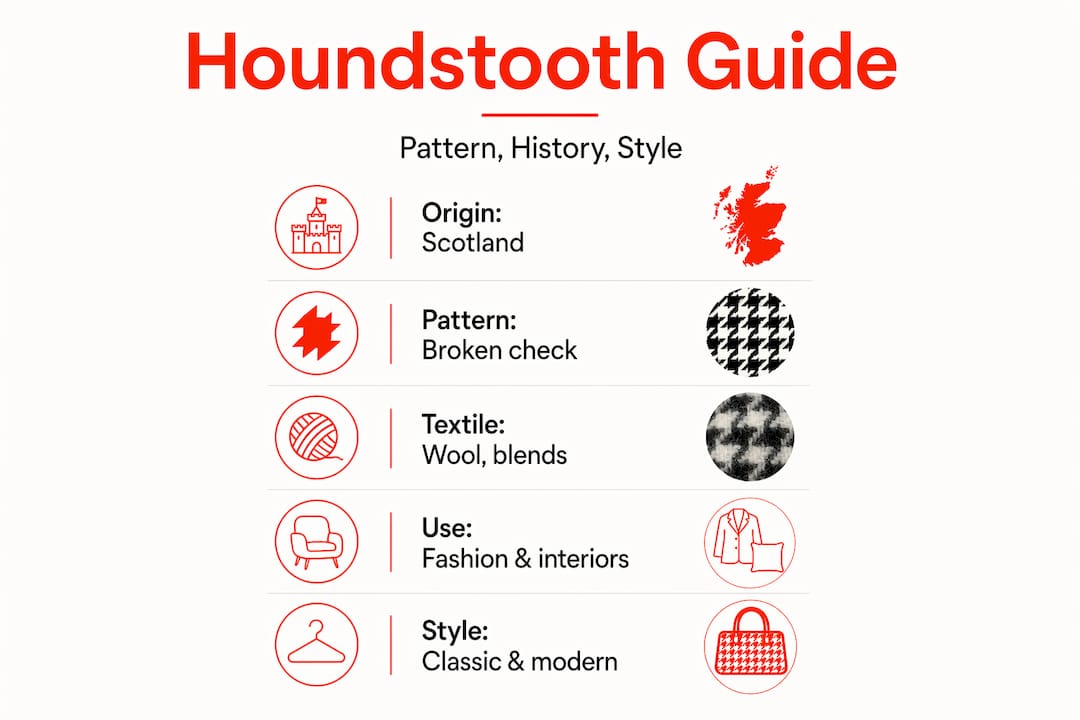
Houndstooth is a geometric, broken-check pattern built from four-pointed, jagged shapes that interlock and repeat across a surface. The name comes from a simple visual truth: each unit resembles the sharp, angular tooth of a dog. In French, it goes by “pied-de-poule,” which translates to “hen’s foot,” and the two names together capture the organic, creature-like sharpness of the design.
The key thing to understand is that houndstooth is a pattern, not strictly a fabric. It is a woven design motif that can appear on wool, cotton, polyester blends, and even synthetic performance textiles. The design itself is defined by the visual structure, not the fiber underneath it. This distinction matters when you’re shopping for material or spec-ing a project, because the performance of a houndstooth textile depends heavily on what it’s woven from.
Traditionally, the pattern is produced through twill weave construction, where alternating groups of dark and light warp and weft threads interlock to create the jagged geometry. This is not a print layered on top of the fabric. The pattern is built into the weave itself, which gives it a crispness and depth that flat-printed imitations never quite replicate.
Here’s a quick breakdown of the most common houndstooth configurations you’ll find at retail:
Pro Tip: When shopping for houndstooth fabric, always ask whether the pattern is woven or printed. Woven houndstooth looks the same on both sides of the cloth, while a printed version will show a faded reverse. Woven versions generally hold up better through washing and heavy use.
The history of houndstooth begins in rural Scotland during the 1800s. Shepherds and outdoor workers wore it because durable wool cloth with a broken two-tone pattern was practical. The high-contrast geometry helped disguise dirt and wear in a way that solid-colored fabric could not. It was a working-class textile, built for function first.

What makes the pattern culturally interesting is its relationship to tartan. While Scottish tartan patterns belonged to specific clans and carried inherited identity, houndstooth symbolized balance and democratic textile tradition. Anyone could wear it. The light and dark threads woven together also reflected broader Celtic themes of duality and harmony. No clan affiliation, no social gatekeeping. Just a strong, well-made cloth.
The shift from working class to fashionable happened gradually through the late 19th and early 20th centuries:
“The transformation of houndstooth from utilitarian wear to a fashion symbol illustrates how cultural adoption shapes textile meaning and popularity.”
The houndstooth pattern meaning has always carried a subtle tension between formality and practicality. That duality is precisely why it has lasted. It looks polished without trying too hard, which is a difficult balance for any pattern to strike.
Knowing how to wear houndstooth well comes down to three decisions: scale, color pairing, and garment type. Get those right and the pattern works across seasons and dress codes.
Garment types that carry houndstooth best:
Color combinations beyond black and white are increasingly common in modern houndstooth fashion styles. Camel and chocolate, cobalt and ivory, and even tonal versions where both shades share the same color family have appeared consistently in recent seasons. Tonal houndstooth is particularly worth knowing about because it reads as subtle texture rather than graphic pattern, making it easier to mix with other printed pieces.
Pro Tip: Avoid mixing houndstooth with other bold geometric patterns in the same outfit. Stripes are the one exception. A fine houndstooth with a widely spaced stripe can work if the two patterns are very different in scale.
The question of whether is houndstooth still in style has a clear answer: yes. It has appeared in designer collections consistently for decades and shows no sign of disappearing. The pattern’s adaptability across scales, colorways, and garment types keeps it relevant regardless of the season’s dominant aesthetic.
Interior designers use houndstooth differently than fashion designers do, but the core rules are the same. Scale matters, contrast matters, and pairing with solids prevents visual overload.
The most common applications in interiors include upholstered furniture, throw pillows, curtain panels, area rugs, and headboards. Houndstooth works particularly well in upholstery when combined with solid-colored fabric on the same piece, such as a bench with a houndstooth seat and solid sides. This approach introduces graphic interest without saturating a room with pattern.
Here’s a practical comparison for choosing scale in interior projects:
| Scale | Best use | Visual effect | Caution |
|---|---|---|---|
| Micro | Accent pillows, drapery | Reads as texture | Can get lost at distance |
| Mid-scale | Chair upholstery, ottomans | Clear pattern identity | Needs solid counterparts |
| Macro | Feature sofas, headboards | Bold graphic statement | Requires careful placement |
Fabric texture also changes how houndstooth reads in a room. A wool or tweed base gives the pattern a warm, tactile presence that suits traditional or transitional interiors. A cotton or linen blend in the same pattern reads as crisper and more contemporary. Velvet houndstooth creates a luxurious, dimensional effect where the pile shifts the contrast under changing light conditions. Understanding how geometric patterns complement hard surfaces like stone counters, wood floors, and metal hardware helps you place houndstooth textiles where they add warmth without clashing.
Pro Tip: Always test a fabric sample in the actual room before committing to upholstery. Houndstooth appears differently under various light conditions, and natural daylight versus evening lamplight can make the same fabric read as bold or nearly neutral.
The reason twill weave produces such sharp, architectural edges in houndstooth is structural. The warp and weft threads are grouped in sets of four, and as each group crosses over or under its counterpart, it produces the angled, jagged tooth shape rather than a smooth line. The result is a pattern that has dimension and crispness that no flat print can recreate. This also means the fabric has a slight diagonal texture to the hand, which tailors have long valued for how it drapes.
Scale and repeat alignment heavily influence construction quality in both tailored garments and upholstered furniture. Mismatched repeats at seams break the visual flow of the pattern and signal poor workmanship. In a well-made houndstooth jacket, the repeat continues across chest seams and lapel edges without interruption. In upholstery, this requires careful yardage planning and precise cutting.
Different fiber choices affect durability and texture significantly. Wool houndstooth is the most traditional and offers excellent resilience. Cotton blends are lighter and washable, making them better for home textiles in high-use rooms. Synthetics like polyester offer the lowest cost but sacrifice the tactile richness that makes the pattern feel premium. If you want to understand how the weave construction compares to other fabric types, Fabric-fabric has a useful breakdown of knit versus woven fabrics that puts the structural differences in plain terms.
I’ve worked with hundreds of fabric patterns across apparel and interiors, and houndstooth is one I return to more than almost any other. Not because it’s trendy, but because it solves problems. It adds visual weight without heaviness. It reads as sophisticated without requiring a formal context. And it works at almost any scale if you approach it with intention.
The confusion between “houndstooth the pattern” and “houndstooth the fabric” is something I see come up constantly, even among experienced designers. People expect the same performance from every houndstooth textile because they think they’re buying a type of fabric. They’re actually buying a design motif on a substrate that could be anything from heavy wool to thin polyester. That distinction changes every decision that follows, from care instructions to seam finishing to durability expectations.
What I find most interesting about the pattern is that its origins as a democratic, non-clan alternative to tartan still feel relevant in how designers use it today. It doesn’t announce allegiance to a trend or a tribe. It just works. My practical advice: if you’re new to it, start with a mid-scale version in a non-traditional color. Something like dusty rose and ivory or slate and camel lets you experiment with the pattern’s geometry without committing to the high-contrast drama of black and white. Once you understand how it behaves in a space or on a body, you can push toward bolder choices with confidence.
— kev
Whether you’re tailoring a statement jacket or reupholstering a reading chair, the fabric underneath the pattern determines everything. Fabric-fabric carries an extensive selection of textiles that work beautifully with geometric patterns like houndstooth.

Browse the home decor fabric collection for upholstery-weight options in houndstooth and complementary solids, perfect for furniture projects and accent pieces. If you need something with more visual drama for a backdrop or fashion project, the backdrop fabric range offers bold pattern options that photograph and drape well. Fabric-fabric also covers the full range of textile types for apparel and crafts, with clear descriptions and usage notes so you can match the right fabric to your specific project without second-guessing.
Houndstooth is a geometric, broken-check pattern made from interlocking four-pointed shapes in a two-tone, high-contrast design. It is a woven pattern motif rather than a specific fabric type, and it can appear on wool, cotton, and synthetic textile bases.
Houndstooth originated in 19th century Scotland, where shepherds and outdoor workers wore it as durable wool cloth. It later spread into aristocratic sporting dress and eventually became a signature pattern in global fashion and interior design.
Yes. Houndstooth has appeared in designer collections consistently for decades and remains widely used in suiting, outerwear, accessories, and home decor. New colorways and scaled variations keep it current across fashion seasons.
Pair houndstooth with clean solid colors and choose a scale that fits the formality of the occasion. Micro-scale reads as a quiet texture in office settings, while macro-scale makes a bold statement in casual outerwear. Avoid pairing it with other busy geometric patterns.
Houndstooth uses interlocking jagged four-pointed shapes in a two-tone design, while plaid is a crosshatch of horizontal and vertical stripes in multiple colors. The two patterns have distinct construction methods and visual effects, though both have Scottish textile roots.