

 US Dollar

Choose the Right Twill: 9 Fabrics Sewists and Designers Should Know
Posted by BLG on 2026 Aug 29th
Posted by BLG on 2026 Aug 29th

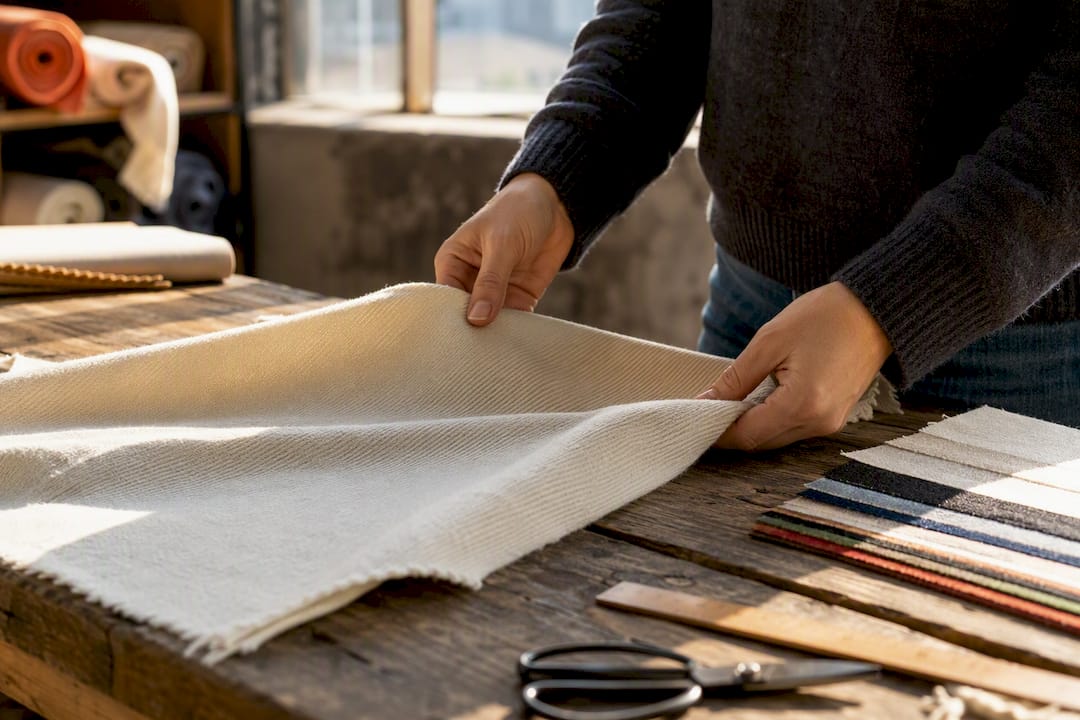
Twill is a weave where the weft crosses over and under warp threads in a staggered pattern, producing a diagonal rib called a wale. What separates one type from another comes down to four variables: float length, which side faces out, the direction of the diagonal, and whether that diagonal runs straight or breaks into a pattern. Get those four right and you can predict how a fabric will drape, wear, and age before you ever touch a swatch.
TL;DR:
- Warp-faced twills like denim have a longer float length that enhances abrasion resistance but can lead to torque issues after washing.
- Denims are almost always 3/1 right-hand twill with indigo-dyed warp yarns, causing uneven fading in stress points during wear.
- Heavier twills (300 GSM and up) are best suited for upholstery and bags, while midweight (150-300 GSM) works for pants and jackets.
- Broken twills like herringbone avoid torque by reversing diagonal direction at intervals, making them more stable for tailored garments.
- Proper finishing processes such as sanforization and mercerization alter feel and durability but do not change the weave structure.
Every twill starts with a float, a stretch where one thread skips over several others instead of alternating one-up-one-down like a plain weave. Shift that float over by one thread on each successive row, and the eye reads a continuous diagonal line, the wale, running across the cloth. Steeper wales come from tighter offsets and finer, denser yarns; flatter wales come from wider spacing.
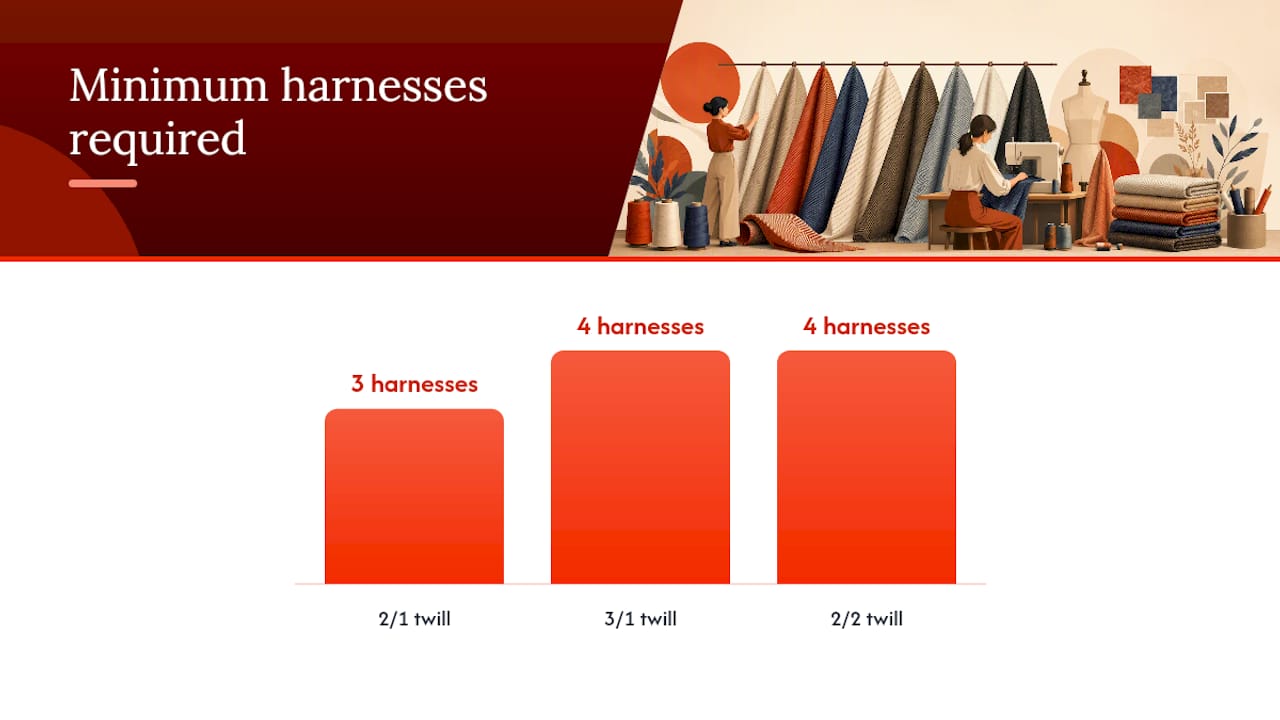
Weavers describe this with a fraction, like 2/1 or 3/1. According to the standard notation explained on Wikipedia’s twill entry, the top number is how many warp threads float over the weft before diving under, and the bottom number is how many weft threads it goes under before floating again. Add the two numbers together and you get the minimum number of harnesses the loom needs to weave it.
A few examples make this concrete:
Direction matters too. A right-hand twill runs the diagonal from lower left to upper right; a left-hand twill runs the opposite way. It’s a construction detail, not a cosmetic one, since it changes how the fabric behaves under stress, which comes up again in the section on torque below. For a broader primer on how these structures compare to plain and satin weaves, our guide on what is twill fabric breaks down the basics further.
Once you know how the diagonal forms, the next question is which face of the cloth carries the most yarn, because that decision drives sheen, stability, and hand feel. Textile classification splits twills into a handful of practical families, each suited to a different job.
According to the taxonomy laid out by Textile School, these categories aren’t just academic. A designer picks warp-faced construction for jeans because the exposed warp yarn is what fades and wears in that classic denim way. A tailor picks balanced twill for suiting because it holds its shape and doesn’t develop a shiny face after months of wear. The class you choose is really a decision about which surface, and which kind of durability, the finished piece needs.
Textile classification is useful, but nobody shops by weave fraction. Here’s how the structural categories above map onto the names you’ll see on a bolt or a product page.
As the reference on twill weave from CAMEO/MFA notes, most of these names describe a construction and a typical fiber base at once, cotton for denim and chino, wool for serge and cavalry twill, so knowing the name usually tells you both. For a deeper look at the cotton-based twills specifically, see our breakdown of cotton twill’s properties and uses.
The diagonal isn’t decorative. It changes measurable mechanical behavior, and that’s where twill earns its reputation as the workhorse weave.
By the numbers: A study comparing 100% cotton fabric structures found twill weaves consistently scored higher on abrasion resistance (wear index) than plain weave, while plain weave often came out ahead on tensile strength under the same test conditions. Neither weave wins across the board. It’s a trade-off, and the right choice depends on whether the fabric’s biggest enemy is friction or a straight pull.
That trade-off traces back to float length. Longer floats mean fewer interlacements per square inch, which lets yarns lie flatter and closer together, so more surface area distributes abrasive contact instead of concentrating it on a few tight crossing points. The same longer floats also give twill its characteristic drape, since fewer interlacements mean less resistance to bending. A review of weave structure effects on fabric properties backs this up, tying float length and interlacement frequency directly to differences in stiffness, tearing strength, and drape across weave families.
A few practical patterns to know:
Broken twills like herringbone sidestep that torque problem by reversing direction at intervals, which cancels out the twisting force panel by panel. It’s a structural fix, not a finishing trick, and it’s a big reason herringbone shows up in tailored garments that need to hang straight wash after wash.
Picking a twill isn’t about finding the “best” one. It’s about matching float length, face, and weight to what the finished piece has to survive.
Run through this before you buy:
For jeans and chinos, stick with warp-faced cotton twill. For suiting and coats, balanced or broken twill wins on shape retention. For upholstery and bags, reach for heavyweight cotton or cotton-blend twill with a tight weave, since that’s where abrasion resistance matters most over years of use. Our fashion fabric checklist walks through matching weight and hand to a specific pattern if you want the fuller version of this checklist.
Pro Tip: Always order a physical swatch before committing to yardage. Photos flatten drape and sheen, and a twill that reads “crisp” on screen can feel stiff or papery in hand. Our swatch selection guide covers exactly what to check for once the sample arrives.

The weave sets the structure, but finishing decides the final hand and how the fabric behaves in daily use. A few processes come up constantly with twill:
None of these change the underlying weave fraction, but they change everything about how the fabric feels off the bolt and how it ages over months of wear.
Fabric-Fabric’s product pages list the specs that actually matter for twill: fiber content, weight, and often the weave notation itself, so you can confirm a “twill” listing is the construction your project needs rather than a marketing label. If a listing calls out 3/1 right-hand cotton twill, you’re looking at denim-family construction, not the balanced 2/2 twill you’d want for a soft-draping skirt.
Before ordering yardage, request or order a swatch through the site’s sample service and check it against your project checklist: weight, hand, and finish. Our roundup of seven twill fabric types is a good next stop if you want project-specific examples pulled straight from the catalog. Twill decorates well too. If your project involves embroidery or tackle twill lettering, this guide to twill and decoration methods explains which constructions hold stitching best.
Most guides oversell the idea that there’s one “correct” twill for a given project. There isn’t. There’s a trade-off between abrasion resistance, drape, and torque, and every twill sits somewhere on that spectrum. The mistake I see most often is buyers chasing weight numbers alone, assuming heavier always means tougher, when float length and yarn twist matter just as much for how a fabric actually holds up.
Here’s the three-step checklist worth following every time: order a swatch first, verify the weight and finish match what the listing claims, then wash-test before cutting into yardage. Skipping the wash test is how people end up with a herringbone jacket that shrinks or a “sanforized” twill that didn’t fully deliver. Balancing looks against function isn’t a compromise. It’s the entire job.
— kev
Fabric-Fabric sells twill by the yard with the fiber content, weight, and construction notes you need to buy with confidence, no guessing from a product photo alone. If your project calls for something heavy enough to hold structure across a large surface, the backdrop fabrics category carries twill and heavyweight options built for exactly that kind of durability.
If you’re outfitting a room instead of a wardrobe, the home decor fabric collection includes twill variants finished for upholstery-grade wear. Either way, the smart move is the same one covered above: order a swatch, check it against your project’s weight and drape requirements, then commit to yardage once you’ve confirmed the hand feels right in person.