

 US Dollar

How to manage textile orders efficiently: a step-by-step guide
Posted by BLG on 2026 May 13th
Posted by BLG on 2026 May 13th


TL;DR:
- Most textile order chaos stems from skipped steps, vague specifications, and late QC checks, not supply issues.
- Implementing a structured, end-to-end workflow with clear documentation and recurring communication prevents costly delays and errors.
Mismanaged textile orders are a quiet profit killer. A delayed shipment, a wrong fabric weight, a missed MOQ clause — any one of these can stall an entire production run, disappoint clients, and eat into margins you can’t afford to lose. For small apparel brands and home decor businesses, the margin for error is razor thin. The good news: order chaos is almost always preventable. This guide walks you through every stage of the textile order process, from the first supplier inquiry to final delivery, so you can build a workflow that protects your business and your reputation.
| Point | Details |
|---|---|
| Structure is crucial | Managing textile orders end-to-end with clear milestones reduces chaos and errors. |
| Prep protects budgets | Clarifying specs and agreements upfront prevents costly surprises later. |
| Communication prevents delays | Coordinating with suppliers and tracking inventory keeps orders on schedule. |
| QC saves profits | Quality checks at key points prevent last-minute defects and compliance issues. |
| Upgrade with growth | Start with simple tools, then scale up to OMS or ERP as your order volume increases. |
With the stakes established, let’s see what a well-managed textile order workflow actually looks like.
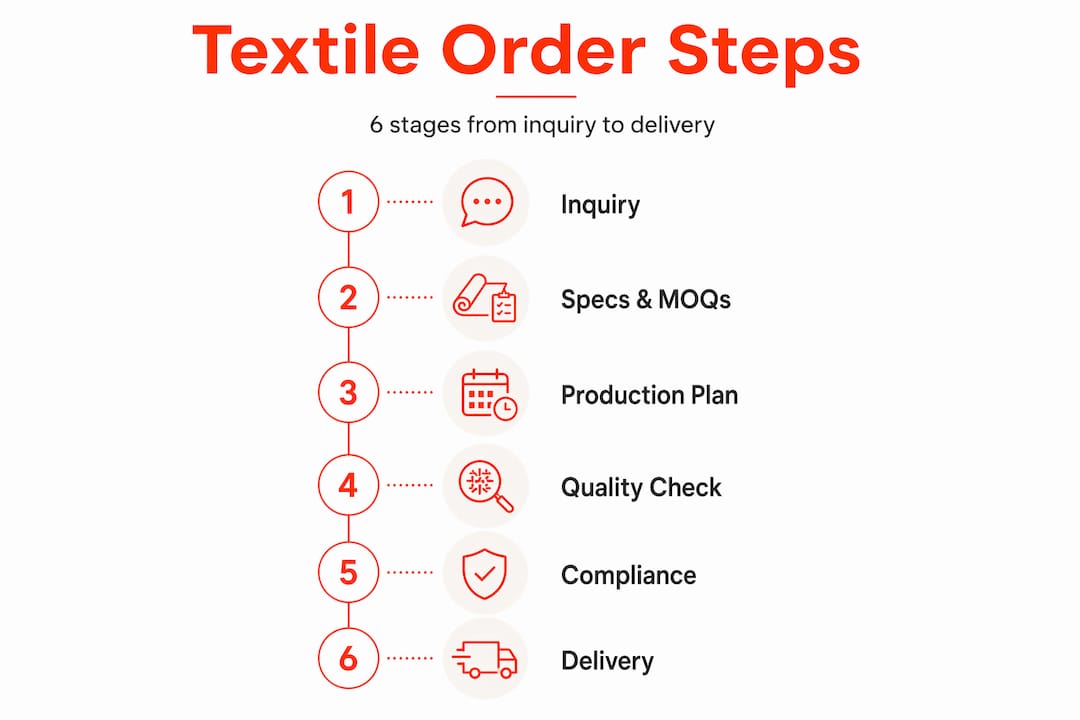
Most small business owners think of textile ordering as a two-step process: pick a fabric, place an order. In reality, managing textile orders as an end-to-end lifecycle involves six interconnected stages, each one feeding into the next. Skipping even one creates compounding problems downstream, not just minor inconveniences.
The six core stages are:
The mindset shift here is important. Each stage is not a separate task—it’s a checkpoint with inputs from the previous stage and outputs that the next stage depends on. When you understand the fabric ordering steps as a connected chain, you stop treating order problems as bad luck and start treating them as process gaps.
Pro Tip: Map your six stages on a single shared document before you place your next order. Even a basic Google Sheet with stage names, owners, and due dates turns an abstract process into an actionable workflow.
| Stage | Key output | Risk if skipped |
|---|---|---|
| Inquiry and sampling | Approved sample on file | Wrong fabric delivered |
| Order confirmation | Signed purchase order | Price or quantity disputes |
| Material procurement | Confirmed lead times | Production delays |
| Production scheduling | Milestone timeline | Missed delivery dates |
| QA and approval | Inspection sign-off | Defective goods shipped |
| Dispatch and documentation | Complete compliance file | Customs holds or fines |
Once you understand the lifecycle, focus on preparing your order so it’s set up for success.
The single biggest source of order errors is a vague or incomplete brief. Before you confirm any order, your product specifications should be locked in a versioned tech pack that includes fabric composition, weight, color codes, finish requirements, and any care or labeling instructions. When specs are updated verbally or through informal messages, versions get mixed up and suppliers produce to the wrong standard. Number your tech packs. Track changes. Treat them like legal documents.
Minimum Order Quantities (MOQs) are a common trap for growing businesses. Many fabric suppliers set MOQs that make sense for large manufacturers but are financially risky for small teams testing new product lines. The practical solution: negotiate MOQ terms with trial quantities and written agreements built into your contract before production starts. A pilot run of 50 units may cost more per unit, but it protects you from committing to 500 units of a product that doesn’t sell or fit your quality standard.
When it comes to tools, there’s a real difference between what a five-person team needs and what a growing brand with multiple SKUs needs. Here’s a practical comparison:
| Team size | Recommended tool | What to track |
|---|---|---|
| 1 to 5 people | Spreadsheet or checklist | Specs, supplier contacts, timelines, payments |
| 5 to 20 people | Lightweight OMS or project tool | Style/color breakdowns, scheduling, billing |
| 20 or more people | Integrated OMS or ERP | Allocation, shipment tracking, reporting |
A proper order management system for apparel should cover style and color breakdowns, work-order generation, scheduling, allocation, billing, and shipment tracking. If you’re not there yet, a detailed checklist with version control can cover most of the same ground.
Your order preparation checklist should always include these four core documents:
Spending an extra day on preparation at this stage saves weeks of back-and-forth during production. When you’re sourcing textile suppliers or in the process of selecting fabric suppliers, always ask for their standard order form and cross-reference it with your own checklist before signing anything.
Pro Tip: Include a revision clause in your supplier agreement that specifies how spec changes are handled and who bears the cost of material already cut. This one clause has saved brands thousands of dollars in disputed charges.

With a solid order brief and plan, the next step is execution: managing production and inventory with structure and visibility.
Production delays rarely come out of nowhere. They build gradually — a fabric shipment arrives three days late, a sewing line shifts to a priority order, a notions supplier runs short. By the time you hear about it, you’ve already missed your ship date. Preventing this requires structured production milestones and recurring communication with your suppliers, not just a phone call when something goes wrong.
A practical production timeline for a standard apparel run looks like this:
| Milestone | Target timing |
|---|---|
| Fabric arrival at factory | Day 1 to 3 |
| Pre-production sample approval | Day 4 to 7 |
| Cut and sew begins | Day 8 |
| Mid-production inspection | Day 14 to 16 |
| Finishing and packaging | Day 20 to 22 |
| Pre-shipment inspection | Day 23 to 25 |
| Goods dispatched | Day 26 to 28 |
Schedule weekly or biweekly check-ins with your production contacts. These don’t need to be long, but they need to happen consistently. Structured production timelines and recurring supplier communication with contingency planning for logistics and capacity constraints are the most reliable way to avoid order delays.
Inventory management is equally critical. If you’re selling finished goods while fabric is still in production, you need a single source of truth to track what’s allocated, what’s available, and what’s on order. Centralizing inventory and channel allocation reduces the operational friction that causes oversells and fulfillment errors. Whether you use an OMS, ERP, or a carefully maintained spreadsheet, the rule is the same: one system, always up to date. Avoid updating inventory in multiple places.
“The brands that consistently hit delivery windows are the ones that treat communication as part of the production process, not a reaction to problems.”
Always have a contingency plan for your two biggest failure points: logistics and capacity. Which carrier do you shift to if your primary carrier has a delay? Which supplier can handle overflow if your main factory hits capacity? Knowing the answers before you need them is what separates a well-run brand from one that scrambles every season.
It’s also worth noting that better coordination directly supports more sustainable production. The environmental impact of fast fashion is significantly worsened by overproduction and waste. When your ordering process is tight, you order exactly what you need, reduce excess inventory, and cut down on returns and disposals. A well-managed procurement workflow guide is not just good business; it’s responsible practice. Use your fabric inventory planning data to fine-tune order quantities each season.
Smooth execution doesn’t end with production. Every order must clear quality checks and compliance to avoid full-scale problems downstream.
Quality control is not a final step. It’s a series of repeatable checkpoints embedded throughout the order. Treating QC as a checkpoint process that includes pre-production and pre-shipment inspections gives you the best chance of catching problems before they become expensive. Here’s how to structure it:
Your compliance documentation file for each order should contain:
Import and export textile compliance requires this documentation to be complete and consistent. Missing or incorrect documents can trigger customs holds that delay your delivery by weeks. For export orders, especially to regulated markets, consider engaging a third-party inspection agency. These agencies provide objective, documented sign-off that protects you legally and operationally if a quality dispute arises.
Pro Tip: Create a compliance file template for each market you sell into. List every required document by name, responsible party, and deadline. Attach it to every order record so nothing gets missed under pressure.
Brands that skip early QC checkpoints and rely only on pre-shipment inspection consistently face the same outcome: defects are discovered too late to fix without delaying the order or absorbing the cost of rework. Early-stage fabric quality assessment is the most cost-effective point to catch material issues.
After all steps are tightly managed and quality-checked, smart businesses focus on continuous improvement and scaling up efficiently.
The right tech tool for your business depends entirely on your order volume and team size, not your aspirations. Too many small brands invest in expensive ERP systems before they’ve outgrown a spreadsheet, while others stay on spreadsheets long after they’ve become a liability. Here’s a straightforward comparison:
| Solution | Best for | Limitations |
|---|---|---|
| Checklist or spreadsheet | Under 50 orders per month | Manual updates, error-prone at scale |
| Lightweight OMS | 50 to 200 orders per month | May lack deep production tracking |
| Integrated ERP or OMS | 200 or more orders per month | Higher cost, longer implementation |
The performance metrics that matter most for textile order management are lead time, on-time delivery rate, and data error rate. ERP and tech-enabled systems for fashion textiles often benchmark improvements such as a 20 to 30 percent reduction in order-to-dispatch lead time, on-time delivery rates rising to 88 to 95 percent, and an 80 to 90 percent reduction in data entry errors. These are achievable targets, even for small teams, once you have consistent tracking in place.
Start by measuring your current performance. If you don’t know your average lead time or on-time delivery rate, begin there. Track every order for one season before adding new tools. Then set realistic targets based on your baseline. For brands scaling their bulk ordering strategy, these KPIs become essential for negotiating supplier terms and forecasting cash flow accurately.
The most important metric to watch is error rate. A single mispicked fabric or incorrect quantity consumes far more time and money than the cost of the original order. Build a brief post-order review into each cycle. Note what went wrong, why it happened, and what step in the workflow would have caught it earlier. This review habit compounds over time into a genuinely optimized process.
Here’s what years of working in fabric supply chains make clear: the vast majority of order disasters are not caused by bad suppliers, unreliable shipping, or market volatility. They’re caused by skipped steps, vague specs, and QC checks that happen too late to change anything. The chaos is self-inflicted, and that’s actually great news, because it means you can fix it.
The most common pattern goes like this: a brand rushes an order because a deadline is close, skips the pre-production sample step to save time, and then receives 500 meters of fabric in the wrong shade because a color code wasn’t confirmed in writing. That’s not supplier failure. That’s a process gap at the confirmation stage.
Even the smallest brand with two people managing orders can run a structured workflow. You don’t need an ERP, a full-time supply chain manager, or expensive software. You need a shared tracker, a consistent checklist, and the discipline to follow both on every order. The process-driven order management approach described in this guide works at any scale because it’s built around clarity, not complexity.
The counterintuitive insight is this: technology is not the solution to order chaos. Structure is. An ERP system running on unclear specs and inconsistent communication will still produce delays. A Google Sheet with clear ownership, version-controlled specs, and a genuine QC checkpoint will outperform expensive software every time. Upgrade your process first, then your tools.
Trial runs and pilot orders are massively underused by growing brands. Before committing to a full production run with a new supplier, place a small order, run the full inspection process, and document every friction point. The cost of a pilot is almost always less than the cost of discovering problems at full scale.
Ready to put this order management approach into action? Here’s how to take the next step with fabrics that match your vision.
Applying a structured order process only works when you have quality materials to work with. At fabric-fabric.com, the selection is built with decorators, apparel brands, and production-focused buyers in mind.
Explore backdrop fabrics for event, photography, and display projects that need consistent color and drape in production-ready quantities. For interior and soft furnishing projects, the home decor fabric collection covers upholstery weights, drapery materials, and decorative textiles with clear product specs and usage guidance. Flexible order quantities make it easier to test new materials before scaling up, which fits perfectly with the pilot-first approach outlined in this guide. Browse by use, weight, or material type to find exactly what your next production run requires.
Delays usually happen because of inadequate production planning or missed communication with suppliers. Structured production timelines and enforced supplier communication with contingency planning are the most reliable prevention.
Use a tracker or OMS with a single source of truth for inventory to prevent double-selling and discrepancies. Centralizing inventory and channel allocation reduces the operational friction that causes oversells.
Check fabric quality before cutting and inspect finished goods pre-shipment to ensure compliance and reduce defects. Treating QC as a checkpoint process with at least pre-production and pre-shipment inspections covers the most critical risk points.
Typical requirements include purchase orders, supplier certificates, test reports, and export documentation with correct labeling. Import and export order compliance should include all documentation artifacts as part of the order’s formal record.
Not always. Small teams can start with a checklist-based workflow and a single status tracker, upgrading as volume increases. A lightweight checklist-based workflow with a single tracker can approximate OMS rigor until your order volume justifies the investment.