

 Canadian Dollars

How to Purchase Fabric Wholesale: A Small Business Checklist
Posted by BLG on 2026 Aug 25th
Posted by BLG on 2026 Aug 25th

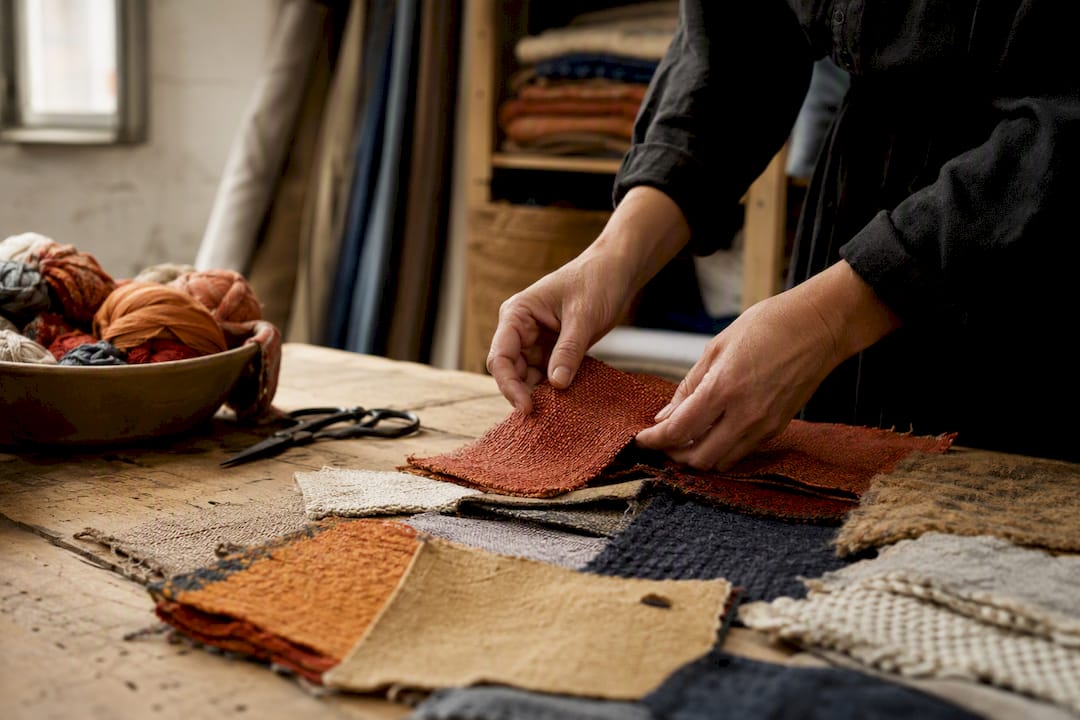
Write a one-page fabric brief and order swatches or sample yardage before you commit to any bulk order. That single step protects you from two of the most common wholesale mistakes: getting locked into a minimum order quantity (MOQ) for fabric that doesn’t behave the way you expected, and discovering a color or hand issue only after 500 yards show up at your door. Once your brief is done, use it to request quotes from two or three suppliers and compare their samples side by side.
Buying fabric wholesale successfully depends on writing a detailed fabric brief, testing samples before bulk commitment, and calculating true landed cost rather than comparing quoted prices alone.
| Point | Details |
|---|---|
| Match supplier to volume | Use jobbers or platforms under 100 yards, converters for 100 to 500 yards, and mills above that. |
| Write a fabric brief first | Include fiber, GSM, width, finish, and acceptance criteria before requesting any quote. |
| Test before you commit | Order swatches and 1 to 3 sample yards, then check hand, wash shrinkage, and color under standard lighting. |
| Calculate landed cost, not sticker price | Add freight, duties, finishing, and inspection fees to the unit price for a real comparison. |
| Start with Fabric-fabric for samples and bulk orders | Fabric-fabric offers swatch ordering and bulk discount tiers as a lower-risk entry point for small buyers. |
The fastest way to waste a week is to email a mill for 50 yards or a jobber for 3,000. Supplier types split cleanly by volume, price, and how long you’ll wait for delivery, and matching your order size to the right channel from the start saves you from dead-end conversations.
Mills sit at the top of the volume chain. They typically require 500 to 3,000-plus yards per color and quote the best per-yard price, but expect long lead times and higher MOQs. Converters sit in the middle, often accepting 100 to 500 yards, useful once you’ve validated a design but aren’t ready for mill-scale commitment. Jobbers, distributors, and online platforms sell anywhere from a single yard to full rolls, which makes them the right entry point for testing a new product line.
Sourcing agents and managed platforms exist because that gap between low MOQ and mill pricing is real for growing brands.
Vague requests get vague answers. If your email just says “I need cotton fabric,” you’ll get quotes that aren’t comparable and samples that don’t match what you had in mind. A tight spec sheet fixes both problems.
Include these fields in every quote request:
A t-shirt brief needs stretch recovery and wash-shrink numbers; an upholstery brief needs abrasion resistance and seam slippage data instead. Record acceptance criteria in concrete terms: a maximum delta-E for color match, a shrinkage percentage ceiling, and an AQL (Acceptable Quality Level) for defects per roll.
Pro Tip: Save your fabric brief as a template. Reusing it across suppliers means every quote answers the same questions, so you can compare them in a single glance instead of decoding five different reply formats.
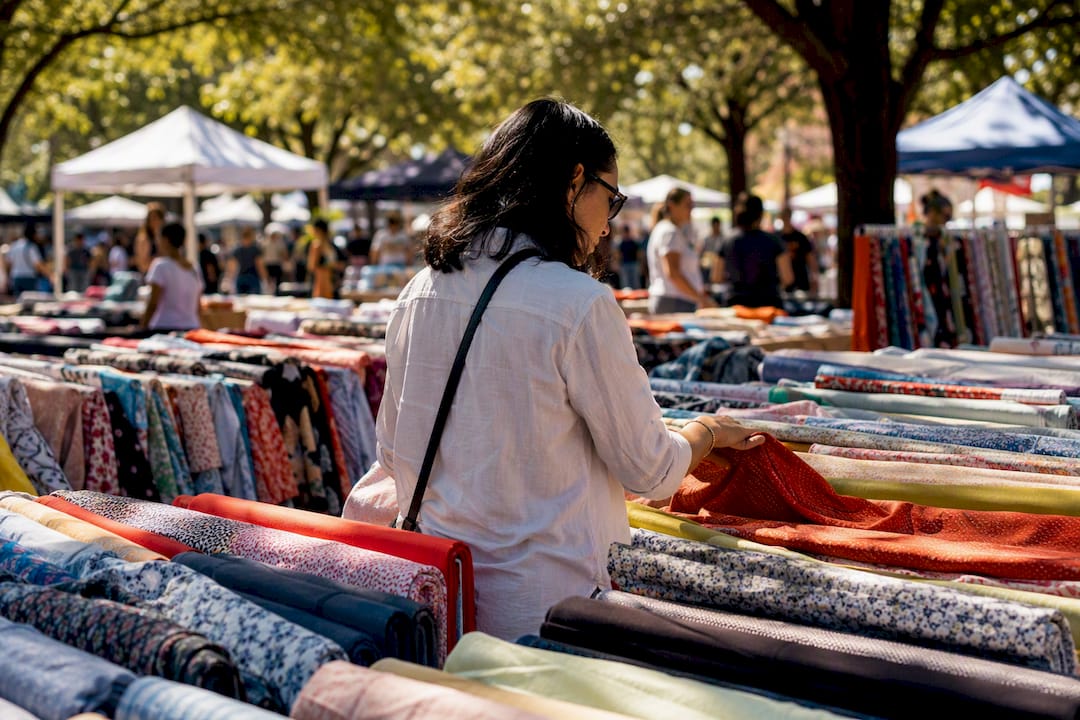
Fabric districts in garment-manufacturing cities, trade shows, and online B2B platforms remain the three most common entry points, alongside distributor directories and independent sourcing agents. Each channel reaches a different tier of supplier, so it pays to work more than one at once.
Before you send money anywhere, run a short vetting pass:
Domestic suppliers cost more per yard but ship faster, which matters if you’re still validating a design. Overseas mills offer lower unit prices with longer lead times and more quality-control risk, so many small brands run their first two or three production cycles domestically before shifting volume overseas once specs are locked.
Never skip straight from a photo on a supplier’s site to a bulk purchase order. The sample-to-bulk pipeline exists for a reason: fabric that looks right on screen can drape wrong, shrink badly, or shift color once it’s off your monitor.
Sample math that matters: if a mill quotes 800 yards minimum and your sample fails the wash test, you’ve avoided a five-figure mistake for the cost of a few yards and a week’s wait. Document approval in writing, either a signed swatch card or an email confirming the lot number and lighting conditions used, so there’s no dispute when bulk arrives. Sample evaluation steps matter more than the fabric’s price tag at this stage.
MOQs aren’t fixed in stone. Suppliers will often split a minimum across two or three colors, or pool your order with another buyer’s to hit the threshold, so ask before you assume you need the full minimum in one color.
The number that actually matters isn’t the quoted per-yard price. It’s landed cost: unit price plus finishing charges, freight, duties, inspection fees, and whatever you spent on samples along the way. Calculating landed cost this way is the only honest way to compare two suppliers quoting different terms.
Price is only one lever. Color lot consistency, lead time, and who pays freight are all negotiable, especially once you’ve placed one successful order.
Agree on Incoterms (FOB, EXW, or DDP) up front so there’s no confusion about who owns the risk once the fabric leaves the warehouse. A written purchase order should lock in specs, acceptance criteria, remedies for off-spec goods, and a firm delivery schedule, not a rough estimate.
Require a third-party inspection for any order over roughly 500 yards or your first order with a new supplier. Negotiating these terms before payment goes out is far easier than disputing them after.
Pro Tip: Never wire the full balance before inspection results come back. A 70% balance held until after a passed inspection gives you real leverage if something arrives off-spec.
Bulk fabric needs a real inspection protocol, not a quick glance at the top roll.
Acceptable remedies typically include replacement yardage, a partial credit, or a discount on the next order, depending on how far outside tolerance the defect falls.
Your second and third orders are where the real savings show up. Reliable suppliers routinely offer better pricing, faster turnaround, and more MOQ flexibility to buyers who’ve already proven they pay on time and order consistently, so treat your first purchase as an audition, not just a transaction.
Budget four to ten weeks from first inquiry to fabric in hand, and that range shifts hard depending on domestic versus overseas sourcing.
Week one is discovery and quoting: you send your fabric brief to two or three suppliers and wait for responses, typically two to five business days each. Weeks two and three cover sample ordering and evaluation. Domestic suppliers usually ship swatches within a few days; overseas mills can take one to two weeks just for the sample package to clear customs and arrive.
Once you approve a sample and place your purchase order, production time varies the most. A converter with fabric already in stock might ship within a week. A mill weaving your order from scratch, especially in a custom color, often needs three to six weeks of production time before it even ships. Add freight on top: domestic trucking runs a few days, while ocean freight from an overseas mill commonly takes three to six weeks depending on the port and season, plus customs clearance.
Here’s a realistic breakdown for a mid-volume order from an overseas mill:
Domestic orders through a converter or jobber can compress that whole cycle into two to four weeks, which is exactly why sourcing domestically for early production runs reduces both risk and waiting time for a new brand.
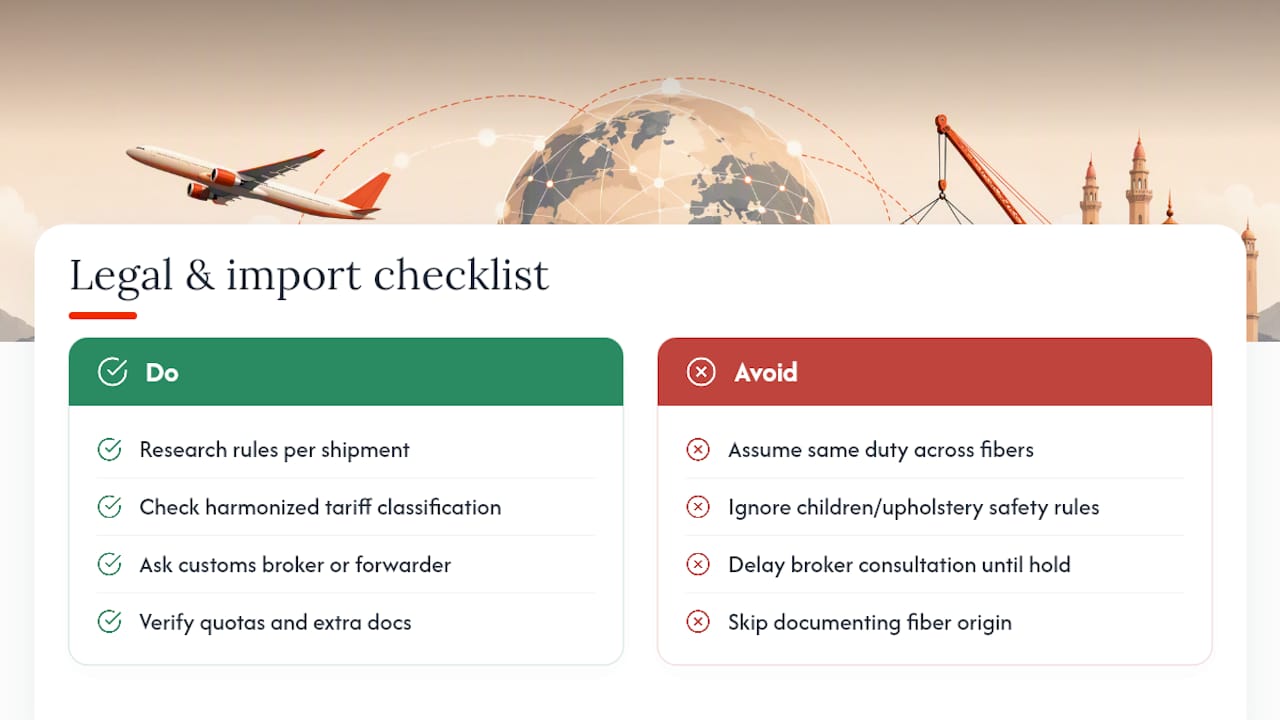
Fabric crossing an international border triggers rules that vary by country, fiber content, and end use, so treat this as a step to research per shipment rather than something you learn once and forget.
Import duties depend on the fabric’s harmonized tariff classification, which shifts based on fiber content and construction. Cotton, synthetic blends, and specialty textiles like flame-retardant fabric can all fall under different duty rates in the same country. Your customs broker or freight forwarder can confirm the exact classification and rate for your shipment. Some countries also apply quotas or additional documentation requirements for textile imports, particularly for fabrics used in children’s clothing or upholstery, which often carry separate flammability and safety standards.
Labeling requirements matter too. Many countries require fiber content and country-of-origin labeling on finished goods, and if you’re importing raw fabric to manufacture domestically, you’ll still need accurate documentation showing where the fiber originated for customs purposes.
Certifications like OEKO-TEX or GOTS aren’t legally mandated in most markets, but retailers and marketplaces increasingly require them, so confirm early whether your buyers or platform will demand proof. If you’re unsure how a specific fabric type or country pairing applies to your business, a customs broker or licensed import consultant is worth the consultation fee before your first overseas order, not after a shipment gets held at port.
The quoted per-yard price is the smallest number on your invoice once everything else lands.
Start with the base unit price, which is what most suppliers lead with in a quote. Add finishing costs if you need treatments like water repellency or flame retardancy applied after weaving. Freight comes next, and it varies enormously: a domestic truck shipment might add pennies per yard, while ocean freight from overseas can add a dollar or more per yard depending on container fill rate and fuel surcharges.
Duties and tariffs apply on top of freight for any imported fabric, calculated as a percentage of declared value based on the fabric’s tariff classification. Inspection fees, whether you hire a third-party inspector or handle it in house, add a flat cost per shipment that hits small orders harder on a per-yard basis. Sample costs, while small individually, add up if you’re testing multiple suppliers before committing.
Hidden costs catch first-time buyers most often: storage fees if your shipment sits at a warehouse or port longer than expected, currency conversion fees on international wire transfers, and rush fees if you need to compress a production timeline. Bank wire fees for international payments typically run $15 to $50 per transaction, small on their own but worth factoring in if you’re paying deposits and balances separately.
The only way to compare suppliers honestly is to calculate the full landed cost for each quote, not just the headline per-yard number.
Most guides treat sourcing like a spreadsheet exercise. It’s really a relationship exercise with a spreadsheet attached. The buyers who do well aren’t the ones who found the absolute lowest per-yard price on their first order. They’re the ones who built enough trust with one supplier to get flexibility on their third order.
Fabric-fabric’s swatch and sample process exists precisely because that first small step, ordering a real piece of fabric before committing real money, is where most wholesale mistakes get caught or missed. If you’re planning a bulk order, requesting swatches and checking current bulk discount tiers is the sane next move before you write a purchase order.
— kev
Fabric-fabric skips the weeks of back-and-forth that come with mills and overseas converters. You browse fabric by type and intended use, order swatches or sample yardage to test hand and color before committing, and scale into bulk quantities for production or upholstery work once you’ve approved what you’re getting.
For makers and small brands working through the exact checklist in this article, that means you can complete your sample-and-approval step and your bulk order through the same supplier instead of juggling separate mills, converters, and freight quotes. If your project leans toward interiors or upholstery-weight textiles, the home decor fabric selection covers everything from drapery weight to heavier decor fabric by the yard. Order a few swatches this week, run your hand and wash tests, and place your bulk order once the sample checks out.