

 US Dollar

Textile Planning Workflow: Strategies for 2026 Efficiency
Posted by BLG on 2026 Jun 2nd
Posted by BLG on 2026 Jun 2nd


TL;DR:
- A structured textile planning workflow integrates demand forecasting, capacity planning, material control, and sustainability metrics to optimize efficiency and reduce waste. Implementing connected, data-driven tools increases production capacity by up to 40%, improves on-time delivery, and cuts costs while embedding environmental considerations into decision-making. Success relies on human-centric system design, early data integration, and management commitment to transform manual processes into intelligent, sustainable operations.
A textile planning workflow is the structured process of organizing, forecasting, and executing production activities to maximize efficiency and minimize waste in textile manufacturing. Production teams that treat this process as a formal discipline, rather than a series of reactive decisions, consistently outperform those that rely on spreadsheets and informal coordination. Tools like Coats Digital’s FastReactPlan and Centric AI Studio now make it possible to connect every stage of the production process, from demand signals to delivery, inside a single integrated environment. The result is measurable. Companies that adopt data-driven planning frameworks report inventory reductions, faster throughput, and stronger on-time delivery rates within the first year.
A production-ready textile planning workflow rests on four pillars: demand forecasting, capacity planning, material control, and execution tracking. Each pillar depends on accurate data, and the weakest link in any one of them creates compounding delays downstream. Most production failures in textile manufacturing trace back to a gap in one of these four areas, not to a shortage of skilled labor.
Demand forecasting is where the workflow begins. Teams that pull signals from e-commerce platforms, retail sell-through data, and historical order patterns can build forward-looking production schedules instead of reacting to purchase orders after the fact. Centric AI Studio connects generative AI outputs directly with PLM data, allowing product teams to generate concepts and production-ready visuals in seconds within a connected planning environment. This eliminates the fragmented handoffs between design, merchandising, and production that slow most teams down.
Capacity planning and material control are where ERP systems earn their place. ERP cut planning modules minimize fabric waste by managing shade grouping and cut ratios, which is especially critical for manufacturers handling 10,000 or more active SKUs. Without this level of precision, fabric yield varies unpredictably across batches, and the cost difference accumulates fast.
The table below compares the key tools used across a modern textile planning workflow and their primary functions:
| Tool | Primary function | Best for |
|---|---|---|
| FastReactPlan (Coats Digital) | Capacity and production scheduling | Mid to large apparel manufacturers |
| Centric AI Studio | AI-driven concept generation linked to PLM | Product development and design teams |
| ERP with cut planning module | Fabric yield optimization and SKU management | High-volume cut-and-sew operations |
| IoT-integrated smart lab systems | Quality control, scheduling, and data tracking | Testing and quality assurance teams |
| E-commerce demand analytics | Forward-looking inventory and dye lot planning | Dyeing and finishing SMEs |
Pro Tip: Connect your demand forecasting tool directly to your dye scheduling software. Teams that do this reduce reactive changeovers and free up capacity without adding headcount.
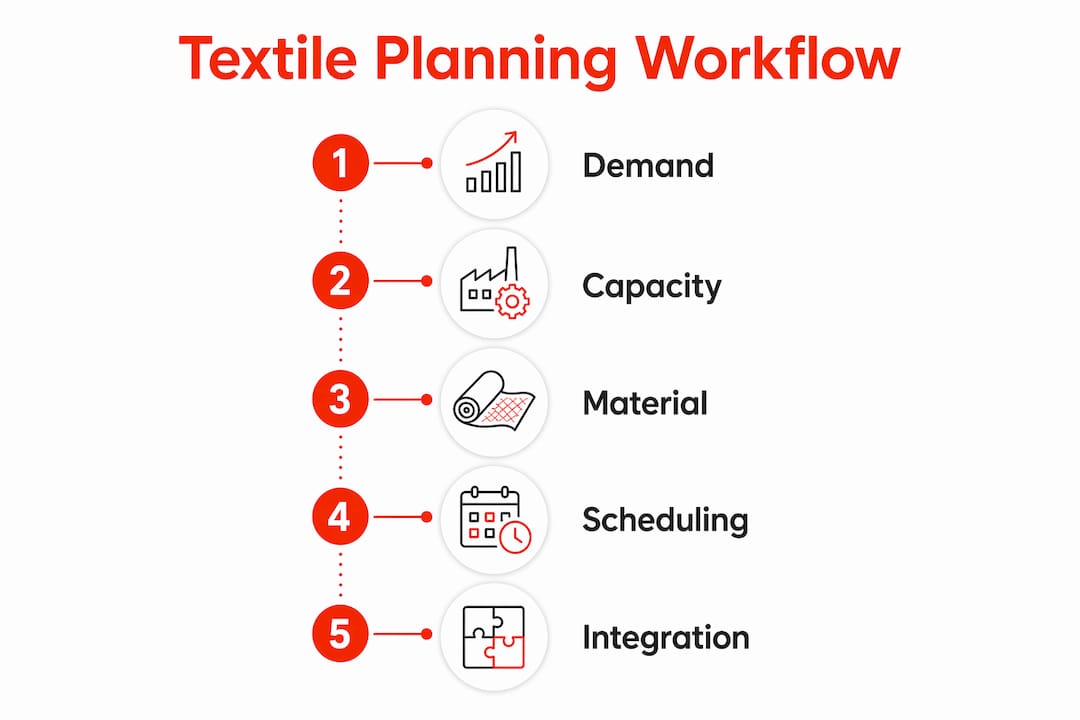
The core insight here is that no single tool solves the workflow problem. The competitive advantage comes from integration. Industry experts confirm that future-ready product teams use AI natively integrated with PLM data, enabling parallel workflows where generated concepts are immediately actionable and compliant with production constraints.
Optimizing a textile production process for waste reduction and capacity gains follows a specific sequence. Skipping steps, particularly the early data integration steps, produces marginal results. The following sequence reflects what production teams at high-performing textile manufacturers have applied with documented outcomes.
The Tunicotex result is worth examining closely. A 40% capacity increase without a proportional increase in physical infrastructure is only possible when planning bottlenecks are removed. The capacity was always there. The planning process was the constraint.
Pro Tip: Before investing in new software, run a one-week audit of how your planners spend their time. Most teams discover that 30 to 40% of planning hours go to reconciling data between disconnected systems, not to actual decision-making.
| Metric | Before optimization | After optimization |
|---|---|---|
| On-time delivery performance | 75% | 85% |
| Production capacity | Baseline | +40% |
| Dye lot changeovers | Baseline | -31% |
| Inventory value | Baseline | -28% |
| Planning administrative time | Baseline | -25% |
The most persistent challenge in textile supply chain management is the continued reliance on manual, Excel-based planning systems. Manual planning often causes 5 to 10% profit loss due to inefficiencies, and integrated platforms reduce planning time by 25% while surfacing hidden problems like unbalanced production lines and excessive rework. The issue is not that planners lack skill. The issue is that spreadsheets cannot process the interdependencies of a live production floor in real time.
Beyond digital limitations, early-phase planning errors are the most expensive mistakes in textile production. In traditional silk weaving, a planning phase called ‘davra’ involves precise measurement and thread layer reconstruction before weaving begins. Errors at this stage become impossible to correct once the loom is in motion. The principle applies equally to industrial textile production: decisions made in the first 10% of the planning cycle determine the cost structure of the entire run.
The most common planning failures production teams encounter include:
“The hidden cost of manual planning is not the time spent building spreadsheets. It is the decisions that never get made because the data arrives too late to act on.” — Production planning insight from integrated manufacturing case studies
Fabric-fabric’s guide to managing textile orders efficiently addresses several of these coordination failures with practical scheduling frameworks that production teams can apply without replacing their existing systems.
Sustainability is not a separate workstream from production planning. It is a direct input into cost, compliance, and supplier selection decisions. Teams that treat environmental metrics as a reporting obligation rather than a planning variable consistently miss the cost reduction opportunities that green supply chain models unlock.

The wet processing stage, which includes pretreatment, dyeing, and finishing, is the most resource-intensive phase of the textile production process. 10 to 50% of dyes are washed out during processing, representing both a material cost and an environmental liability. Precision chemical management at the batch planning level directly reduces this loss. This is not a technology problem. It is a planning problem.
Sustainable fabric planning strategies that production teams can embed directly into their workflow include:
“Wet processing stages are pivotal for environmental impact. Brands that adopt precision chemical management and novel technology to reduce waste and pollution will hold a structural advantage as regulatory pressure increases.” — Fashion for Good
Fabric sustainability trends are shifting buyer expectations faster than most production teams anticipate. Building sustainability metrics into your planning workflow now, rather than retrofitting them later, is the lower-cost path. The green supply chain models that deliver 18.6 to 25.8% cost reductions do so precisely because sustainability and efficiency are optimized together, not separately.
Smart textile laboratory systems using IoT automation improve workflow management, scheduling, and quality control while generating the data streams that make ESG reporting accurate and audit-ready. Investing in these systems pays back through both operational visibility and compliance readiness.
A textile planning workflow delivers measurable gains only when demand forecasting, capacity planning, material control, and sustainability metrics are integrated into a single connected system rather than managed as separate functions.
| Point | Details |
|---|---|
| Integration drives capacity gains | Connecting PLM, ERP, and demand data removes planning bottlenecks and can increase capacity by up to 40%. |
| Early planning phases determine cost | Errors in the first 10% of the planning cycle, like dye lot scheduling, set the cost structure for the entire production run. |
| Manual planning has a measurable cost | Excel-based systems cause 5 to 10% profit loss and hide inefficiencies that integrated platforms surface immediately. |
| Sustainability belongs in the planning layer | Embedding green supply chain models into procurement and scheduling cuts costs by up to 25.8% alongside emissions reductions. |
| Data-driven forecasting reduces inventory | Using e-commerce signals for proactive planning reduces inventory value by 28% and dye lot changeovers by 31%. |
I have spent years watching production teams invest in software and still underperform. The pattern is consistent. The tool gets implemented, the training happens, and within six months the planners are back to maintaining a parallel spreadsheet because the new system does not match how they actually think through a production problem.
The real issue is that most workflow optimization projects are led by IT or operations leadership without deep input from the planners who will use the system daily. Centric AI Studio and FastReactPlan are genuinely capable platforms, but their value depends entirely on whether the planning logic embedded in them reflects the actual constraints of your production floor. A system that forces planners to override it constantly is not a planning system. It is a documentation burden.
What I advocate for is a human-centric design approach to workflow implementation. Before selecting a platform, map how your best planner makes decisions. What data do they check first? What signals tell them a schedule is at risk? Build the system around that decision logic, not around the vendor’s default configuration.
The sustainability angle is where I see the most untapped opportunity in 2026. Most production teams I observe still treat carbon and water metrics as something the sustainability team handles separately. The teams pulling ahead are the ones who have made those metrics visible inside the planning interface, so that a scheduler choosing between two dye lots can see the environmental cost difference alongside the price difference. That is when behavior changes.
The transition from manual to integrated planning is not primarily a technology decision. It is a change management decision. Get that right, and the technology delivers. Get it wrong, and you will be back to spreadsheets within a year.
— kev
Planning a tight production schedule means your fabric sourcing needs to be just as precise as your scheduling. Fabric-fabric carries a wide selection of materials suited to both professional production runs and specialty projects, with clear product specifications that make procurement planning straightforward.

Whether you are sourcing materials for large-format backdrop production or planning a home decor collection, Fabric-fabric’s backdrop fabric range and home decor fabric catalog give you access to quality textiles with the product detail you need to plan accurately. Fabric specifications, usage guidance, and pricing are all visible upfront, so you can build sourcing decisions into your workflow without back-and-forth with suppliers. Free shipping thresholds and seasonal promotions make it practical to order at the quantities your production schedule requires.
A textile planning workflow is the structured process of forecasting demand, scheduling production capacity, managing material procurement, and tracking execution to minimize waste and maximize throughput in textile manufacturing.
FastReactPlan by Coats Digital replaces manual scheduling with integrated capacity planning, which helped Tunicotex Group increase production capacity by 40% and improve on-time delivery from 75% to 85%.
Manual Excel planning causes 5 to 10% profit loss through hidden inefficiencies like unbalanced production lines and delayed data, while integrated platforms reduce planning time by 25% and surface these issues automatically.
Embed precision chemical dosing into dye lot scheduling, score suppliers on carbon and water metrics alongside price, and use IoT-enabled lab systems to capture ESG data at the production level for buyer reporting.
Using e-commerce and retail sell-through signals for proactive demand forecasting reduces inventory value by 28% and dye lot changeovers by 31%, freeing capacity without additional equipment investment.