

 US Dollar

Avoid Blotchy Velvet: Makers' Rules for Cutting Pile Weave Fabric
Posted by BLG on 2026 Sep 15th
Posted by BLG on 2026 Sep 15th

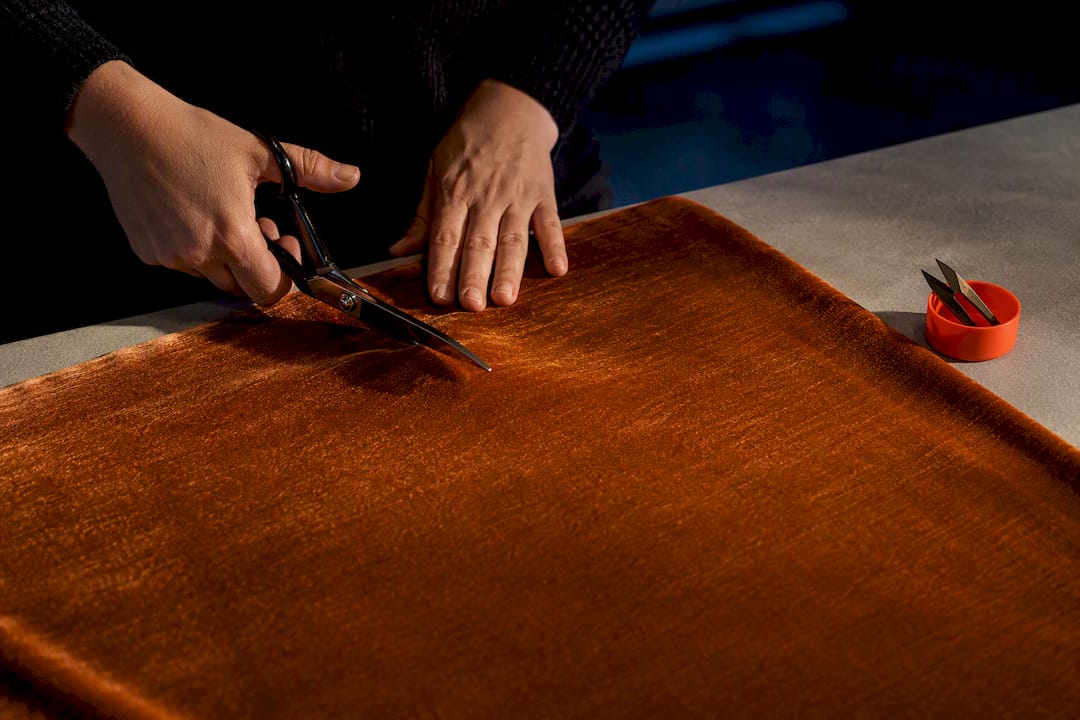
Pile weave fabric is a textile with upright loops or cut yarn ends rising from a flat ground weave, and those raised fibers, called the pile, are what give velvet its sheen and terrycloth its absorbency. Two questions decide almost everything about how a pile fabric behaves: is the pile cut or left as loops, and does it run from the warp or the weft? Velvet, corduroy, and rugs sit on one side of that split; terrycloth and looped upholstery sit on the other.
TL;DR:
- Pile fabric construction can be either cut or loop, and woven using warp or weft techniques, which significantly influences durability, appearance, and intended use.
- Loop pile fabrics like terrycloth and Berber carpet resist wear and shedding, making them ideal for high-traffic or abrasive environments, while cut pile fabrics like velvet offer sheen and softness but shed more easily.
- Warp pile fabrics, such as velvet, typically have a directional nap requiring careful pattern layout, whereas weft pile fabrics like corduroy display visible ribs and are more forgiving in multiple directions.
- Pile height and density are key indicators of fabric longevity and feel, with short, dense piles being more resistant to crushing and long-lasting in upholstery.
- Always evaluate pile fabric by nap direction and construction quality, not just fiber content, to prevent project issues like uneven color or premature wear.
A ground weave alone is flat. Add a second, supplemental yarn system that gets pulled up into loops (or cut after weaving) and you get pile, the raised surface that makes velvet feel different from plain cotton under your palm. That structure is what ScienceDirect’s engineering reference uses to define the entire pile fabric family, from velvet and velveteen to corduroy, terrycloth, chenille, and carpet.
The standard industry term for this fabric category is simply “pile fabric” or “pile weave.” Craft forums sometimes call it “plush fabric” or lump it in with generic descriptions like “textured upholstery fabric,” but neither phrase is precise. Plush usually refers to a specific dense, soft cut pile, not the whole category, and “textured upholstery fabric” could mean anything from a woven jacquard to a nubby bouclé with no pile at all. If you are shopping by yardage or reading a technical spec sheet, “pile weave” is the term that will get you an accurate answer.
Every pile fabric splits along two independent axes:
Those two choices, made independently, produce the entire vocabulary of pile fabrics you’ll encounter as a maker.
Cut pile is sheared flush after weaving, which is why velvet has that smooth, light-catching nap you can brush in different directions and see the color shift. Loop pile keeps its yarn uncut, standing in small rounded arches, which is why a bath towel can soak up water instead of just sliding it around.
The functional trade-off is straightforward. Cut pile gives you softness, drape, and sheen, but the exposed fiber ends are more prone to shedding and crushing over time. Loop pile sacrifices some of that softness for real durability: Flooring America’s comparison of cut and loop pile carpet notes that loop construction resists wear, matting, and shedding far better than cut pile, which is exactly why commercial carpet and heavy-use upholstery lean loop, while formal drapery and eveningwear lean cut.
Where each type shows up:
Loop pile holds up. Cut pile looks better doing it. That’s the whole trade-off in six words, and it’s worth keeping in mind before you commit yardage to a project.
For garment work, the decision usually comes down to how the piece gets used. A velvet blazer only needs to survive dry cleaning and the occasional brush against a chair, so cut pile’s fragility barely matters. A robe or bath sheet gets wrung, scrubbed, and machine washed weekly, which is exactly the abrasive environment where loop pile’s resilience earns its keep. For home upholstery that takes daily sitting and shifting, loop or tight low-cut pile will outlast a long, loose cut pile by a wide margin. If you’re torn between the two for a chair or sofa project, test a swatch by rubbing it against denim fifty times and see which one shows wear first. That five-minute test tells you more than any label.
Pile direction isn’t a cosmetic detail. It determines which loom setup produces the fabric, how the nap behaves when you cut it, and whether the piece has any stretch at all.
Warp pile uses a supplemental set of lengthwise yarns, run parallel to the fabric’s length, that get raised and either looped or cut. Weft pile does the same thing with crosswise yarns, woven back and forth across the fabric’s width. ScienceDirect’s overview of pile fabric construction treats this as the fundamental split beneath every named pile fabric you’ll shop for.
The nap-direction rule matters more than most beginners expect. Lay a velvet pattern piece with the pile running “up” (against the nap) and the color reads darker and richer; lay it “down” and it reads lighter, almost silvery. Mixing directions across a single garment is one of the most common and most visible mistakes in pile sewing, and it’s why commercial patterns almost always print a “nap layout” diagram just for pile fabrics.
Every pile fabric on the market traces back to one of four production families, and understanding them tells you what a fabric can and can’t do before you even touch a swatch.
Knotted pile is the oldest and most hands-on method, still used for rya and Ghiordes-style rugs. The process is simple to describe even though it’s slow to execute: cut short lengths of yarn, wrap each one around a pair of warp threads, pull it tight into a knot, then pack it down against the previous row before weaving a few picks of plain weave to lock it in place. Wikipedia’s technical description of knotted pile confirms this tie-and-secure structure is what gives hand-knotted rugs their durability and their price tag. If you want to try this yourself on a small frame loom, start with a rug 12 inches wide. Anything larger gets punishing fast for a first attempt.
Wire weaving and wire-cut techniques produce industrial pile at scale. A wire is woven into the fabric alongside the pile yarns, creating raised loops over the wire’s length; pulling the wire out either leaves loops intact (wire loop pile) or, if the wire has a cutting edge built in, shears the loops into cut pile automatically as it’s withdrawn.
Face-to-face (double-cloth) weaving is the technique behind most quality velvet. Two ground fabrics are woven simultaneously, one above the other, connected by pile yarns running between them. A traveling blade slices the connecting yarns down the middle, splitting one loom pass into two finished cut-pile fabrics at once. It’s efficient and it’s why good velvet has such a uniform, dense nap.
Modern machine methods, covered in detail by the Home Textile Journal’s guide to carpet weaving technology, include rapier and double-rapier looms, Axminster and Wilton constructions, and systems using dummy fillings and specialized lancets to selectively cut or loop yarn on the fly. These machines can blend cut and loop within the same piece, producing the high-low sculpted textures common in modern area rugs.
Pro Tip: If you’re evaluating a rug or heavy pile upholstery fabric for durability, tug a few tufts by hand before buying. A well-anchored pile resists a firm pull; loose tufts that shift or pull free signal weak backing construction, regardless of how thick the pile looks.
Once you know the cut/loop and warp/weft framework, the entire aisle of pile fabrics sorts itself into a short list of named categories, each with its own signature construction.
For a broader map of where pile weaves sit relative to other weave families, our overview of the seven major fabric weave types is worth a look before you commit to a project.
Two numbers do most of the work in predicting how a pile fabric will feel and wear: pile height and pile density. Height is simply how far the pile stands off the ground weave; density is how tightly packed those pile yarns are per square inch. A tall, sparse pile crushes fast and looks patchy after a few months of use. A short, dense pile resists crushing and keeps an even surface for years, even under regular contact.
Velvet typically runs a short pile height, terry loops are longer, and standard corduroy wale counts are moderate, according to TextileTuts’ guide to pile fabric construction. Those ranges are a useful gut check when a product listing feels vague about “pile height” or “nap depth.”
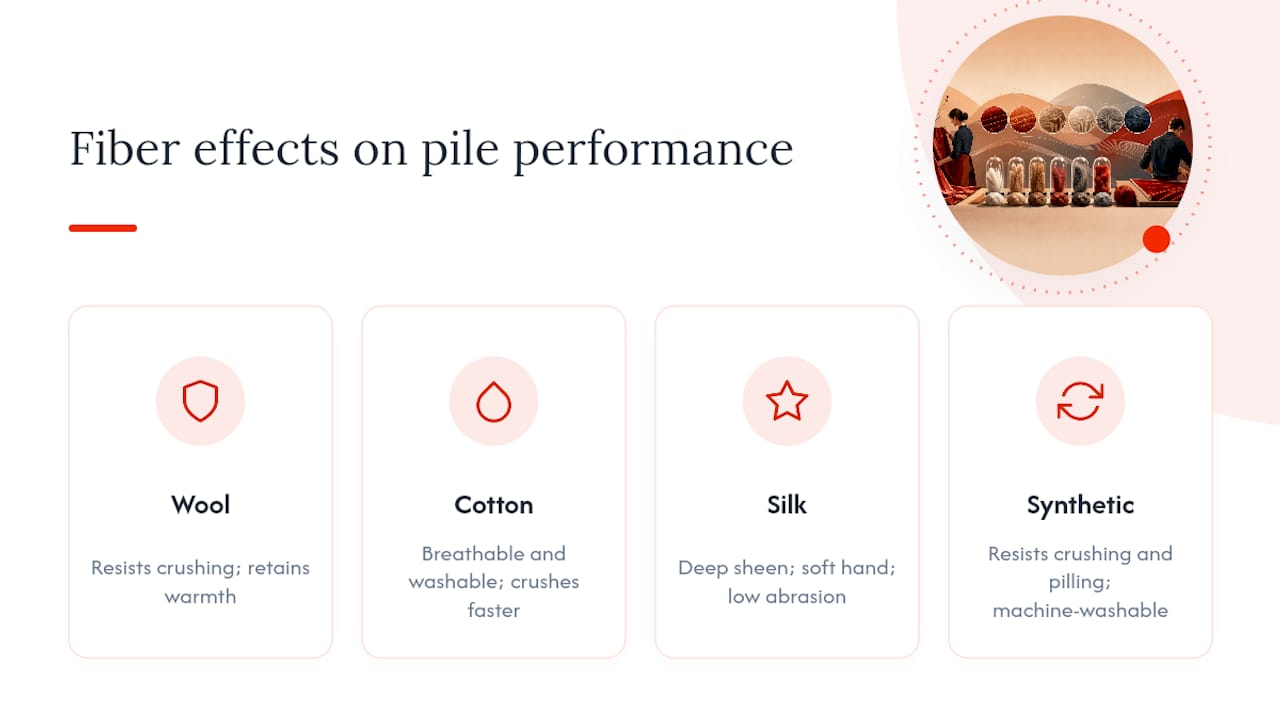
Fiber content changes what those numbers mean in practice. Wool pile resists crushing and holds warmth well, which is why wool has dominated rug and heavy upholstery pile for centuries. Cotton pile, common in velveteen and terrycloth, is breathable and washable but crushes more easily than wool and mats faster under repeated wet use. Silk pile, found in higher-end velvets, gives the deepest sheen and the softest hand but is the least abrasion resistant of the common options. Synthetic pile, usually polyester or nylon, splits the difference: it resists crushing and pilling reasonably well and handles machine washing better than natural fibers, at the cost of some of that natural luster.
Cut and loop pile diverge again here on maintenance. Cut pile sheds loose fiber ends over its first several washes or uses, which is normal and settles down over time. Loop pile rarely sheds on its own, but a single snagged loop can pull and unravel a visible line across the surface, which is the main failure mode to watch for with pets, buttons, or Velcro nearby.
Buying pile fabric by the yard without a plan is how most sewing-room disasters start. Work through this checklist before you order, whether you’re buying a swatch or committing to full yardage.
Ordering a small swatch and testing it under different lighting before committing to yardage catches problems that a spec sheet alone often misses, particularly color shift and hand.
For cutting, always lay every pattern piece in the same nap direction, use sharp shears rather than a rotary cutter on deep pile (a rotary blade tends to push pile fibers instead of cleanly slicing them), and add a slightly wider seam allowance to account for pile bulk in the seam. For upholstery-grade work, ask about rub count and pick density before buying; a fabric rated for tens of thousands of double rubs is built for a couch cushion, not just a throw pillow.
Pro Tip: Brush a velvet or corduroy swatch with your hand before cutting anything. If the nap flattens unevenly or feels sparse in patches, the pile density is inconsistent, and that inconsistency will show up as blotchy color once the piece is sewn and lit.
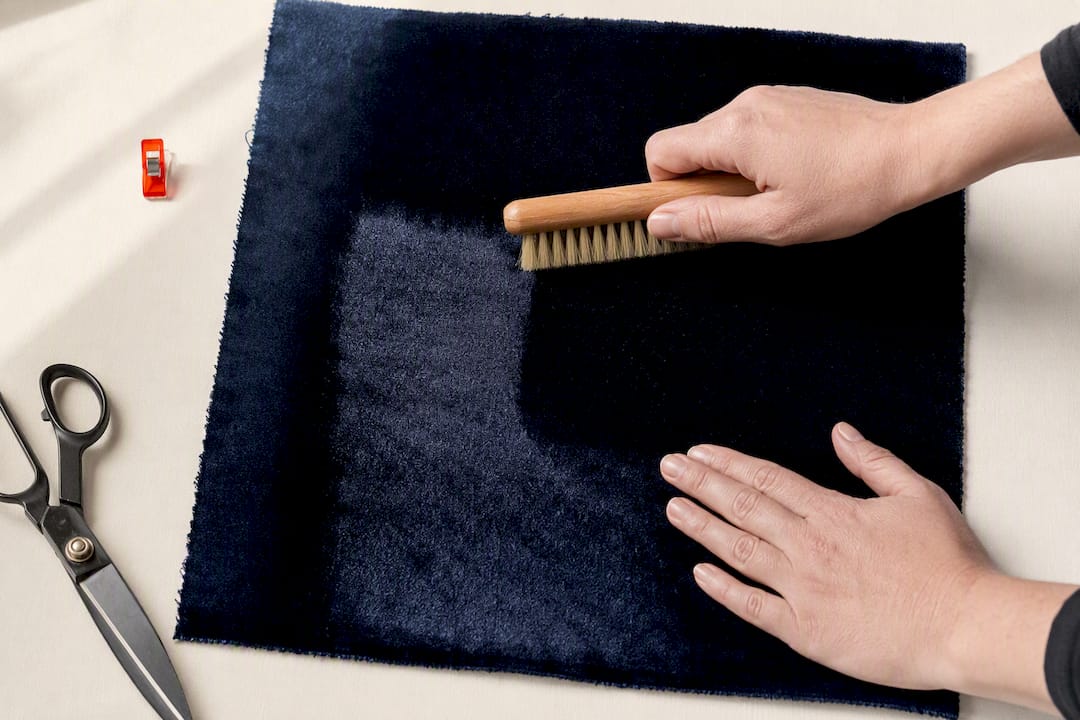
Mills finish pile fabric with shearing to even out height, brushing to set the nap direction, and compaction or backing treatments to lock pile in place before it ever reaches a bolt. Once it’s in your hands, care is mostly about protecting that structure rather than fighting it.
There are retailers that stock velvet, corduroy, terrycloth, and other pile weaves by the yard, often organized by intended use rather than just fiber type, allowing shoppers to find upholstery-grade options separately from garment-weight choices. Some fabric websites offer swatch systems that let you check nap, color, and hand before committing to yardage, which matters more with pile fabric than almost any other category. Browsing fabric categories by project type can simplify the search when you already know you need a heavier decor-weight pile rather than a lightweight apparel velvet.
Most guides to pile fabric spend too much time on fiber content and not enough on construction, and that’s backwards for anyone actually cutting and sewing the stuff. Fiber tells you how it feels on day one. Construction, cut versus loop, warp versus weft, pile height, backing, tells you how it will behave on day two hundred.
The conventional advice to “just check the fiber content label” misses the real risk points: nap direction mismatches, inconsistent pile density across a bolt, and backing that won’t hold up to the seams you’re planning. Those are structural questions, not fiber questions, and they’re the ones that wreck a project.
If you take one thing from this guide, prioritize nap direction and pile density over sheen and softness when you’re evaluating a swatch. A gorgeous, sparse pile that crushes in a month isn’t a bargain. A modest, dense pile that holds its shape for years is the better yardage every time, even if it photographs a little less dramatically on the bolt.
— kev
Fabric-fabric carries the pile weaves this guide covers, velvet, corduroy, and terrycloth among them, organized so you don’t have to guess which category fits your project. The Backdrop Fabrics collection covers heavier decorative and upholstery-grade pile options for set work and furniture projects, while the home decor fabric category is built for curtain and upholstery-weight pile fabrics sized for room-scale projects.
It’s advisable to order a swatch before committing to yardage, especially for fabrics with directional nap, and to check the pile height listed in product specs against known ranges to understand what you are getting before it ships. For bulk or upholstery-scale orders, contacting customer support may help confirm backing weight and rub count for professional projects that require durable fabric.
A pile weave is a fabric construction where supplemental yarns form loops or cut ends standing up from a flat ground weave, creating the raised surface seen in velvet, terrycloth, and carpet.
Pile fabric is any textile built with this raised-loop or cut-yarn surface, including velvet, velveteen, corduroy, terrycloth, chenille, and pile carpet, as defined by ScienceDirect’s engineering reference.
Dobby weave is a separate technique from pile weave, producing small geometric patterns through controlled floats rather than raised pile; common dobby fabrics include piqué and some seersucker-style textiles, though pile fabrics like corduroy and velvet are not dobby weaves themselves.
Pile knit fabric achieves a raised surface through knitting rather than weaving, typically by knitting in a supplemental yarn that forms loops or is later sheared, producing knit-based textiles like sherpa fleece and some plush fabrics that mimic the hand of woven pile without the same warp-and-weft structure.
Choose loop pile for high-traffic seating where durability and resistance to matting matter most, and reserve cut pile for lower-contact, decorative pieces where softness and sheen take priority over long-term wear resistance.