

 Canadian Dollars

Textile Grading: Ensuring Fabric Quality Standards
Posted by BLG on 2026 Feb 22nd
Posted by BLG on 2026 Feb 22nd


Choosing the right fabric often feels like a gamble for North American fashion designers and small business owners. The world of textile grading is filled with industry terms and confusing grades, making smart sourcing a real challenge. By clearing up common misconceptions and focusing on what textile grading actually is, you set your designs and your business up for success, whether you order bulk runs or specialty materials.
| Point | Details |
|---|---|
| Understanding Textile Grading | Textile grading is a comprehensive evaluation of fabric quality, assessing multiple properties to ensure performance meets specific production needs. |
| Misconceptions to Avoid | Higher grades do not always indicate better quality; standards vary between suppliers, requiring careful evaluation of grading criteria. |
| Impact on Fabric Selection | Grading influences both fabric choice and pricing, with higher grades often resulting in increased costs but fewer defects and higher customer satisfaction. |
| Request Grading Documentation | Always ask for complete grading test reports from suppliers to verify claims and ensure quality before making bulk purchases. |
Textile grading is the systematic evaluation of fabric quality based on specific, measurable standards. It’s not a single test or certification—it’s a complete assessment that determines whether a fabric meets industry requirements for your production needs.
When you’re sourcing fabrics for your designs, you’re essentially asking: Does this fabric perform as promised? Will it hold up through washing, wearing, and handling? Grading answers those questions with data.
Textile grading evaluates fabrics across multiple dimensions, not just appearance. The process examines structural integrity, color consistency, and dimensional stability. Think of it like a health checkup for fabric—multiple tests paint the full picture.
Grading standards differ by fabric type and intended use. A cotton knit for t-shirts follows different grading criteria than a silk charmeuse for evening wear. The standard depends on your specific application.
Here’s what gets evaluated during textile grading:
Grading isn’t about making a fabric “pass or fail”—it’s about documenting exactly what the fabric will do in real-world conditions.
Misconception 1: Grading is the same as labeling. Many small business owners confuse federal labeling requirements with grading standards. Accurate fiber content disclosures are mandatory for compliance, but grading goes far beyond listing what fibers are in the fabric.
Labeling tells you what’s in the fabric. Grading tells you how it will perform.
Misconception 2: Higher grade always means better quality. Grade systems vary significantly. One supplier’s A-grade might not match another’s standards. You need to understand the specific grading criteria being used—not just accept the letter grade at face value.
Misconception 3: Blended fabrics are harder to grade. While blended fiber identification does add complexity, professional grading systems handle blends effectively. The challenge isn’t grading itself—it’s ensuring accurate fiber identification before grading begins.
Misconception 4: Only large manufacturers care about grading. Small fashion brands actually benefit more from understanding grading than large operations. You’re selecting fabrics for specific designs with limited production runs—knowing exactly how your chosen fabric will behave is critical.
Misconception 5: One test covers everything. Grading requires multiple evaluations. No single test determines overall quality. A fabric might have excellent colorfastness but poor tensile strength—both matter depending on your use case.
Visual inspection catches obvious defects, but instrumental testing reveals hidden performance issues that only show up after customer purchase and use.
Why does this matter for your business? You’re making purchasing decisions based on limited fabric samples. Grading documentation gives you confidence that what you’re seeing in the sample represents the full production run.
Pro tip: Request grading test reports from your fabric suppliers for any fabrics you’ll use repeatedly—these documents become your quality baseline and protect your reputation with customers.
Textile grading comes in several distinct types, each designed to assess different aspects of fabric performance. Understanding which type applies to your fabric helps you know exactly what was tested and what results mean for your designs.
Grading types vary based on the fabric’s intended use, fiber composition, and performance requirements. A performance knit for activewear needs different testing than a decorative lace for garment trim.
Most textile grading falls into two main categories: performance-based grading and appearance-based grading. Many professional assessments use both simultaneously.

Performance-based grading measures how fabric behaves under real-world conditions. Appearance-based grading evaluates visual quality and consistency.
Here are the main grading types you’ll encounter:
Use this quick reference to compare key textile grading types:
| Grading Type | Main Focus | Typical Use Cases |
|---|---|---|
| Performance-Based | Durability, strength, quality | Sportswear, uniforms |
| Appearance-Based | Visual consistency, defects | Fashion, decorative fabrics |
| Sustainability-Based | Environmental & social impact | Eco-certified products |
| Specialty Grading | Specific traits (e.g., flame resistance) | Safety apparel, technical textiles |
Different grading types answer different questions. Know which type you need before requesting test reports.
Certain criteria show up repeatedly across most grading systems because they directly affect how customers experience your finished garment.
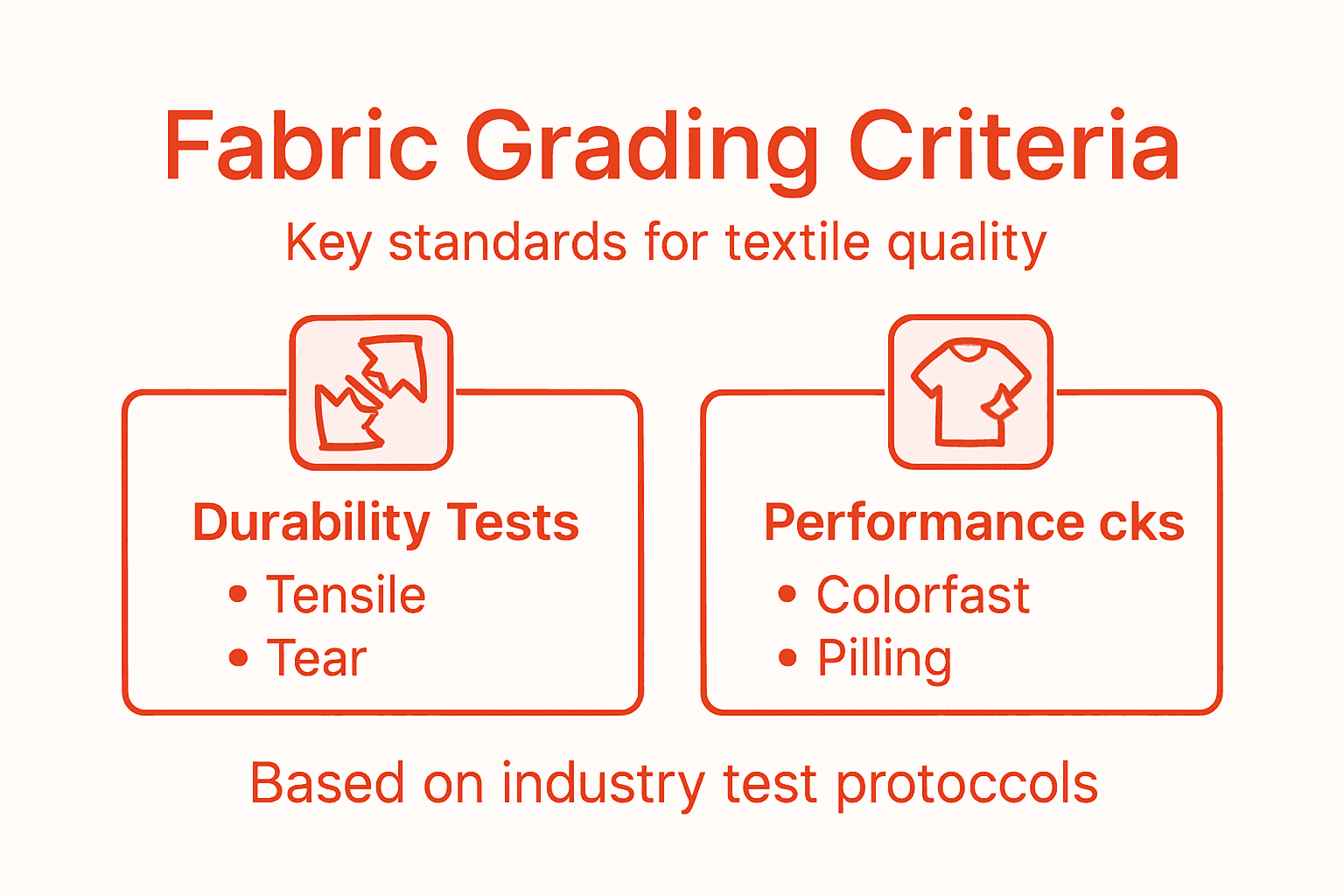
Colorfastness determines whether your dyed fabric will fade or bleed. Colorfastness testing methods include exposure to light, washing, perspiration, and friction. This matters enormously for dark colors and repeated washing.
Tensile strength and tear resistance measure how much force the fabric can withstand before breaking. A fabric with poor tear strength will shred during normal sewing or wearing.
Seam quality evaluates how well the fabric holds stitches without puckering or tearing. Poor seam quality creates premature garment failure—a nightmare for your brand reputation.
Dimensional stability tracks how much the fabric shrinks or stretches after washing. Surprise shrinkage makes sizing inconsistent and ruins customer satisfaction.
Pilling resistance assesses how easily fabric fibers ball up on the surface during wear. High pilling makes even quality fabrics look cheap and worn after a few washes.
Fiber-specific criteria vary significantly. Grading criteria for different fibers and production methods differ based on whether you’re evaluating cotton, wool, synthetics, or recycled materials. Each has unique performance characteristics that need specific testing.
When you request grading information from suppliers, ask specifically which criteria were tested. Not all grades evaluate the same things.
Pro tip: Create a grading checklist for your signature fabrics—document which criteria matter most for each design, then request those specific test results from suppliers to ensure consistency across production runs.
The textile grading process isn’t random. It follows established procedures and industry standards that ensure consistency across suppliers and production runs. Understanding this process helps you interpret grading reports and make informed fabric choices.
When you request grading information from suppliers, you’re asking them to follow standardized testing protocols. These protocols exist so you can compare fabrics confidently, knowing the tests mean the same thing everywhere.
Textile grading follows a structured workflow from sample collection through final reporting. Each step has specific requirements and documentation.
Here’s the practical sequence:
The grading process only works if every step follows the same methodology. That’s why standards matter.
Sustainability standards have become increasingly important in North American textile sourcing. Materials Matter Standards outline comprehensive grading procedures that include environmental impact assessment alongside traditional quality metrics. This means modern grading evaluates not just performance, but also production practices and sustainability.
Durability standards specify exactly how tests get conducted. Test methods for measuring durability are documented in detail so results remain comparable across different labs and suppliers.
Different standards apply based on your fabric type and intended market. Cotton fabrics follow different protocols than polyester blends. Activewear has stricter durability requirements than decorative fabrics.
When you source fabrics, ask your supplier which standards their grading follows. Common ones include:
Suppliers who take grading seriously will readily provide this information. They’ll specify exactly which tests were run and which standards apply to their results.
You don’t need to memorize every standard. You need to understand what your grading reports mean. Ask suppliers these questions before committing to a fabric:
Comparing grading across suppliers becomes easier when you understand the process behind it. Different suppliers using different standards can’t be directly compared—you need to evaluate their testing methodologies alongside the results.
Pro tip: Request grading documentation before ordering samples, not after—this helps you identify suppliers who take quality seriously and understand the specific performance requirements your designs demand.
Grading directly influences both which fabrics you’ll choose and how much you’ll pay for them. Higher grades command premium prices because they guarantee consistent performance and reduced risk of quality issues during production.
Understanding this relationship helps you make smart sourcing decisions. You’re not just paying for fabric—you’re paying for quality assurance that protects your brand.
Higher grades cost more. This isn’t arbitrary pricing. Better-performing fabrics require stricter quality control, more careful handling, and often superior raw materials. Those costs get passed to you.
Grade improvements at each level translate to measurable price increases. A-grade cotton might cost 15-25% more than B-grade fabric with the same fiber content. Grading criteria such as fiber color and staple length directly affect market pricing across North American cotton suppliers.
The investment pays off when you consider production efficiency. Lower-grade fabrics mean higher defect rates, more production delays, and customer complaints. Your time cost to handle these issues often exceeds the savings from choosing cheaper fabric.
You’re essentially buying risk reduction when you select higher grades. That’s a legitimate business expense.
Here’s a summary of how textile grading impacts business operations:
| Area of Impact | High-Grade Fabrics | Low/Mid-Grade Fabrics |
|---|---|---|
| Production Efficiency | Fewer defects, smooth runs | More rejects, process delays |
| Customer Satisfaction | Fewer complaints, consistent fit | Higher returns, inconsistent quality |
| Brand Reputation | Enhances brand credibility | Increases risk of negative reviews |
| Long-Term Cost | Lower rework/repair costs | Higher remediation expenses |
Grading criteria eliminate certain fabrics from consideration for specific applications. A decorative lace might score well for appearance but poorly for durability—making it unsuitable for activewear regardless of price.
This actually simplifies your selection process. Instead of comparing dozens of similar-looking fabrics, grading narrows your options to those meeting your actual performance requirements.
When evaluating options, consider these grading-related factors:
Choosing based on grade rather than just price prevents costly production problems and keeps your designs consistent.
Premium brands leverage grading differently than budget-focused lines. Understanding how grading affects fiber quality and sustainability pricing helps you position your collection appropriately.
For signature fabrics you’ll use repeatedly, invest in top grades. You’ll recoup costs through reduced defects and faster production. For experimental designs or limited runs, acceptable mid-grade fabrics make sense.
Build a grading strategy aligned with your brand positioning:
Suppliers offering detailed grading documentation deserve preference. They’re signaling transparency and quality commitment. Those dodging grading questions are hiding something.
Transparency around grading also supports your own customer marketing. You can confidently describe fabric performance when grading data backs your claims.
Pro tip: Negotiate better prices on high-grade fabrics by committing to consistent volume over multiple seasons—suppliers reward reliability with discounts that offset the quality premium.
Most textile grading problems stem from predictable mistakes. Knowing what goes wrong helps you avoid expensive errors and make confident purchasing decisions that protect your business.
Small business owners often trip up on the same issues repeatedly. Learning from these patterns saves you time, money, and reputation damage.
Pitfall 1: Trusting grades without verification. A supplier’s grade letter means nothing if you haven’t seen the actual test report. Many suppliers exaggerate grading or use non-standard systems. Request complete documentation before committing to bulk orders.
Pitfall 2: Ignoring fiber content accuracy. Inaccurate fiber content labeling violates Federal Trade Commission regulations and exposes you to liability. Verify fiber percentages match labels before production. Your customers trust your accuracy.
Pitfall 3: Skipping care label requirements. Grading measures performance, but care labels guide customer use. Mismatched labels cause customer complaints and returns. Ensure grading aligns with realistic care instructions you’ll provide.
Pitfall 4: Comparing incompatible grades. Different suppliers use different grading systems. Supplier A’s A-grade might not equal Supplier B’s A-grade. Always compare actual test results, not just letter grades.
Pitfall 5: Overlooking blended fabric complexity. Ensuring fabric quality for blended materials requires detailed fiber identification. Blends perform differently than their individual fibers. Don’t assume a blend performs like its primary fiber.
Avoid these pitfalls with a simple checklist:
The most expensive mistake is discovering quality issues after production begins.
Ask the right questions. Suppliers taking grading seriously welcome detailed questions. Those who refuse to answer are hiding something. Your questions signal you understand quality and expect accountability.
Before committing to any fabric, get these specifics:
Build relationships with transparent suppliers. Suppliers who provide grading transparency deserve your repeat business. They’re demonstrating professionalism and commitment to quality. Transparency costs them nothing but prevents problems.
Test small before scaling. Order grading reports on sample quantities first. Verify that production batches match the graded samples. Small problems with sample grading become huge problems at volume.
Document everything. Keep all grading reports organized by supplier and fabric type. This creates a quality baseline you can reference. If problems emerge, documentation proves what you purchased and when.
Pro tip: Create a simple spreadsheet tracking grading results for your favorite fabrics across suppliers—this visual comparison quickly reveals which suppliers deliver consistent quality and which ones fluctuate.
Choosing the right fabric means understanding the quality behind it. This article highlights how textile grading provides critical insights into durability, colorfastness, and fiber content accuracy — all essential for your next apparel or craft project. Don’t let inconsistent fabrics risk your reputation or production efficiency. At fabric-fabric.com, we simplify your sourcing with fabrics that meet clearly documented quality standards across multiple grading criteria.
Explore our Bulk Pricing - Fashion Fabrics - Page 1 - fabric fabric for carefully curated textiles designed to meet rigorous grading expectations. For quilting enthusiasts, our Quilting Cotton selection ensures consistent performance backed by transparent quality measures. Ready to source with confidence and protect your brand’s integrity? Visit fabric-fabric.com today and secure fabrics that deliver both quality and value.
Textile grading is the systematic evaluation of fabric quality based on specific standards, assessing multiple dimensions such as physical properties, surface quality, and performance characteristics.
Labeling provides information on the fiber content of the fabric, while grading evaluates how the fabric will perform under real-world conditions, documenting its quality and durability.
Small businesses benefit significantly from understanding textile grading because it helps ensure that fabrics selected for production meet their specific design and durability requirements, ultimately protecting their brand reputation.
Some misconceptions include the idea that higher grades always mean better quality or that grading is the same as labeling. It’s important to understand that grading involves detailed performance evaluations, and not all grading systems are comparable.