

 US Dollar

Fabric Printing Techniques List: 11 Methods Explained
Posted by BLG on 2026 Jul 25th
Posted by BLG on 2026 Jul 25th

Here are the main fabric printing techniques you need to know: stamp printing, transfer printing, screen printing, dye sublimation, pigment printing, reactive printing, block printing, heat transfer vinyl (HTV), direct to garment (DTG) printing, discharge printing, and digital textile printing. Each method suits different fabrics, budgets, and production scales. The quick breakdown below tells you what each one does before the full explanations follow.
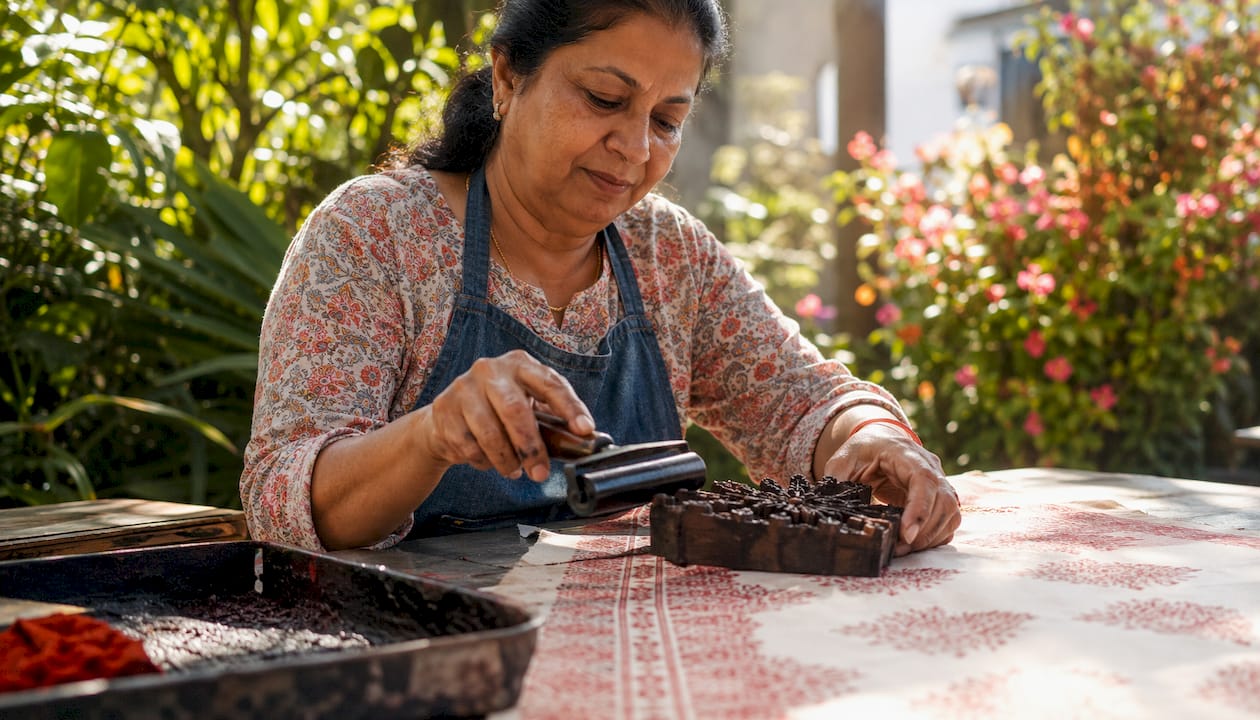
Stamp printing is exactly what it sounds like: a carved stamp, either by hand or a mechanical press, is inked and pressed onto fabric to leave a repeated or single motif. It is one of the oldest fabric printing methods still in active use, and for good reason.
The tactile, slightly imperfect quality of a stamped print is genuinely hard to replicate digitally. That irregularity is the appeal for artisanal brands and craft projects. Setup costs are minimal — a carved rubber or foam stamp, fabric ink, and a steady hand are all you need.
The trade-offs are real, though. Detail is limited by the stamp’s resolution, and each color requires a separate stamp and pass. Production is slow, making it impractical for anything beyond small runs or one-off pieces.
Pro Tip: Use a brayer to apply ink evenly across the stamp surface before pressing — uneven ink coverage is the most common reason stamp prints look muddy rather than crisp.
Transfer printing prints your design onto a special release paper, then a heat press bonds that image to the fabric. The result can be photorealistic, with gradients and fine detail that simpler methods cannot achieve.
It works across a wide range of fabrics and requires no screen setup, which keeps entry costs low. For short runs with complex artwork, it is genuinely hard to beat on cost per unit.
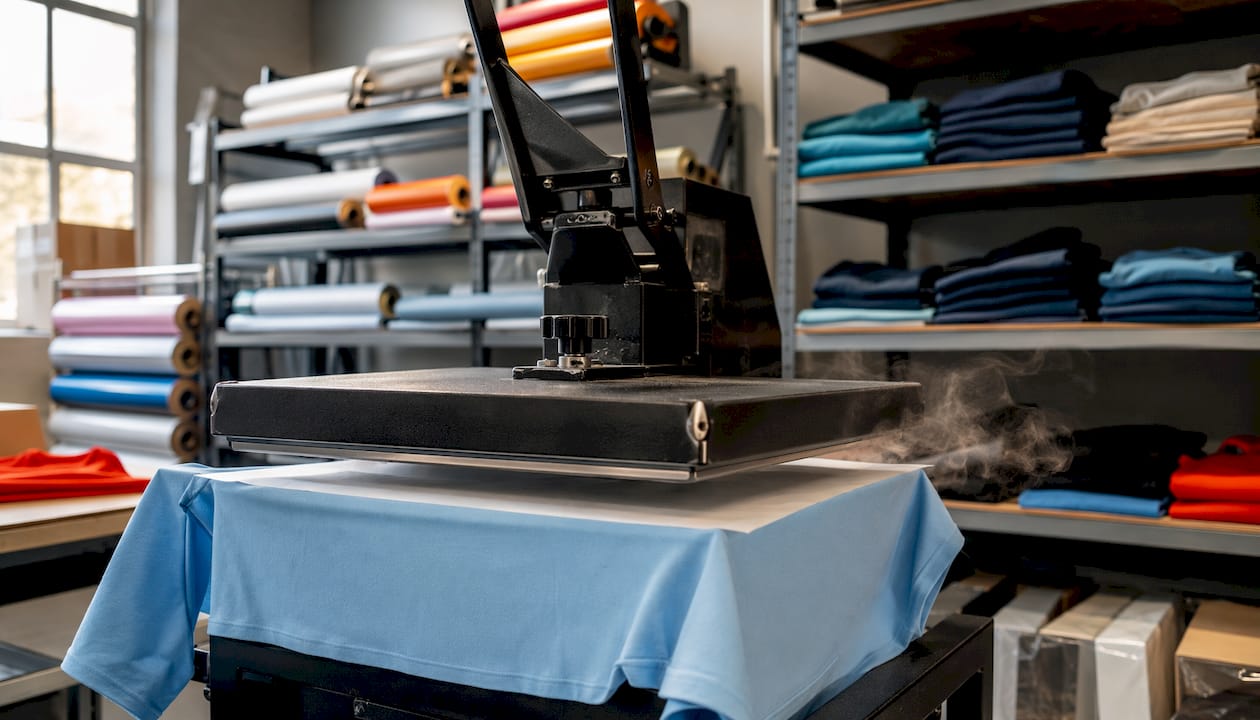
The durability gap is the main concern. Transfer prints sit on top of the fiber rather than bonding inside it, so cracking and peeling over time are real risks, especially on garments that see heavy washing. Breathability also drops slightly in the printed area. Stick to polyester blends or treated fabrics for the best adhesion.
Pro Tip: Always pre-press your fabric for 5–10 seconds before applying the transfer. Removing moisture and wrinkles from the substrate dramatically improves adhesion and color vibrancy.
Screen printing forces ink through a fine mesh screen stretched over a frame, with a stencil blocking the areas that stay ink-free. Each color in the design requires its own screen, which is where the setup cost lives.
Once those screens are made, though, the economics flip fast. Rotary screen printing runs at 80–100 meters per minute, making it the top choice for mass production. Flat screen printing is slower but still far faster than most digital methods for simple, bold designs. Colors are vivid and durable, and the ink sits on or slightly into the fiber for excellent wash fastness.
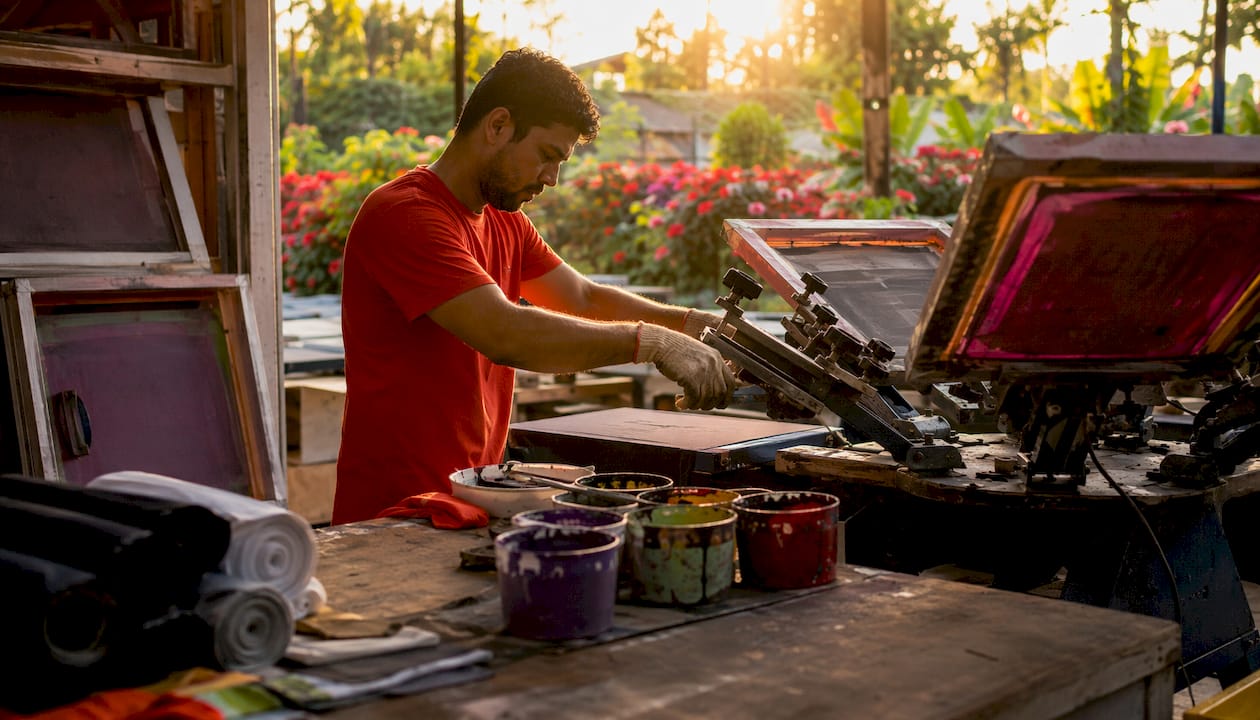
The ceiling is color count. Every additional color adds a screen, setup time, and cost. Photorealistic or gradient-heavy designs are not screen printing’s strength.
Pro Tip: For a crafter or small business testing a new design, print one screen at a time and use water-based inks. They clean up easily and work well on natural fibers without the ventilation demands of plastisol.
Dye sublimation converts solid dye into gas under heat and pressure, and that gas bonds directly inside polyester fibers. There is no ink layer sitting on top of the fabric, which means no cracking, no peeling, and no hand feel change. The print is part of the fiber itself.
Color vibrancy is exceptional, and the process handles photographic detail and gradients with ease. Sportswear, activewear, and custom polyester home goods are the natural home for this technique.
The hard limit: sublimation only works on polyester or polymer-coated substrates. On cotton or most natural fibers, the dye has nowhere to bond and the colors come out washed out or barely visible. It also requires a higher equipment investment than transfer printing.
Pro Tip: If you want sublimation on a cotton-feel garment, look for poly-cotton blends with at least 65% polyester. The higher the poly content, the more vivid and durable the final print.
Pigment printing applies pigment particles to the fabric surface and locks them in place with a binder, typically through heat curing. Unlike reactive or disperse dyes, pigment inks do not need steaming or wet processing after application. That simplicity makes the process faster and cleaner.
Water-based pigment printing offers softer prints with less environmental impact and works on virtually any fabric type, from cotton to synthetics to blends. For eco-conscious brands, it avoids the chemical-heavy fixation steps that other dye types require.
The trade-off is color depth. Pigment prints tend to be less saturated than reactive dyes on cotton, and the hand feel, while soft, can stiffen slightly at high ink coverage. For muted palettes, vintage aesthetics, or mixed-fiber fabrics, pigment printing is often the smartest call.
Pro Tip: After heat curing a pigment print, wash the fabric once before final use. This removes any loose binder residue and gives you a truer read on the final hand feel and color.
Reactive printing uses dyes that form a covalent chemical bond with cellulose fibers — cotton, linen, rayon, and similar naturals. That bond is not a coating; it is a molecular attachment, which is why reactive-printed fabrics have outstanding wash fastness and color brightness even after repeated laundering.
The soft hand feel is another advantage. Because the dye integrates into the fiber rather than sitting on top, the fabric drapes and feels exactly as it did before printing. Fashion textiles, bed linens, and high-end apparel rely on reactive printing for this reason.
Post-printing fixation requires steaming to set reactive dyes, adding a processing step that pigment printing avoids. The method also does not translate well to synthetic fabrics, so it is essentially a natural-fiber technique.
Pro Tip: Reactive dyes are pH-sensitive during fixation. Keep your steaming environment alkaline and consistent — fluctuations cause uneven color development and patchy results.
Block printing uses a carved block, traditionally wood but also linoleum or rubber, loaded with dye or ink and pressed onto fabric by hand. It is the ancestor of modern screen printing, and it still produces something no digital process can replicate: a print with visible human touch.
Each impression carries slight variations in pressure and ink distribution. For artisan brands, that is the whole point. Block printing suits small batches, bespoke textiles, and projects where the handmade quality is a selling feature rather than a flaw.
Speed and scalability are the obvious constraints. Registering multiple colors accurately takes skill and patience, and production volume is inherently limited by the manual process.
HTV starts with sheets of colored vinyl that you cut into your design using a cutting machine like a Cricut or Silhouette. You weed out the negative space, then heat-press the design onto fabric. The vinyl bonds to the fiber surface under heat and pressure.
It is fast, requires minimal equipment investment, and handles bold graphics and text with clean edges. Custom T-shirts, team uniforms, and personalized gifts are the natural use cases. Stretch fabrics need a flexible HTV formulation to avoid cracking when the fabric moves.
Photorealistic images and fine gradients are beyond HTV’s range. It is a solid-color, vector-design method.
DTG printing works like a standard inkjet printer, except the garment sits on a platen and the print head moves across it directly. Digital printing technologies like DTG perform best on 100% cotton, where the ink bonds well and colors stay vivid. Blends and synthetics produce noticeably duller results without a pretreatment step.
No screens, no setup fees, and no minimum order size make DTG ideal for on-demand printing and sampling. The per-unit cost stays flat regardless of run size, which is an advantage for small batches but a disadvantage at volume compared to screen printing.
Discharge printing removes existing dye from fabric rather than adding new color on top. A discharge agent, typically zinc formaldehyde sulfoxylate or a more modern low-impact alternative, bleaches out the base color in the printed areas, leaving a lighter pattern.
The result is a print that sits flush with the fabric surface with no raised ink layer, giving it an exceptionally soft hand feel. It works best on reactive-dyed cotton. Discharge printing is popular in fashion for vintage washes and tonal effects that look worn-in from day one.
Digital textile printing prints directly from a digital file onto fabric using modified inkjet technology. There are no screens, no plates, and no minimum runs. Design complexity is essentially unlimited — photorealistic images, thousands of colors, and intricate repeats all print at the same cost.
The economics favor small batches. Digital printing is generally economical for smaller runs, while screen printing becomes more cost-effective at larger volumes. File preparation matters: artwork should be 150–300 dpi with correct ICC color profiles to avoid waste and color drift.
One emerging approach pairs digital bases with specialty screen-printed layers for metallic or textured effects, combining the detail of digital with the tactile finish of screen printing.
The right method comes down to five factors: production volume, design complexity, fabric type, budget, and turnaround time.
One practical approach used by experienced designers: use digital printing for sampling and small capsule collections, then shift to screen printing for confirmed high-volume runs. That combination keeps sampling costs low while capturing screen printing’s cost advantage at scale. For bulk fabric orders, knowing your print method before you source fabric prevents costly mismatches between substrate and technique.
Pro Tip: Before committing to a print method, run through three questions: How many units? How many colors? What fiber content? Those questions will help you narrow down your optimal printing technique.
Ready to print on the right fabric from the start? Fabric-fabric carries backdrop fabrics and a full range of textiles suited to every printing method above.
Matching your fabric printing method to your production volume, fabric type, and design complexity is the single most important decision in any textile printing project.
| Point | Details |
|---|---|
| Volume drives method choice | Digital printing suits runs under 100–200 meters; screen printing wins above 300 meters. |
| Fiber type limits your options | Sublimation needs polyester; reactive printing needs natural fibers; pigment printing works on any fabric. |
| Fixation affects durability | Reactive dyes require steaming, disperse dyes need heat fixation, and pigment inks cure with heat alone. |
| Low-volume flexibility | DTG and transfer printing have no minimum order size, making them ideal for sampling and custom runs. |
| Hybrid methods are emerging | Pairing digital bases with screen-printed specialty layers delivers photorealistic detail plus tactile finish. |