

 US Dollar

How to Select Sofa Fabric That Survives Real Life
Posted by BLG on 2026 Aug 18th
Posted by BLG on 2026 Aug 18th

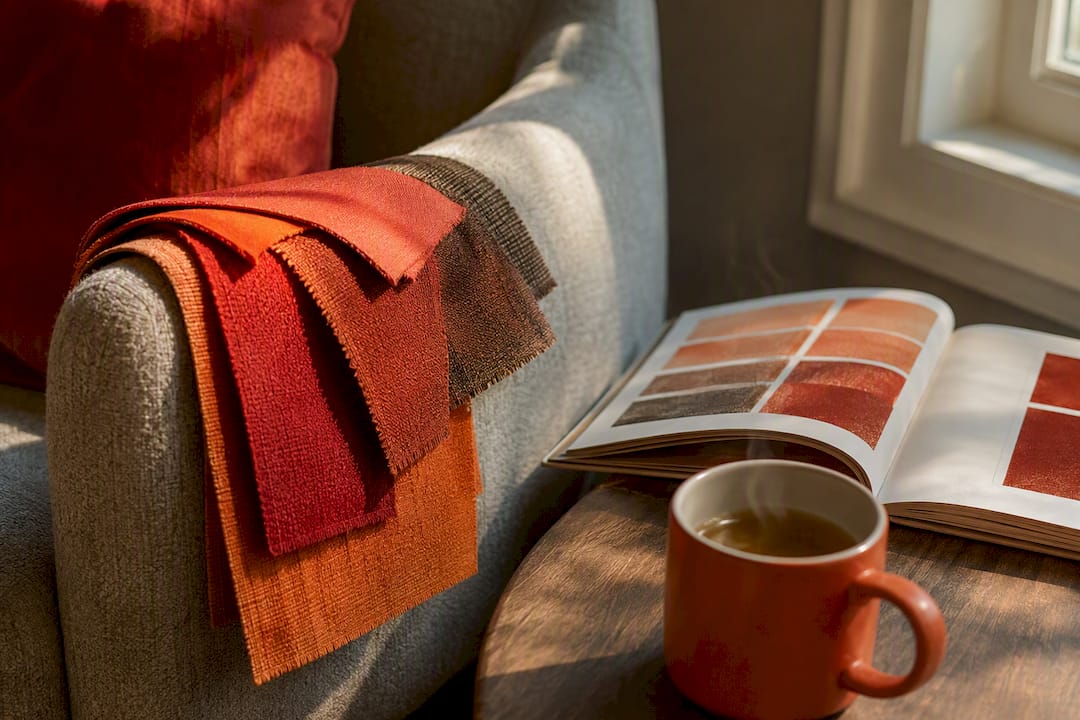
The right sofa fabric matches three things at once: how hard your household is on furniture, a durability rating that fits that use, and a cleaning code that matches your patience for maintenance. Get that match wrong and you’ll be shopping again in three years.
For busy homes with kids or pets, look at performance fabrics (Sunbrella indoor, Crypton) or top-grain leather first. For low-traffic formal rooms, linen and velvet earn their keep on looks alone. For everyday family rooms in between, a tightly woven fabric or microfiber with a solid rub count splits the difference.
Before you order yardage, verify three things:
The ACT Voluntary Performance Guidelines put low-traffic residential woven upholstery around 15,000 double rubs and higher-traffic residential use closer to 30,000. That single number won’t tell you everything, but it’s the fastest filter you have.
The right sofa fabric always balances a household’s real traffic level against a documented durability rating and a compatible cleaning code, not against appearance alone.
| Point | Details |
|---|---|
| Match fabric to traffic | Performance fabric or leather for pets and kids; linen or velvet for low-traffic formal rooms. |
| Check the rub count | Look for 15,000+ double rubs for light use, 30,000+ for heavy residential use per ACT guidelines. |
| Confirm the cleaning code | W, S, WS, or X determines which cleaners are safe and whether professional cleaning is required. |
| Test real swatches | Order larger patterned swatches and check them in your room across different lighting. |
| Budget extra yardage | Add 10 to 25% for pattern repeat or napped fabrics like velvet before cutting. |
| Start with Fabric-fabric | Browse upholstery-ready yardage and order sample swatches before committing to a full order. |
Fabric selection isn’t really about taste first. It’s about matching a material’s physical limits to how people and pets actually use the piece. A sofa in a guest room and a sofa facing a toddler and a golden retriever are not the same purchasing decision, even if they look identical in a showroom photo.
Start with who sits on it and what the worst-case scenario looks like. A practical decision framework that upholstery professionals use asks four questions: who uses the piece, what’s the worst-case risk (spills, claws, sunlight), what’s the aesthetic goal, and what’s the budget. Answer those before you fall in love with a swatch.
High-traffic homes with pets and kids. Performance fabrics or leather are the safer bet here. Solution-dyed performance textiles resist staining at the fiber level rather than relying on a surface coating, and many exceed 50,000 to 100,000 double rubs in abrasion testing. Leather resists odors and most spills wipe right off, though it will show claw marks over time.
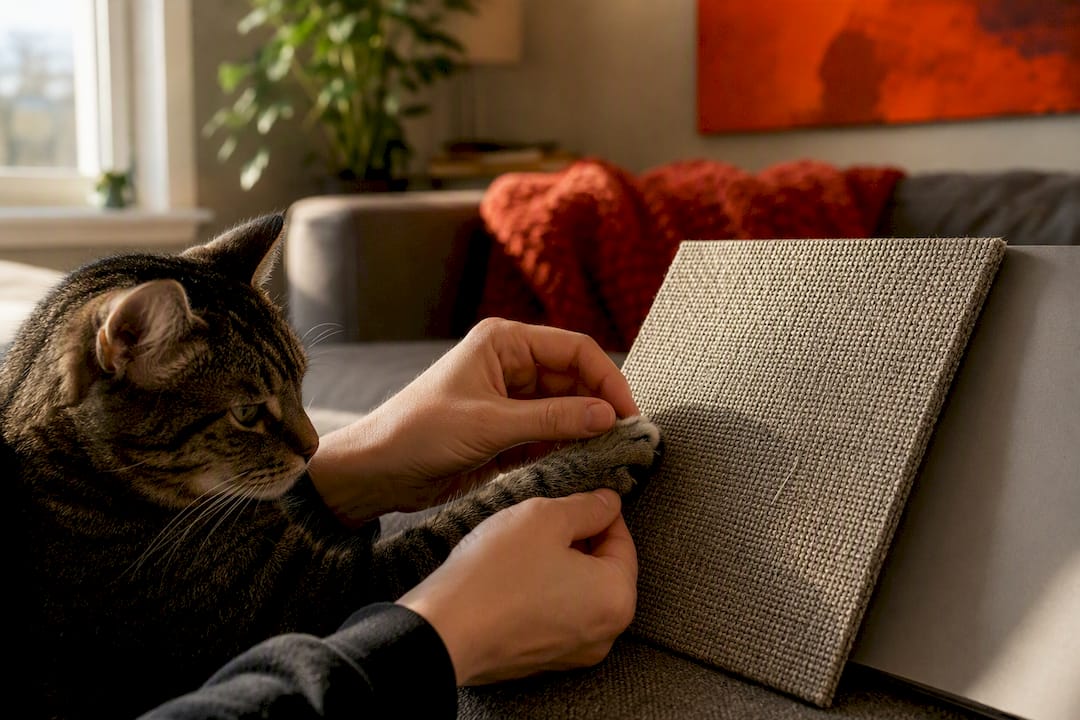
Adults-only formal living rooms. This is where linen, velvet, and looser weaves make sense. You’re trading some cleanability for a look and feel that performance fabrics can’t fully replicate. If nobody’s eating tacos on the sofa, the durability math changes.
Mixed-use family rooms. Most households land here, and it’s the trickiest category. A tightly woven fabric rated for everyday residential use, or a good microfiber, usually threads the needle between comfort and cleanup.
The tradeoff running through all of this: comfort and softness often work against cleanability, and eye-catching texture often works against snag resistance. Boucle looks great and snags on a cat’s claw. Chenille feels soft and holds onto dust. Nothing is free.
Two abrasion tests dominate fabric spec sheets, and they don’t measure the same thing the same way. Wyzenbeek (ASTM D4157) drags a cotton duck pad back and forth across the fabric and counts “double rubs” until the material shows wear. Martindale (ASTM D4966) rubs a wool abradant in a figure-eight pattern and counts cycles instead. There’s no reliable formula to convert one number into the other, so a fabric rated 30,000 double rubs on Wyzenbeek isn’t automatically equivalent to 30,000 Martindale cycles.
That inconsistency is exactly why the ACT guidelines exist. They set application-based thresholds rather than a single universal number, and they explicitly recommend checking abrasion results alongside seam slippage, pilling, tensile strength, and colorfastness before you sign off on a fabric. A fabric that survives 40,000 double rubs but pills badly after six months of use still fails you at home.
Here’s how the thresholds translate into shopping decisions:
One caveat worth flagging: abrasion results can swing significantly between labs and even between the warp and weft direction of the same fabric roll. Ask your supplier which direction the sample was cut from before you treat a rub count as gospel. And ignore fabric “grade” letters (A, B, C) printed on price lists. Those are manufacturer pricing tiers, not performance indicators. A grade C fabric can outlast a grade A one on abrasion testing.
Once you know your traffic level, narrow the field by fiber and construction. Each fabric family carries its own durability ceiling, cleaning demands, and feel underfoot, or under-elbow, as the case may be.
Performance fabrics (Sunbrella indoor lines, Crypton, and similar engineered textiles) are built specifically to resist stains and heavy wear. Many post rub counts well above 50,000, and the stain resistance is often woven into the fiber itself rather than sprayed on top, so it survives repeated cleaning. The tradeoff is price and, on some lines, a slightly less plush hand-feel than natural fibers. Best for: households with kids, pets, or anyone who eats on the couch.
Microfiber earns its popularity honestly. Its tight weave repels liquids and resists pet hair embedding, and mild soap and water usually handles cleanup. It won’t match leather’s lifespan, but for the price, it’s hard to beat in a family room. Best for: budget-conscious households that still want easy cleanup.
Leather (top-grain or full-grain) can last decades with basic care. It resists stains and odors better than almost any woven fabric, and it develops a patina that many people prefer to a “new” look. It can scratch, though distressed grains hide that well, and it needs conditioning roughly every six to twelve months. Best for: long-term primary seating in households without cats.
Linen brings texture and a relaxed, breathable feel that synthetic fabrics rarely achieve. It wrinkles, shows watermarks easily, and isn’t the fabric to put in front of a toddler with a juice box. Best for: formal or adult-only rooms.
Cotton is affordable, breathable, and comfortable, but plain cotton weaves wear faster than blends and stain more easily unless treated. Best for: secondary seating or rooms with light use.
Wool and wool blends resist pilling and hold color well, with natural flame resistance as a bonus most people don’t realize. It costs more than cotton and can feel scratchy to some people. Best for: cooler climates and design-forward living rooms.
Chenille feels soft and cozy, with a slight sheen that catches light nicely, but its looped construction is prone to snagging on rings, zippers, and claws. Best for: households without cats and without a lot of casual friction.
Velvet is the fabric people fall in love with visually. It photographs beautifully and feels luxurious, but nap direction shows every fingerprint and pet paw, and cleaning options vary wildly by weave. Best for: accent chairs or low-traffic statement sofas rather than daily-use furniture.
Faux leather/vinyl gives you leather’s easy wipe-down cleaning at a lower price point, though it doesn’t breathe as well and can crack over time in dry climates. Best for: budget-limited households prioritizing cleanup over longevity.
Blends (poly-cotton, linen-synthetic) often exist specifically to patch a natural fiber’s weakness, adding durability to linen’s softness or texture to polyester’s flatness. Best for: shoppers who want a natural look without the fragility.
Quick best-for summary:
Nap and pile direction matter more than most people expect. Velvet and corduroy have a “grain” that changes color depending on which way light hits it, and shifts in that direction over time from sitting and shifting create visible wear patterns called shading. It’s not damage exactly, but it can look like it if you weren’t warned.
Color and pattern choice affects how forgiving a fabric feels day to day. Design guidance consistently points toward mid-tone, multi-tone weaves as the best camouflage for both stains and light wear. Solid whites show every mark; solid blacks show dust and pet hair constantly. A subtle two-tone weave hides both.
Pro Tip: If your sofa has curves, like a rolled arm or a tufted back, stick to solids or very small-scale patterns. Bold prints distort visibly across curved surfaces and can make a well-built sofa look cheap. Save the statement pattern for a simple, boxy silhouette where the fabric lies flat.
Quick pairing guide:
Every upholstery fabric should carry a cleaning code, and it tells you more about day-to-day livability than almost any other spec. W means water-based cleaners are safe. S means solvent-based cleaners only, water can cause staining or shrinkage. WS allows either. X means vacuum only, professional cleaning required for anything beyond that.
When something spills, speed matters more than technique. Follow this order:
Beyond spills, realistic maintenance is lighter than people assume. Vacuum weekly with an upholstery attachment to prevent grit from grinding into the weave. Leather needs conditioning roughly twice a year to prevent cracking. Most fabrics benefit from professional cleaning every 12 to 18 months regardless of how careful you are. If maintenance sounds like more than your household will realistically do, that’s a strong argument for a performance-treated fabric from the start.
Never order full yardage from a screen image alone. Request physical swatches, and for anything with a pattern, ask for a larger swatch so you can actually judge the repeat and scale rather than guessing from a two-inch square.
Once swatches arrive, drape them over the actual sofa or a similar surface and check them at different times of day. Morning light, afternoon sun, and evening lamp light can each make the same fabric look like a different color entirely.
Before you order anything, ask the supplier or upholsterer:
Pattern repeat and nap direction quietly inflate your yardage total, and this is where budgets get blown. A large motif with a big repeat means extra fabric gets used to match the pattern across cushions and arms; nap fabrics like velvet require every panel cut in the same direction, which limits how efficiently the yardage gets used.
Your upholsterer can give you an exact number once they know the fabric’s specs.
Also confirm fabric weight and backing. Lightweight decorative fabrics sometimes need an added backing for structural upholstery use, which your upholsterer may charge for separately. Before cutting anything, verify three things with whoever’s doing the work: COM (customer’s own material) acceptance, the rub count, and the cleaning code. Skipping that conversation is how people end up with fabric that doesn’t fit the frame or void a warranty.
Allergy-prone households have different priorities than a household optimizing purely for stain resistance. Tightly woven synthetics and treated leather tend to trap fewer dust mites and pet dander than loosely woven natural fibers like wool or heavy chenille, simply because there’s less surface area and fewer gaps for particles to settle into.
Leather and vinyl are often the top picks for allergy-sensitive homes because they don’t hold onto dander or dust the way fabric fibers do, and they wipe clean rather than requiring deep cleaning to remove trapped allergens. Among woven options, a tight, smooth weave beats a loose, textured one for the same reason.
If you’re set on a natural fiber, look for a tighter weave count and commit to more frequent vacuuming, since natural fibers can’t be treated the same way performance synthetics are. Washable slipcovers are worth considering too. Being able to strip and wash a cover regularly does more for allergen control than any single fabric choice.
One overlooked factor: some stain-resistant topical treatments use chemicals that can bother people with sensitivities. If allergies or chemical sensitivity are a concern in your household, ask specifically whether stain resistance is built into the fiber (solution-dyed) or sprayed on afterward, and choose accordingly.
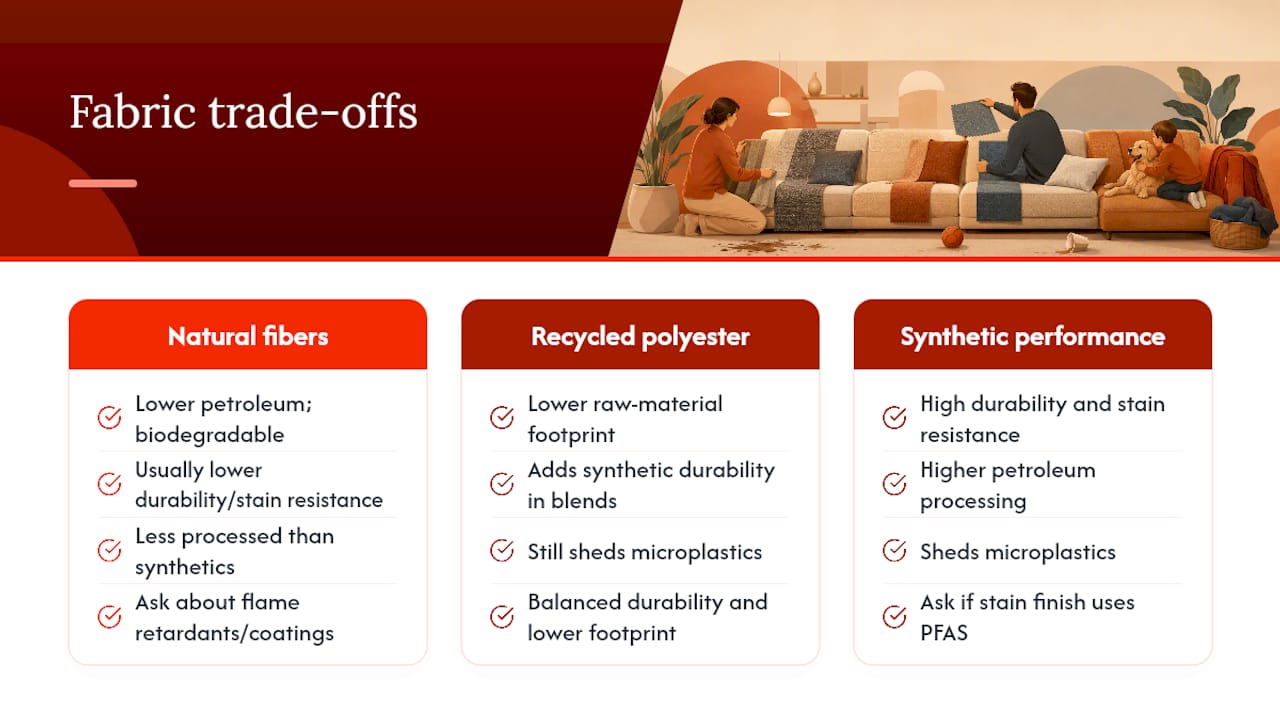
Fabric choice has an environmental footprint most buyers never think about until they’re already reading labels. Natural fibers like linen, organic cotton, and wool are biodegradable and generally require less petroleum-based processing than synthetic alternatives, though they typically don’t match synthetic performance fabrics on durability or stain resistance.
Recycled polyester blends have become more common in performance upholstery, offering some of the durability of standard synthetics with a lower raw-material footprint. They’re not perfect. Synthetic fibers still shed microplastics during washing and manufacturing, but they represent a meaningful step for buyers trying to balance durability with environmental impact.
The bigger concern for most households is chemical treatment, not fiber source. Stain-resistant coatings historically relied on PFAS (perfluoroalkyl substances), chemicals linked to environmental persistence and health concerns, and many manufacturers have been phasing them out in favor of alternative treatments. If chemical exposure matters to your household, ask directly whether a fabric’s stain resistance comes from a PFAS-based treatment or an alternative finish, and don’t assume “performance fabric” automatically means the older chemistry.
Flame retardant treatments are another area worth a direct question, since regulations and formulations vary significantly by fabric type and manufacturer. A quick email to the supplier asking what treatments are applied, and whether they meet current safety standards, takes two minutes and settles the question for good.
The biggest mistake in fabric shopping isn’t picking an ugly color. It’s picking a gorgeous fabric that was never built for the sofa’s actual job. Save velvet and boucle for an accent chair nobody wrestles a toddler on, and put your durability budget where the traffic actually happens.
Order the swatches. Sit on them, spill something test-safe on them, and write down what happens. That two-day delay saves years of regret.
You now know what to check: rub count, cleaning code, pattern repeat, and how it feels under your actual household’s traffic. The fastest way to confirm a fabric works before committing to yardage is to hold it in your hands, in your own room, under your own lighting.
Fabric-fabric carries a wide range of upholstery-ready textiles by the yard, from performance-grade wovens to linen, velvet, and chenille, with sample swatches available so you can test durability, color, and hand-feel before ordering full yardage. Large swatches are available for patterned fabrics, which matters if you’re trying to judge scale and repeat rather than guessing from a thumbnail photo. Browse the home decor fabric selection to compare options by weight, weave, and use, and order a few swatches before your next upholstery project so the fabric that arrives at your door is the one you actually expected.
What is the minimum rub count for a sofa fabric? For everyday residential use, look for at least 15,000 double rubs on the Wyzenbeek scale. Households with kids or pets should aim closer to 30,000, matching the ACT guideline for higher-traffic residential upholstery.
How do I know if sofa fabric is durable enough for pets? Check for a rub count above 30,000 double rubs, a solution-dyed performance finish, and a W or WS cleaning code. Leather and tightly woven performance fabrics both hold up well against claws and shedding.
What’s the difference between Wyzenbeek and Martindale ratings? Wyzenbeek measures double rubs with a cotton duck pad; Martindale measures cycles with a wool abradant in a figure-eight motion. The two numbers don’t convert directly, so compare fabrics using the same test method when possible.
Is microfiber or performance fabric better for sofas? Microfiber offers strong cleanability and pet-hair resistance at a lower price. Performance fabrics like Sunbrella indoor or Crypton generally post higher rub counts and better long-term stain resistance, at a higher cost.
How much extra fabric should I order for a patterned sofa?
For deeper technical detail on the standards mentioned here, the ACT abrasion guidelines and the full abrasion resistance breakdown explain how Wyzenbeek and Martindale testing actually works. Architectural Digest’s upholstery fabric guide and StitchDesk’s selection framework offer practical buyer-side perspectives worth bookmarking.