

 US Dollar

How to Manage Fabric Samples Like a Pro
Posted by BLG on 2026 May 21st
Posted by BLG on 2026 May 21st


TL;DR:
- Organizing fabric samples efficiently reduces clutter, saves time, and prevents costly mistakes in projects. Using simple tools like binders, labels, and spreadsheets, along with routine maintenance, ensures long-term management success. Focusing on essential samples and just-in-time ordering keeps collections current, functional, and easy to navigate.
Disorganized fabric samples cost you more than time. They lead to wrong purchases, duplicated swatches, and design decisions made from memory instead of reality. Learning how to manage fabric samples is one of those skills that pays off every single time you start a new project, whether you’re sourcing upholstery fabric for a living room refresh or pulling together a custom garment. This article walks you through the tools, systems, and habits that actually work, with none of the unnecessary complexity that makes most organization advice fall apart the moment life gets busy.
| Point | Details |
|---|---|
| Gather the right tools first | Binders, labeled sleeves, and a simple spreadsheet save more time than any complex app. |
| Catalog as you collect | Recording fabric details at the moment you receive a sample prevents guesswork later. |
| Keep systems simple | Systems too complex to reset quickly will be abandoned. Simple beats perfect every time. |
| Verify before committing | Always check stock availability and reorder options before basing a project on a sample. |
| Store smart for longevity | Breathable containers with humidity control protect fabric quality over months and years. |
Before you touch a single swatch, you need the right tools in place. Skipping this step is why most people end up with a shoebox full of unlabeled scraps that mean nothing six months later.
Here’s what you need to get started:
For each sample you record, you need at minimum five data points. Effective fabric tracking requires fabric name, fiber composition, total yardage, fabric width, and supplier or source. Add color, intended use, and project name if you want more searchability.
A simple SKU system adds consistency without much effort. Something like “UPH-VEL-NAVY-01” tells you it’s an upholstery velvet in navy, first sample. You can build whatever shorthand makes sense to your categories.
Pro Tip: Choose breathable storage containers over airtight plastic bins for any samples you plan to keep longer than a few weeks. Sealed containers trap moisture and can cause mold, especially in humid climates.
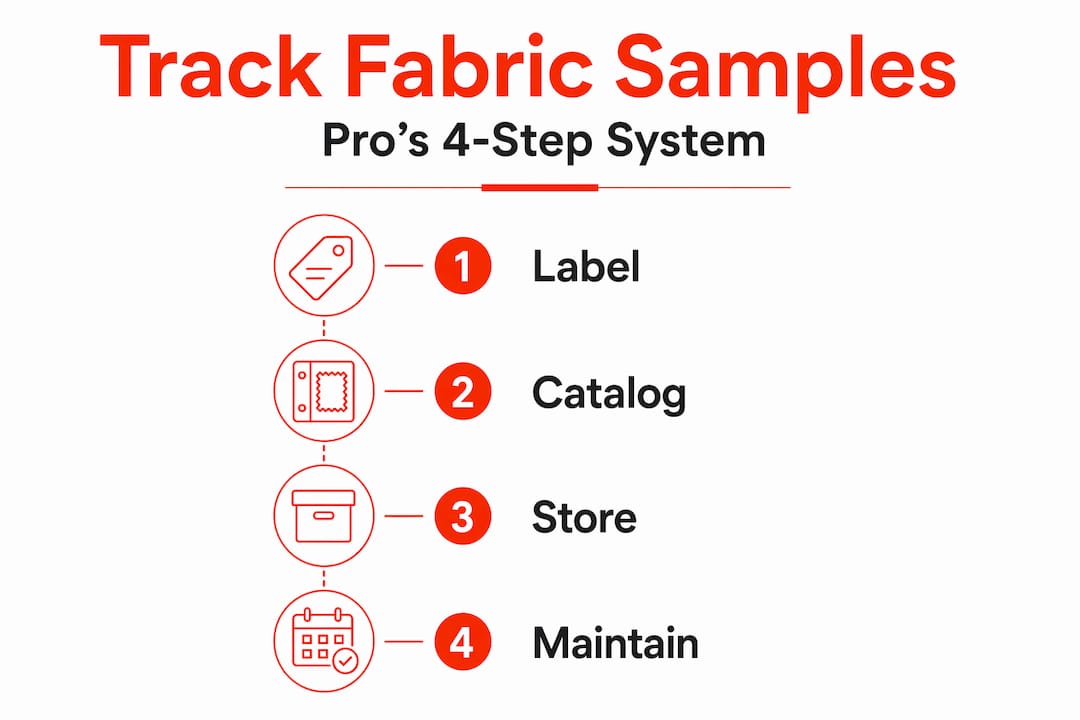
Once your tools are ready, the actual cataloging process takes less time than you’d expect. Here’s a process that works whether you have five swatches or five hundred.
Pro Tip: Build your system around the laziest version of yourself. If it takes more than 60 seconds to file a new sample, the system is too complex and you will stop using it the moment things get hectic.
Here’s a quick comparison of the two most common physical organization approaches:
| Method | Best for | Drawback |
|---|---|---|
| Project-based binders | Client work, room-specific projects | Harder to cross-reference fabric types |
| Type-based binders | Speculative buying, fabric retailers | Harder to keep project context |
| Combined (type + project tag) | Active hobbyists, small businesses | Requires more upfront label work |
Even a well-designed fabric sample organization system breaks down when a few common habits creep in. Knowing what to watch for keeps your system working long term.

The biggest mistake is over-collecting. It feels productive to grab every free sample you see, but over-collecting leads to clutter and a collection that’s genuinely hard to use. If you can’t remember why you have a sample, it’s probably time to return it or toss it.
A close second is building a system too complicated to maintain. Systems that are too complex fail during busy periods because there’s no mental bandwidth left to follow the process. If your system requires 10 steps to file one swatch, simplify it.
The third mistake is falling in love with a fabric before checking whether you can actually get more of it. Verify stock availability and minimum order quantities before you build a project around a sample. Finding out a fabric is discontinued after you’ve committed to it is an expensive and frustrating problem.
Other mistakes worth avoiding:
“The most functional fabric libraries I’ve seen are the ones with fewer, better-chosen samples, grouped by project and regularly reviewed, not massive collections that no one actually uses.”
Many designers now favor client-specific sample grouping rather than maintaining large permanent libraries. The idea is simple: you pull what you need for a project, work with it, and return or retire what you don’t use. It keeps your collection lean and current.
Managing a fabric sample collection isn’t a one-time setup job. The physical samples need care, and the information attached to them needs regular updates.
For storage, the single most important rule is to avoid airtight containers. Long-term fabric storage requires breathable containers and silica gel packets, with temperature kept between 60 and 75 degrees Fahrenheit and humidity between 30 and 50 percent. That range prevents mold without drying the fibers out.
Pro Tip: Toss a few silica gel packets into any binder or storage box where you keep longer-term samples. Replace them every three to four months. It’s a cheap way to protect fabric that can be expensive to replace.
Beyond storage conditions, here are the maintenance habits that keep a fabric sample organization system running well over time:
Physical organization handles the tactile side of fabric sample management. Digital tools handle the data side, and the two work best together.
A spreadsheet is the starting point for most people, and it’s genuinely sufficient for collections up to a few hundred samples. Your spreadsheet should include these columns:
Spreadsheets with dropdown menus and data validation prevent the inconsistencies that make searching painful. If “navy” is sometimes entered as “Navy Blue” and sometimes “dark blue,” your filters stop working. Dropdowns fix that.
Back up your spreadsheet to cloud storage every time you update it. Losing your catalog to a crashed hard drive is genuinely painful when you’ve spent hours building it.
For managing fabric inventory planning at a slightly larger scale, consider free tools like Airtable, which lets you attach photos of each swatch directly to the record. You can also organize your fabric inventory using purpose-built templates that give you a head start on structure.
I spent two years convinced that a bigger, more detailed system was the answer. I had color-coded tabs, nested categories, a multi-sheet spreadsheet with pivot tables, and cross-referenced binders for every project type. And I almost never used it correctly because it took too much effort to keep up.
What actually worked was stripping it back to one binder per active project, a single flat spreadsheet, and a rule that any sample I hadn’t used in 90 days either got returned or filed in a “cold storage” box out of sight. That was it.
The shift to ordering swatches just-in-time, meaning digitally sourcing first and only ordering physical samples when I was close to a real decision, cut my sample backlog by about 70 percent. I stopped accumulating fabric I’d never use and started using the samples I had.
What I’ve found is that most people who struggle with fabric swatch selection aren’t struggling with organization. They’re struggling with decision delay. The sample piles up while the decision sits unmade. A good system doesn’t replace making the call. It just means you can find the swatch again when you’re ready to make it.
Tailor your system to your actual habits, not your ideal habits. If you sew on weekends and have 20 minutes to file a new sample, your system needs to work in 20 minutes. Not 20 hours.
— kev
When your system is in place, the next step is filling it with quality fabrics worth organizing. Fabric-fabric carries an extensive selection of textiles for every project type, from upholstery and drapery to quilting and apparel. Browse the backdrop fabric collection if you’re sourcing for decor or photography setups, or explore the full home decor fabric range for curtains, cushions, and upholstery projects. Every product listing includes fiber content, usage suggestions, and pricing so you can make a fully informed decision before you even order a swatch. Free shipping thresholds and seasonal sales make it easy to stock up without overspending.
At minimum, record the fabric name, fiber composition, yardage, width, and supplier. Adding color, project assignment, and a reorder URL makes your catalog significantly more useful when you return to it months later.
Use breathable containers with silica gel packets and keep the storage area between 60 and 75 degrees Fahrenheit. Avoid airtight plastic bins, direct sunlight, and damp spaces, all of which degrade fabric over time.
Update it every time you add, use, or return a sample. Daily updates are ideal for active collections. At minimum, do a weekly review to keep physical samples and digital records in sync.
Slide protector pages let you store swatches non-destructively and rearrange them as projects change. Sort by project for client or room-specific work, or by fabric type if you build a general inventory for speculative buying.
Adopt a just-in-time approach: make design decisions digitally first, then order only the physical swatches you need for a near-final decision. Return unused samples promptly and do a quarterly review to retire anything no longer tied to an active project.