

 US Dollar

Fabric Repeats: Maximizing Design and Fabric Use
Posted by BLG on 2026 Feb 13th
Posted by BLG on 2026 Feb 13th


Sourcing fabric for a new clothing line can quickly turn into a puzzle when every inch counts. Understanding fabric repeats is a practical tool for maximizing your material and avoiding costly waste, especially as regulations like the Textile Fiber Products Identification Act shape how patterns and fiber content must be labeled across the United States. This guide highlights how mastering the concept of fabric repeats gives you the keys to boost manufacturing efficiency, achieve seamless designs, and stretch your fabric budget further.
| Point | Details |
|---|---|
| Understanding Fabric Repeats | Fabric repeats define how visual motifs are positioned and replicated, impacting both aesthetic and manufacturing efficiency. |
| Types of Fabric Repeats | Designers should choose between straight, half-drop, and mirror repeats based on intended visual effects and production complexities. |
| Calculating Repeat Size | Accurate measurement of repeat size is essential for minimizing material waste and ensuring design consistency during production. |
| Waste Reduction Strategies | Implementing precise cutting and digital simulations can significantly reduce textile waste, promoting sustainability in production. |
In textile design, fabric repeats represent the systematic pattern that recurring visual elements create within a fabric’s surface. These repeats define how motifs, designs, and printed/woven patterns are positioned and replicated across the textile’s entire width and length. Understanding fabric repeats is crucial for designers, manufacturers, and businesses seeking to create visually consistent and production-efficient textiles.
Fabric repeats have significant technical and aesthetic implications. They determine several critical aspects of textile production:
The Textile Fiber Products Identification Act establishes specific regulations regarding how fabric repeats must be documented and represented in textile product labeling. These regulations ensure transparency about design elements and manufacturing processes.
Designers typically measure fabric repeats in two primary dimensions: vertical and horizontal. A vertical repeat represents the distance between identical pattern points moving up the fabric, while a horizontal repeat tracks pattern recurrence across the fabric’s width. These measurements are essential for understanding how much fabric will be required to match patterns precisely during garment or product creation.
Fabric repeats are not just aesthetic choices - they’re technical specifications that impact manufacturing, design, and ultimately, product quality.
Technical Classifications of Fabric Repeats:
The following table summarizes how repeat size influences textile projects:
| Repeat Size | Design Impact | Material Use | Pattern Match Difficulty |
|---|---|---|---|
| Small (<4 in) | Intricate patterns | Minimal excess | Easy |
| Medium (4–12 in) | Balanced aesthetics | Moderate | Moderate |
| Large (>12 in) | Bold visual | Increased consumption | Challenging |
Pro tip: Always request fabric repeat measurements before purchasing textiles to ensure your design vision can be accurately realized.
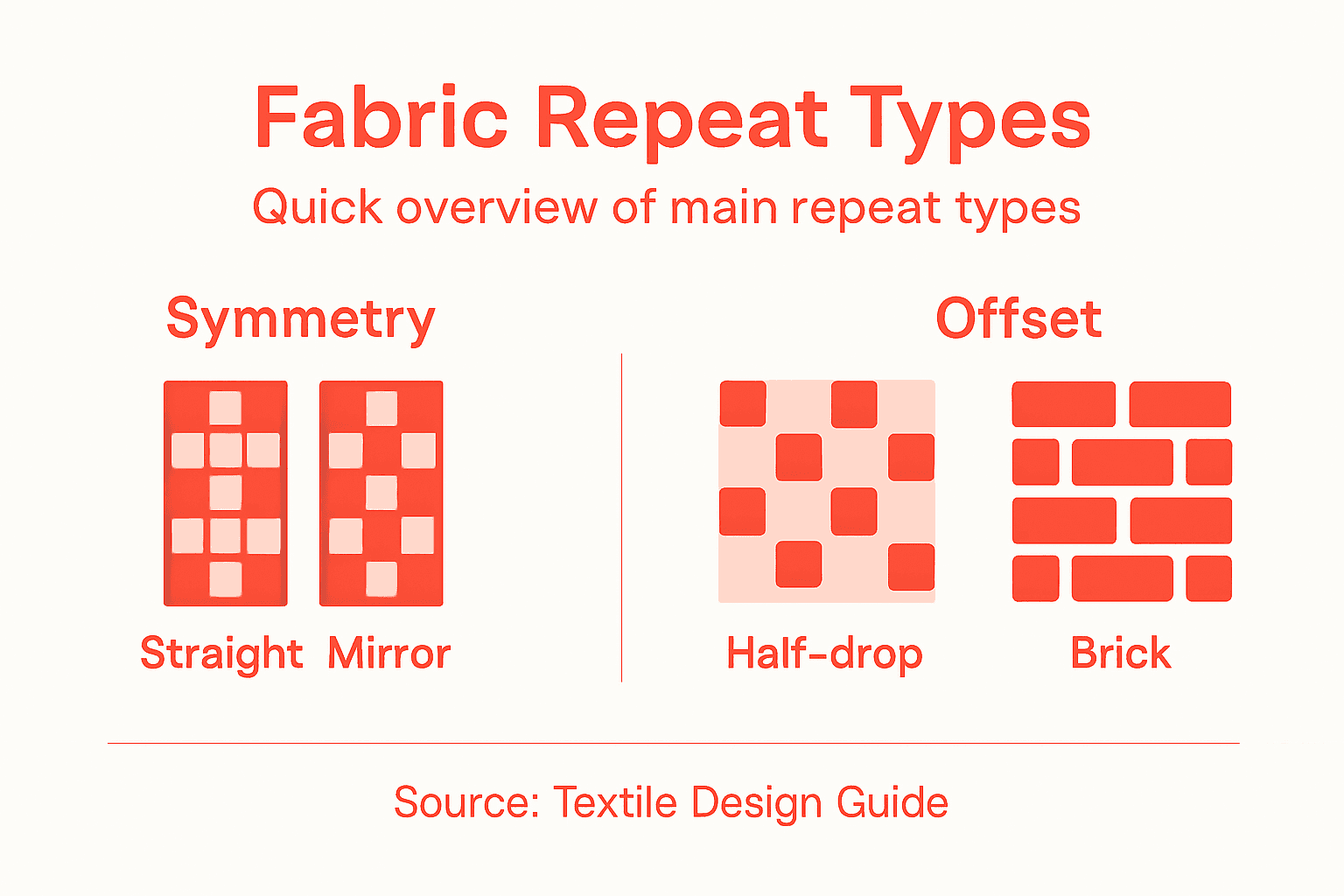
Textile designers utilize several distinctive types of fabric repeats, each creating unique visual patterns and presenting specific manufacturing considerations. Textile industry standards recognize three primary repeat types that fundamentally transform how patterns are constructed and perceived across fabric surfaces.
The main types of fabric repeats include:
Each repeat type offers distinct advantages and challenges for designers and manufacturers. Straight repeats are the most straightforward, allowing precise pattern matching and minimal fabric waste. Half-drop repeats introduce visual complexity, making designs appear more dynamic and less predictable.
Here’s a comparison of primary fabric repeat types and their impact on design and production:
| Repeat Type | Visual Effect | Pattern Alignment | Production Complexity |
|---|---|---|---|
| Straight Repeat | Predictable, orderly look | Rows and columns | Low |
| Half-Drop Repeat | Staggered, dynamic movement | Offset every other row | Medium |
| Mirror Repeat | Symmetrical, dramatic impact | Flipped or rotated | High |
Pattern repeats are the architectural blueprint of textile design, determining how visual elements interact and flow across fabric surfaces.
Designers must consider multiple factors when selecting repeat types:
Mirror repeats, in particular, require careful planning. They involve flipping or rotating design elements to create intricate, symmetrical patterns that can dramatically enhance a fabric’s visual appeal while potentially increasing production complexity.
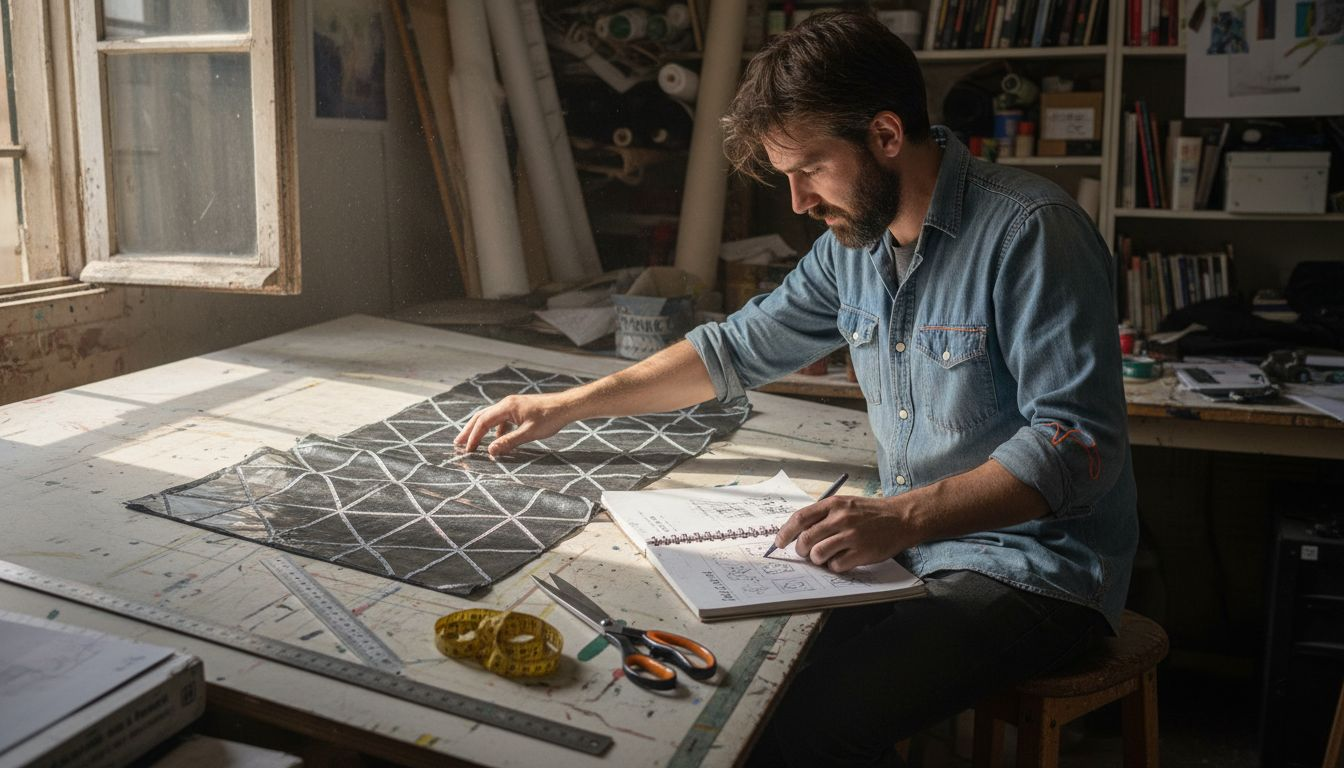
The Environmental Protection Agency’s textile waste research highlights how different repeat types directly influence material consumption and sustainability in textile production. Efficient repeat design can significantly reduce fabric waste and manufacturing costs.
Practical Considerations for Repeat Selection:
Pro tip: Always create a small sample or digital mockup of your chosen repeat type to visualize how the pattern will truly appear across the entire fabric surface.
Visual design in textiles is fundamentally transformed by the strategic implementation of fabric repeats. Visual composition principles demonstrate how repeating patterns create rhythm, establish balance, and guide the viewer’s perception across a fabric’s surface.
Fabric repeats influence visual design through several critical mechanisms:
Symmetrical repeats typically communicate stability and formality, while asymmetrical patterns introduce dynamic movement and visual intrigue. Designers carefully select repeat styles to evoke specific emotional responses and aesthetic experiences.
Fabric repeats are not merely decorative elements - they are powerful visual communication tools that shape how we perceive and interact with textiles.
The Government Accountability Office research reveals that strategic repeat design significantly impacts user experience, transforming fabrics from simple coverings into expressive visual statements. Different repeat techniques can emphasize specific motifs, colors, and design elements, creating visual hierarchies that draw the viewer’s attention.
Key visual design strategies with fabric repeats include:
Designers must consider multiple visual factors when selecting repeat patterns, including intended emotional impact, cultural context, and the specific application of the textile. A repeat that works beautifully for upholstery might feel overwhelming in a clothing design.
Visual Impact Categories:
Pro tip: Sketch multiple repeat variations and view them at different scales to understand how the pattern truly transforms the fabric’s visual narrative.
Calculating fabric repeat size requires precision and strategic planning to maximize design potential and minimize material waste. Research methods for textile measurement demonstrate that accurate repeat size determination is crucial for successful project outcomes, impacting everything from design consistency to fabric efficiency.
The fundamental process of calculating repeat size involves several critical steps:
Designers and manufacturers must understand that repeat size directly influences fabric consumption and cutting strategies. A complex repeat might require more fabric to match patterns precisely, while a simpler repeat could reduce material waste and production costs.
Repeat size calculation is not just a technical exercise - it’s a critical design strategy that bridges creativity and practicality.
The Environmental Protection Agency’s textile waste research emphasizes how precise repeat size calculations contribute to sustainable manufacturing practices. By minimizing scrap material and optimizing fabric yield, designers can significantly reduce environmental impact.
Repeat Size Calculation Methods:
Key considerations when calculating repeat size include:
Repeat Size Measurement Tools:
Pro tip: Always create a physical or digital mockup to validate your repeat size calculations and verify pattern alignment before full-scale production.
Textile waste represents a significant environmental challenge, with innovative fabric repeat strategies offering critical solutions for material conservation. Government waste reduction research demonstrates that strategic design approaches can substantially minimize textile waste and improve manufacturing efficiency.
Key strategies for minimizing material waste include:
Manufacturers and designers can implement several targeted approaches to maximize material utilization. By carefully planning pattern placement and repeat dimensions, significant reductions in textile waste become possible.
Effective material management transforms waste from an environmental challenge into an opportunity for innovation and sustainability.
The National Institute of Standards and Technology’s textile lifecycle research emphasizes the importance of extending fabric usage through intelligent design strategies. These approaches not only reduce environmental impact but also create economic advantages for manufacturers.
Waste Reduction Techniques:
Additional considerations for material maximization include:
Material Conservation Tools:
Pro tip: Develop a systematic approach to measuring and tracking material waste, using digital tools to continuously refine and improve your fabric utilization strategies.
Navigating the complexities of fabric repeats can challenge even the most skilled designers and makers. Whether you are balancing intricate pattern alignment or aiming to reduce material waste, understanding repeat size and type is essential to bring your creative vision to life. At fabric-fabric.com, we provide a comprehensive selection of high-quality textiles including those perfect for fashion, as well as sophisticated options in Home Decor - Jaquard Fabric - Floral Jacquard Fabric - fabric fabric. Our detailed product descriptions will help you analyze fabric repeats and select materials that optimize both design impact and fabric use.
Experience the benefits of combining technical knowledge with premium textile sourcing. Take advantage of our user-friendly site today to explore fabrics that meet your project’s repeat requirements with precision. Visit fabric-fabric.com now to start creating with confidence and minimize waste while maximizing your design’s beauty.
Fabric repeats refer to the systematic pattern that recurring visual elements create across a textile’s surface, defining how motifs and designs are positioned and replicated.
Fabric repeats significantly influence cutting, printing, and weaving processes, impacting the overall efficiency of textile production and material usage.
The main types of fabric repeats are straight repeat, half-drop repeat, and mirror repeat. Each type has a unique pattern alignment and visual effect, affecting manufacturing complexity and design aesthetics.
To calculate fabric repeat size, measure the horizontal and vertical distances of the pattern before it repeats, accounting for any offsets, and document these measurements for accurate production.