US Dollar

Fabric Inventory Management Guide for Crafters in 2026
Posted by BLG on 2026 Jul 23rd
Posted by BLG on 2026 Jul 23rd


Fabric inventory management is the practice of tracking, measuring, and organizing your fabric stock so you always know what you have, how much remains, and when to reorder. For crafters and professionals alike, it solves one specific, expensive problem: buying duplicates of fabric you already own.
The core benefits come down to three things:
A solid fabric inventory management guide does not require a complex system. It requires a consistent one.
Accurate fabric tracking starts with six fields: fabric type, yardage, width, fiber content, price per yard, and supplier information. That’s it. Every additional field you add reduces the chance you’ll keep the log current.
Pro Tip: Attach a small fabric swatch to your log entry, physical or digital. When text descriptions fail you six months later, the swatch doesn’t.
Physical organization and digital tracking work best together, but the physical layer matters more than most crafters expect. Fabric stored rolled on boards or standing upright in magazine holders gives you a full visual scan in seconds. Fabric folded in bins hides everything below the top layer.
For digital tracking, updating your log at purchase rather than at the point of use is the single habit that separates accurate inventories from abandoned ones. The moment you get home from the fabric store, or the moment an online order arrives, is when the entry gets made.
Pro Tip: Organize your fabric inventory for stress-free sewing by dedicating one fixed location to every fabric category. Random placement means random retrieval.

A reorder point is the stock level that triggers a new purchase before you actually run out. The reorder point formula is straightforward:
Reorder point = (average daily usage × supplier lead time) + safety stock
For a crafter who uses roughly half a yard of black ponte per week and orders from a supplier with a 10-day lead time, the reorder point is about 0.7 yards plus whatever buffer feels comfortable.
Slow-moving stock is fabric that hasn’t been touched in several months. Dead stock is fabric you genuinely cannot name a project for. Both tie up space and money.
Reviewing your stock every few months catches these before they compound. A practical approach:
Linking your fabric log to your project plans turns a passive pile into an active resource. Before you start any new project, cross-reference your inventory against the pattern requirements. If you have 3.5 yards of ivory broadcloth, you can immediately see whether it covers the shirt you’re planning, or whether you need to order more.
Practical ways to keep inventory active rather than archival:
Accurate measurement is the foundation of any inventory control for fabrics. Measure each piece before it goes into storage, not after you’ve already cut into it.
For standard yardage, a flat surface and a fabric ruler give reliable results. For remnants, approximate measurements are fine. “Cotton voile, approx. 0.6 yards, irregular piece” is far more useful than an unlabeled scrap on a shelf.
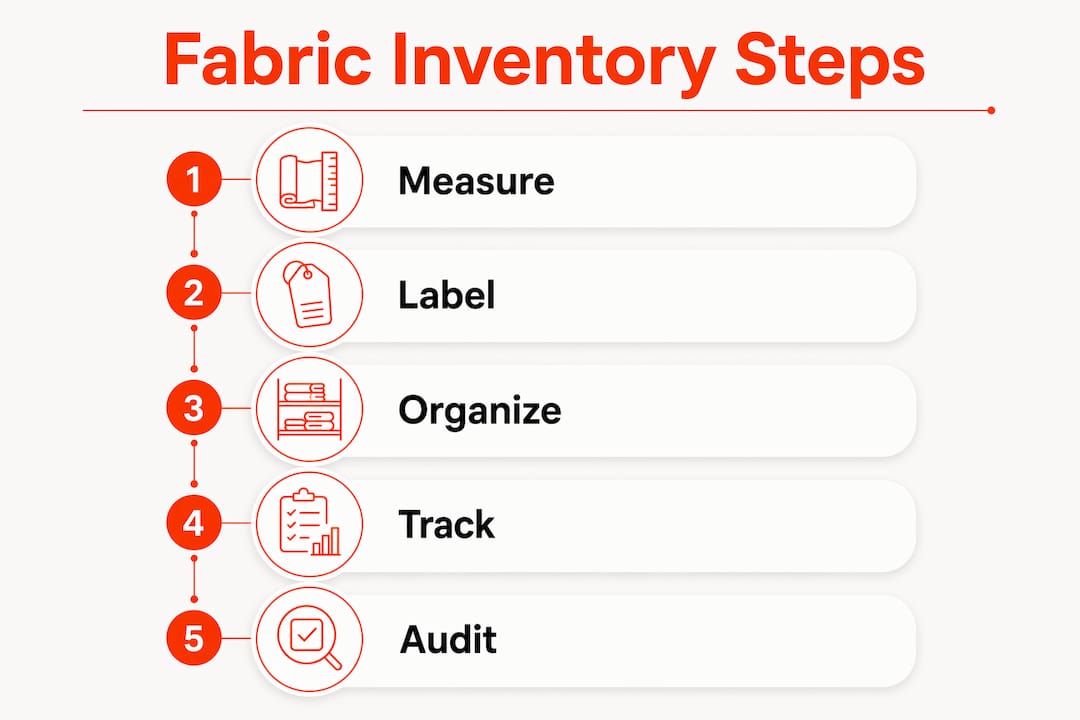
Label every piece with at minimum: fabric name, fiber content, yardage, and width. Use hang tags, painter’s tape labels, or printed cards tucked into rolled bolts. Digital systems that support fractional yardage are worth prioritizing because rounding to the nearest yard compounds into real errors over time.
Spreadsheets are the most common starting point, and they work well for collections under 20 to 30 fabrics. A Google Sheet with columns for each of the six core data fields costs nothing and requires no learning curve. The limitation is that spreadsheets don’t auto-deduct when you use fabric, don’t generate reorder alerts, and break down as collections grow.
Purpose-built inventory apps handle the complexity spreadsheets can’t. Look for tools that support fractional yardage, connect to your purchasing records, and let you link materials to specific projects. StitchKeeper, for example, tracks fabric yardage with true cost per yard including shipping and tax, and links materials directly to orders. For makers selling through Shopify, that kind of cost visibility directly affects pricing accuracy.
The right system is the one you’ll actually use consistently. A simple physical binder updated daily outperforms a sophisticated app that gets ignored after two weeks. You can also explore fabric inventory planning strategies to find the approach that fits your workflow.
A full physical count once or twice a year is the minimum for keeping records honest. Spot audits by category, one fabric type per week, maintain accuracy far better than waiting for an annual reckoning where errors have compounded for months.
The process for each audit session:
For fabric on bolts, measure the remaining amount and cross-reference with your digital count. For notions and notions-adjacent items like interfacing or bias tape, a simple count against the log is enough. Auditing one section at a time creates far less disruption than shutting down your workspace for a full-day count.
Waste reduction starts at the cutting table, but inventory tracking is what makes it possible to plan cuts intelligently. When you know exactly how much of each fabric you have, you can nest pattern pieces to use the full width, plan smaller projects around remnants, and avoid over-ordering.
Practical waste-reduction habits:
Light, moisture, and pests are the three enemies of a fabric collection. Direct sunlight fades color and breaks down fibers permanently. Humidity encourages mold and mildew. Stored fabric needs protection from all three.
Key storage practices:
Narrow shelves beat deep ones. Deep shelving looks spacious but turns into a black hole where fabric disappears behind other fabric. Narrow shelves keep everything visible and reachable.
Consistent, simple tracking habits prevent duplicate purchases, protect your budget, and keep your fabric working for you rather than sitting forgotten in a bin.
| Point | Details |
|---|---|
| Six core data fields | Track fabric type, yardage, width, fiber content, price per yard, and supplier for every piece. |
| Log at purchase | Record new fabric the moment it arrives, not when you use it, to prevent missed entries. |
| Use the reorder formula | Reorder point equals average daily usage multiplied by lead time, plus safety stock. |
| Audit by category | Spot-check one fabric category per week rather than running one large annual count. |
| Store rolled and upright | Rolling fabric on boards and standing them upright keeps every bolt visible at a glance. |
Ready to stock your next project with fabrics worth tracking? Fabric-fabric carries a full range of backdrop fabrics and home decor fabric by the yard to keep your inventory stocked with quality textiles.