

 US Dollar

Cut Window Heat 25–33%: Curtain Materials and DIY Fixes That Work
Posted by BLG on 2026 Sep 22nd
Posted by BLG on 2026 Sep 22nd

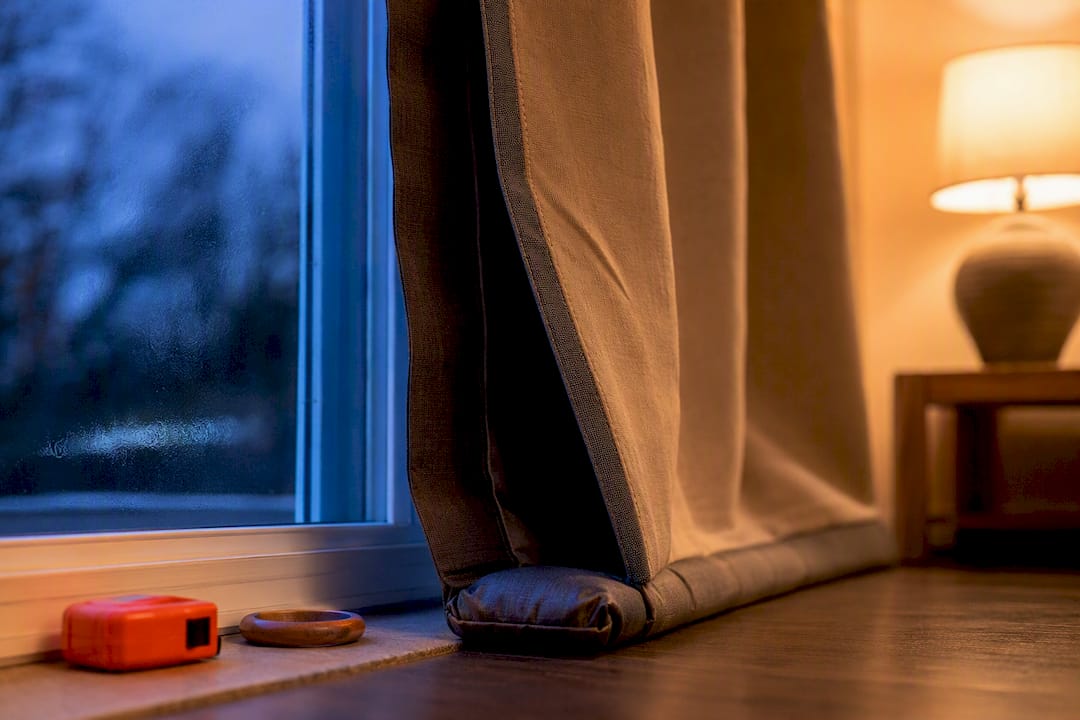
For raw insulating power, nothing beats a multi-layer or foam-backed thermal panel, followed closely by dense velvet, wool, and triple-weave polyester. But the material matters less than you think: a wide, floor-length curtain that seals at the edges and hangs close to the wall will outperform a heavier fabric hung loose and short. Pick a good insulating fabric, then install it like you mean it.
TL;DR:
- Thick fabrics like velvet, wool, and triple-weave polyester perform best when installed with full coverage, close to the wall, and floor length to trap more still air.
- Proper installation, including sealing edges and using layered constructions, can increase a curtain’s thermal resistance by up to three times compared to basic hanging.
- Insulated curtains can reduce heat loss by around 25% to 33%, with installation quality and fit playing a bigger role than fabric weight alone.
- Pairing curtains with a thermal lining, either sewn-in or detachable, significantly improves insulation without needing the most expensive fabrics.
- Window seals and draft-proofing measures should be prioritized before investing in high-end curtains, especially for modern, well-sealed double-pane windows.
If you want a quick answer before you shop, here’s how the main contenders stack up by room, budget, and how much effort you’re willing to put in.
If you’re outfitting a whole house on a budget, triple-weave polyester or a heavy cotton with added lining will get you most of the way there. If you’re finishing one statement room, velvet or wool with interlining is worth the splurge.
A curtain doesn’t block cold. It traps a pocket of still air between the glass and the fabric, and still air is a lousy conductor of heat. That’s the entire mechanism. Fold a curtain and you multiply the number of small air pockets it holds; hang it flush against a drafty window and you’ve built a crude but functional buffer zone that slows heat from escaping through convection and radiant loss.
Reflective or foil-backed linings add a second trick: they bounce radiant heat back into the room instead of letting it pass through to the cold glass. That’s the same principle behind emergency blankets, scaled down and sewn into a curtain lining.
Independent testing on window attachments backs this up. The Attachments Energy Rating Council (AERC) has measured cellular shades delivering energy savings in the range of 5% to 16% in tested cases, and the same still-air principle applies to heavy curtains, just with less precise industry-standard testing behind them.
It helps to know the difference between two labels that get used interchangeably at retail: blackout curtains control light, using a dense, opaque weave or coating. Thermal curtains control heat, through layered construction and insulating linings. Some curtains do both. Plenty of blackout curtains do neither job for heat, because a dark, light-blocking fabric can still be thin and single-layer.
For actual numbers, look at R-value, the standard measure of resistance to heat flow used for insulation in the United States. A single pane of glass sits around R-1. A well-built multi-layer thermal curtain, closed properly against the wall, can add enough resistance to bring the combined window-and-curtain system into the R-3 to R-5 range, roughly comparable to the localized effect of an inch of common insulation. That’s not enough to compete with a wall cavity, but it’s a meaningful bump for a $50 to $150 accessory.
There’s no federal energy-efficiency rating specifically for curtains the way there is for windows, so treat any “R-6” or “40% savings” claim on a product tag as a manufacturer estimate rather than a certified figure, unless it cites AERC or a similar independent test.
Not every fabric on a bolt is created equal for keeping heat in, and the differences come down to fiber density, weave tightness, and whether there’s an actual insulating layer doing the work behind the pretty face fabric.
Velvet has the densest pile of any common curtain fabric, and that pile is basically millions of tiny air-trapping fibers standing on end. A quality cotton or polyester velvet, hung full length, does more insulating work per square foot than almost anything else you can buy off the shelf without adding a separate lining. The tradeoff is upkeep: velvet shows dust, can crush under pressure, and often needs professional cleaning rather than a home wash. Budget for it in a bedroom or a room where you’re not fighting pet hair daily.
Wool and wool blends bring a different strength: wool fiber naturally regulates moisture, pulling humidity out of the air without feeling wet to the touch, which matters in rooms prone to condensation on cold windows. Wool also resists odor and holds a tailored, structured drape well. It runs pricier than synthetic options and some wool blends need flame-retardant treatment to meet local fire codes for window coverings, so check labeling before you commit to a large room.
Polyester, microfiber, and triple-weave fabrics are the workhorses of the ready-made thermal curtain market, and for good reason. The tight synthetic weave resists moisture, doesn’t sag over time the way natural fiber can, and holds up to washing far better than wool or velvet. Bob Vila’s product testing found that triple-weave polyester panels consistently combined solid insulation with blackout performance and stain resistance at prices well below custom natural-fiber options. If you’re outfitting a whole house, this is where your dollars stretch the furthest.
Heavy cotton and linen blends are more about looks and breathability than raw thermal mass. They drape beautifully and take dye well, but on their own they’re a moderate insulator at best. Pair one with a bonded interlining or a sewn-in thermal lining and it changes categories entirely. Fabric-fabric’s guide to choosing the right curtain fabric breaks down which face fabrics take a lining well and which ones fight it.
Technical linings are the unsung heroes of the whole category. A foam-backed lining sandwiches a thin foam layer between two fabric layers, adding both bulk and an air gap. Thermal fleece linings do something similar with a brushed synthetic layer. Reflective or foil-backed linings add a metallic layer that bounces radiant heat, and testing shows reflective backings measurably cut summer solar gain in addition to their winter benefits. Bonded interlining sits between the face fabric and a separate lining fabric, adding density without changing how the curtain looks from either side.
When you’re reading a product tag or a fabric listing, three things separate real thermal performance from marketing language:
Pro Tip: Order a swatch before you commit to yardage. Hold it up to a window at night; if you can see a porch light through it, it’s not doing much thermal work no matter what the label says.
Grammage, the weight of fabric per square meter, gives you a quick screening number when you’re comparing options you can’t physically touch yet. Specialist guides commonly point to 500 g/m² as a practical threshold for fabric that’s likely to perform well thermally, with three or more layers recommended for the best results. Below that weight, you’re probably looking at a decorative curtain that needs a separate lining to do any real insulating work.
Treat that number as a screening tool, not a guarantee. A dense, heavy fabric with a single layer of construction still loses to a lighter fabric backed by a proper foam or reflective lining, because the layering matters as much as the raw weight. The combination of grammage and a genuine multi-layer build is what actually predicts performance, and grammage on its own can mislead you toward a fabric that’s heavy but poorly built.
Interlining and backing layers do two jobs at once: they add thermal mass, and they add the air gaps between layers that trap still air, which is the real insulating mechanism. A single heavy fabric has one boundary layer of air on each side. A three-layer curtain, face fabric plus interlining plus lining, has multiple boundary layers stacked together, and each one adds resistance to heat flow.
Construction details you can’t see on a fabric swatch matter just as much as what’s in the weave. Sealed or bound hems keep cold air from sneaking through loose stitching at the bottom edge. A weighted hem, using a sewn-in chain or heavier interlining at the bottom few inches, helps the panel hang flush against the sill or floor instead of billowing with every draft. Return edges, where the fabric wraps back toward the wall at each side of the rod, close the gap that otherwise lets cold air slide around the curtain’s outer edge.
Be skeptical of any curtain marketed as “thermal” that weighs next to nothing and has a single layer of thin fabric. The word “thermal” isn’t regulated the way an R-value rating is, and retailers use it loosely. If a fabric feels light enough to see light through easily, no marketing copy changes the physics.
Get the fit wrong and even a $200 velvet panel underperforms a $40 polyester one hung correctly. Several sources point to installation quality, full coverage, tight sealing, and proper length, as the factor that delivers the biggest measurable gains, often outweighing marginal differences between heavy fabrics.
Here’s the installation checklist that actually moves the needle:
Pro Tip: When measuring for custom panels, add 2 to 3 centimeters of extra width per side for the return edge if you plan to press the fabric against the wall. That small allowance is the difference between a curtain that seals and one that gaps.
Yes, and it’s usually the best return on effort in this entire category. Buying a length of thermal lining and sewing or clipping it to curtains you already own delivers much of the benefit of buying new thermal drapes, at a fraction of the cost, according to consumer guidance on retrofit lining options.
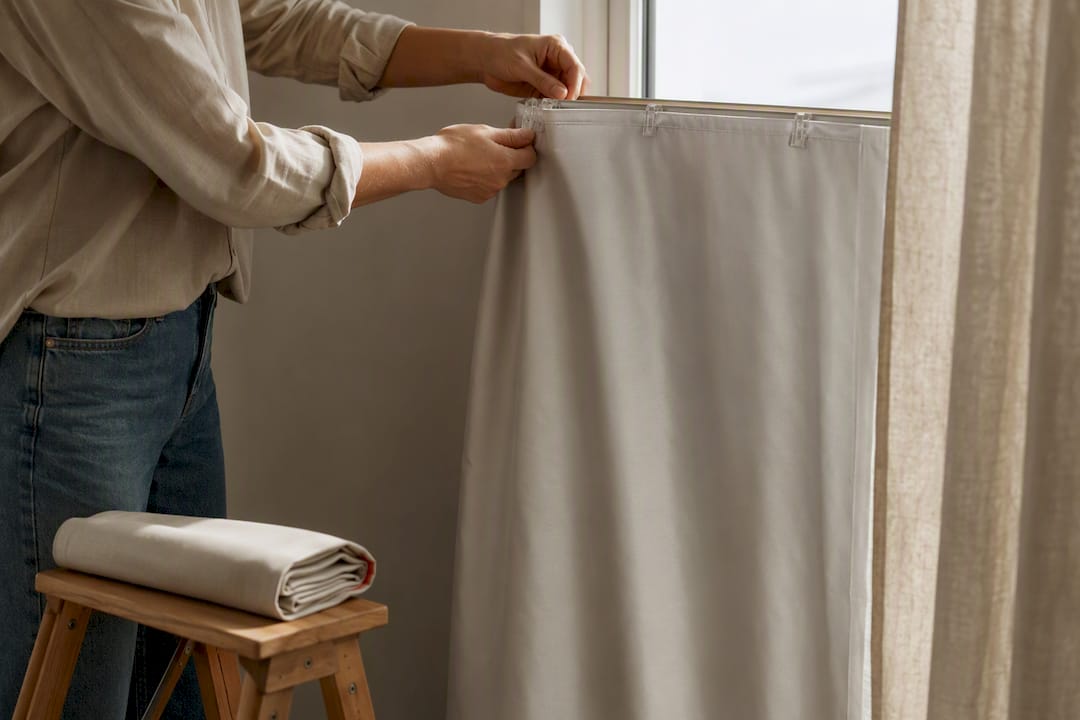
Before you start, gather what you need: a thermal lining fabric (foam-backed or fleece-backed are the most common for DIY), matching thread if you’re sewing, curtain weights or chain for the hem, and either hook-and-loop tape or magnetic strips if you’re going the no-sew route for side sealing.
You’ve got two realistic approaches:
When measuring and cutting, allow extra width for the return edges at each side, and add weight or a folded hem allowance at the bottom so the finished panel hangs flush rather than curling away from the sill.
If you’re comfortable with a sewing machine and have an afternoon free, sew-in interlining is worth the effort for curtains you plan to keep for years. If you want results today with zero sewing, attachable liners get you there. For anything more complex, like curved bay windows or oddly shaped panels, Fabric-fabric’s step-by-step curtain lining guide walks through the exact cutting and attachment process in more detail than a quick summary can cover.
Here’s the number that matters most: research summaries put standard, unlined curtains at roughly a 10% reduction in heat loss through a window, while properly fitted thermal curtains, heavy fabric, multiple layers, sealed edges, floor length, can cut that heat loss by 25% to 33% or more.
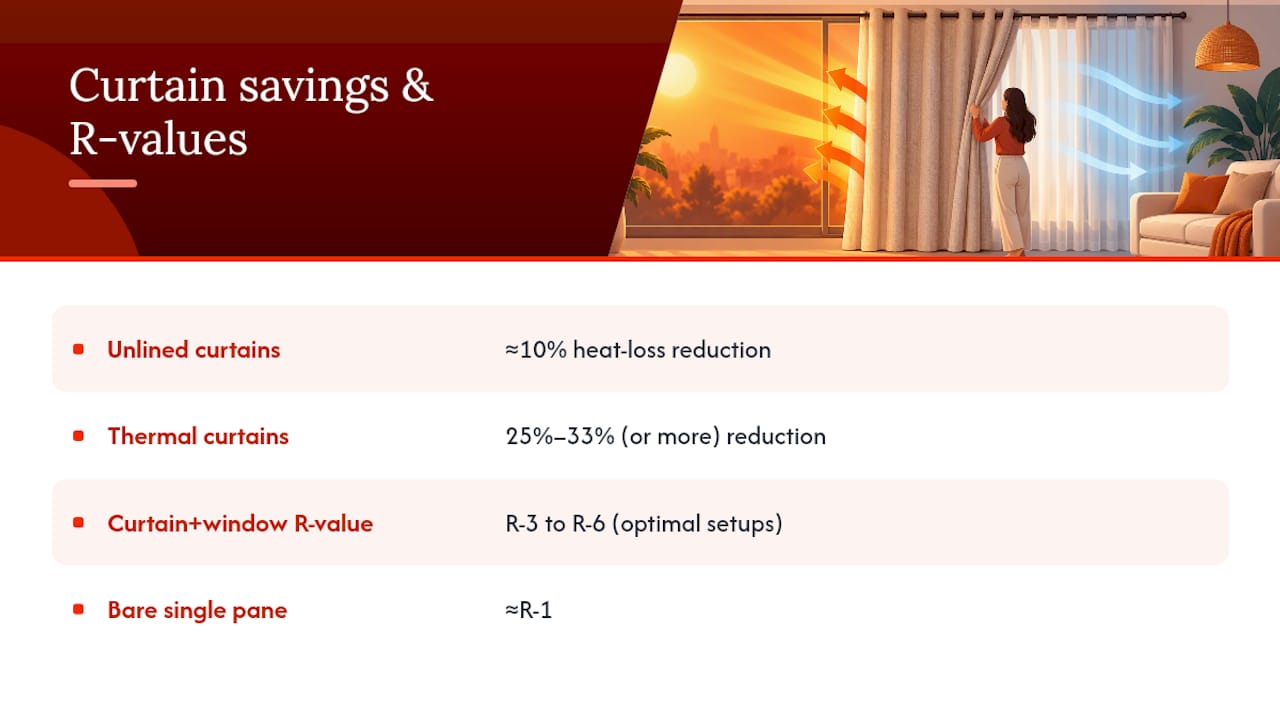
That gap between 10% and 33% is almost entirely explained by fit and construction, not fabric alone. A thin curtain hung loose delivers the low end. A multi-layer thermal panel installed with returns and a pelmet delivers the high end, and the R-value data backs this up: curtain-and-window systems in some tested setups reach improvements in the R-3 to R-6 range when everything is done right, compared to roughly R-1 for a bare single pane.
On cost, expect three rough bands. DIY lining added to curtains you already own typically runs the least, mostly the cost of lining fabric by the yard plus notions. Ready-made thermal panels from a retailer sit in the middle. Bespoke multi-layer curtains, custom-sewn with interlining and a decorative face fabric, cost the most but give you exact sizing and the best seal.
Here’s a sensible order of operations if you’re working with a limited budget: fix any obvious drafts or gaps around the window frame first, since no curtain fixes a leaky frame. Next, add lining to curtains you already own. Only after that consider ready-made thermal panels, and save full custom multi-layer curtains or window replacement for windows that are still cold after everything else.
Curtains earn their keep fastest on single-pane windows, older double-pane units with failed seals, and any window in a room you actually use at night, bedrooms, home offices, living rooms with evening use. Renters get an outsized benefit here too, since curtains are one of the few insulation upgrades you can install without touching the window itself and take with you when you move.
The payoff shrinks fast on modern, properly sealed double-pane or triple-pane windows. If the glass and frame are already doing their job, a curtain adds a modest comfort boost rather than a meaningful energy save, and your money is better spent elsewhere.
If drafts are coming from gaps around the window frame or from an old, warped sash rather than through the glass itself, curtains won’t fix the actual problem. Weatherstripping and caulk address that directly, for less money than a full curtain upgrade.
Curtains work best as part of a combination, not a solo fix. Pair them with basic draft sealing around the frame, add a pelmet if the room allows it, and consider cellular shades as a mid-range option if your budget stretches beyond fabric alone. Layering these measures gets you closer to the performance of a full window replacement, at a fraction of the cost.
Once you know which construction you’re after, multi-layer, velvet with interlining, or triple-weave polyester, the next step is getting fabric in hand to compare against your actual window. Fabric-fabric’s home decor and drapery fabric category organizes options by weight and use, so you’re not guessing from a thumbnail photo.
Ordering a swatch before committing to yardage removes most of the guesswork around color, weight, and how a fabric actually drapes once it’s off the bolt. It’s a small step that prevents an expensive mismatch. For readers ready to sew their own lining, the curtain lining walkthrough covers cutting allowances and attachment methods in more detail than a general overview can.
Most homeowners overthink the fabric decision and underthink the installation. If you’re outfitting a typical room on a normal budget, a lined triple-weave polyester or a heavy cotton with a sewn-in interlining will handle 90% of what you need, and it’s far more forgiving to wash and maintain than velvet or wool. Save velvet with interlining for the one room where you actually notice the cold at night, usually a bedroom facing north or a drafty older window.
The bigger mistake I see is buying the heaviest, most expensive fabric available and hanging it the way most curtains get hung, too narrow, too short, with gaps at every edge. That setup wastes the fabric’s potential. Fit and sealing consistently outperform marginal upgrades in fabric weight, and it costs nothing extra to hang a curtain 6 inches wider than the window instead of exactly window width.
Order swatches before you buy yardage. It’s a five-dollar decision that prevents a two-hundred-dollar mistake.
— kev
Drapery and home decor fabrics can be organized by weight and use to help find heavier, insulating-grade material without scrolling through fashion prints not intended for insulation.

That matters because the fabric you’d want for a lightweight kitchen valance is not the fabric you want for a drafty bedroom window in January, and a category built around use rather than just pattern makes that distinction easy to act on. Order a swatch of a triple-weave polyester or a heavier cotton blend first, hold it up to your actual window at night, and see how much light and draft it still lets through before you commit to yardage. If you’re outfitting several windows at once, bulk pricing brings the per-yard cost down, and the curtain lining guide walks through exactly how much extra width to buy for returns and hems.
Start with the home decor and drapery fabric category, request a swatch, and measure your window before you order the full yardage.
Multi-layer constructions, a decorative face fabric combined with a foam, fleece, or reflective lining, deliver the strongest measured performance, sometimes reaching R-3 to R-5 when closed. Among single fabrics, dense velvet and wool insulate best on their own, while triple-weave polyester offers the best balance of price and performance for ready-made panels.
Velvet holds the edge for raw warmth thanks to its dense pile trapping the most still air per square foot. Wool comes close and adds natural moisture handling, while a lined heavy cotton or triple-weave polyester panel can match either one once a proper thermal lining is added.
Yes, properly fitted thermal curtains can cut window heat loss by roughly 25% to 33%, compared to about 10% for standard curtains. The gap between those figures comes down almost entirely to installation: full coverage, floor length, and sealed edges.
Curtains work best on single-pane windows, older double-pane units with failing seals, and any window in a frequently used room. They’re less effective on modern, well-sealed windows, where the glass and frame are already doing most of the insulating work, and they don’t fix drafts coming from gaps in the wall or window frame itself.
No. Specialist guides often cite 500 g/m² as a useful screening threshold, but a heavy single-layer fabric still loses to a lighter fabric paired with a genuine thermal lining and sealed installation. Weight is a starting filter, not the deciding factor.